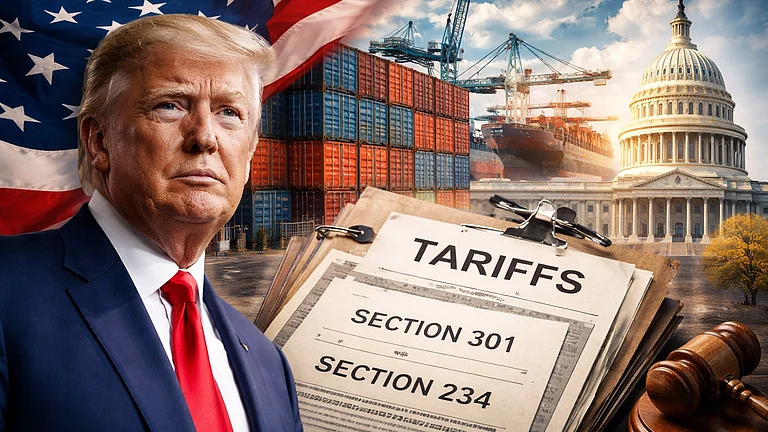
A US trade court ruled that all importers who paid tariffs imposed by Donald Trump under the International Emergency Economic Powers Act (IEEPA) are entitled to refunds.
The decision follows a Supreme Court ruling last month that struck down the tariffs, potentially triggering repayments of up to $175 billion.
US Customs and Border Protection must now design a mechanism to process refunds, in what could become one of the largest repayment exercises in US trade history.
In yet another blow to US President Donald Trump’s tariff policy, a federal judge in New York has ruled that companies which paid the now-invalid reciprocal tariffs are entitled to refunds — a move that could result in one of the largest repayments in the history of US trade.
Judge Richard Eaton of the US Court of International Trade said that “all importers of record” are “entitled to benefit” from last month’s ruling by the US Supreme Court, which struck down Trump’s global tariffs imposed under the International Emergency Economic Powers Act (IEEPA).

1 September 2026
Get the latest issue of Outlook Business

Eaton clarified that the refunds are not limited to the plaintiffs who challenged the tariffs but apply broadly to companies that paid duties under the emergency powers law. The ruling significantly expands the financial consequences of the Supreme Court’s decision.



The judge also specified that he alone “will hear cases pertaining to the refund of IEEPA duties,” effectively centralising oversight of what is expected to be a complex and high-stakes refund process.
Advertisement
According to estimates, the US federal government collected more than $130 billion in the now-invalid reciprocal tariffs through mid-December. Reports suggest that total refunds could reach as high as $175 billion, underscoring the massive fiscal implications of the ruling.
The decision stems from a case filed by Tennessee-based filtration company Atmus Filtration. Several other companies, including global logistics and postal giant FedEx, have also filed lawsuits seeking full refunds of tariffs paid under the measure.
The ruling comes at a time when uncertainty still surrounds the future of US import tax policy. US Treasury Secretary Scott Bessent recently indicated that Washington may move toward implementing a 15% global tariff this week, up from the 10% rate initially announced.
Advertisement
Meanwhile, the US Customs and Border Protection (CBP) will now have to design and implement a mechanism to process the refunds. While the agency routinely returns duties in cases of clerical mistakes or classification errors, trade lawyers say its systems were not built to handle repayments on this scale.
As a result, the refund process is expected to be legally and administratively complex, with potentially hundreds of billions of dollars at stake.