
India's transmission and grid infrastructure is expanding rapidly, but shortages of critical equipment are becoming a serious challenge.
Lead times for transformers and other substation equipment have increased from 2–3 months to as much as 9–12 months, delaying project execution.
Manufacturers of transformers, circuit breakers, CTs and PTs need to significantly expand capacity to keep pace with India's energy transition.
As India races to expand its power and renewable energy infrastructure, supply chain bottlenecks are emerging as a critical challenge. One of the companies addressing this space is Punjab-based Hartek Group. Founded in 1991 as an electrical equipment trading company, the group has evolved over three decades into an integrated power infrastructure conglomerate, operating through three business units.
In addition to electrical products, the group operates Hartek Power, incorporated around 2005–07, to build substations for industrial customers, state utilities, and central entities such as Power Grid Corporation of India. The power systems business has grown into one of the country's leading players in this segment. It entered the third segment, renewable energy, around 2009–10, participating in some of India's earliest grid-connected solar projects. Today, it offers large-scale solar EPC solutions and rooftop solar installations, and ranks among the top three solar EPC companies in India by capacity commissioned in FY25.

1 September 2026
Get the latest issue of Outlook Business

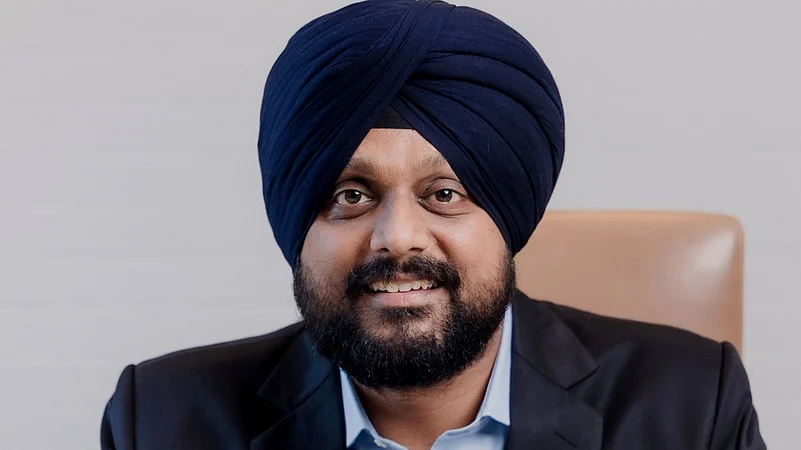
In an interaction with Outlook Business, Hartek Power, Executive Director and CEO Simarpreet Singh spoke about the challenges facing India's power transmission sector, company's evolution from an electrical equipment trader in 1991 to an integrated power solutions provider, its ambitious Mission 2030 growth plans, the importance of execution in the EPC business, and the growing strain on India's grid infrastructure.
Advertisement
How concerned are you about the resilience of India's power distribution network?
I think the most important question today is whether India's transmission and grid infrastructure can keep pace with this rapid capacity addition.
In that regard, I believe the government has done an excellent job in reforming the sector and accelerating investments in transmission infrastructure. Significant progress is being made in strengthening the national grid.
Battery storage is certainly one of the solutions and will play an important role. However, there are several other structural issues that also need urgent attention.
As an EPC company, our primary focus is on execution. We are seeing increasing opportunities in storage as well, but because our business spans power systems, renewable energy and power distribution products, we have visibility across the value chain.
One challenge I have repeatedly highlighted is the supply chain bottleneck in critical equipment. Today, it is relatively easy to procure solar panels, but securing key grid equipment such as transformers remains far more difficult.
The reason is simple. We are deeply involved in project execution on the ground. Our teams are building substations, solar projects and electrical infrastructure every day. We see these bottlenecks firsthand.
When people talk about integration, they often use the term loosely. In our case, we are genuinely integrated across multiple segments of the power ecosystem. Because we operate across grid infrastructure, renewable energy projects and electrical equipment manufacturing, we get a comprehensive view of where the challenges exist and how they impact project execution.
One of the biggest challenges we face today is the availability of critical transmission and substation equipment.
A few years ago, equipment required for grid and substation projects could typically be procured within two or three months. Today, lead times have stretched dramatically. In many cases, we are seeing waiting periods of nine months, ten months and even up to a year.
This is becoming a serious bottleneck for the sector because project execution ultimately depends on the timely availability of equipment.
Manufacturers of transformers, circuit breakers, CTs, PTs and other critical grid components need to significantly expand capacity to meet the growing demand. The pace at which power generation, renewable energy and transmission infrastructure are expanding in India requires a corresponding increase in manufacturing capabilities.
I have been very vocal about this issue because it is not a future concern—it is a challenge we are facing today on the ground. If India wants to accelerate grid expansion, renewable integration and power infrastructure development, then strengthening the domestic supply chain for critical electrical equipment must become a priority.
The industry needs to treat this as a wake-up call. Otherwise, equipment shortages and longer delivery timelines could become one of the biggest constraints on the country's power sector growth.
Advertisement
EPC is generally considered a highly execution-driven and competitive business. How is Hartek building defensible advantages beyond competitive bidding?
Every industry is competitive. EPC has its own set of challenges, but those challenges are primarily linked to execution.
When people say EPC is a low-margin business, I tend to look at it differently. Suppose I win a contract where the scheduled completion period is 12 months. If I can execute and commission that project in eight months instead, would you still call it a low-margin business?
That is where the real value lies. You have to understand that people like us have spent nearly two decades in this sector. We are not executives who sit in offices all day. We spend time on project sites, interact with stakeholders on the ground and understand the realities of execution firsthand.
In large infrastructure companies, the real competitive advantage comes from execution capability. It is about project management, construction management, engineering expertise and the ability to deliver projects efficiently.
The way I see it, every power infrastructure project we build ultimately provides electricity to millions of people. That responsibility drives us. At its core, this is an execution-led business. If you can build strong project management systems, robust construction capabilities and disciplined execution teams, it can actually be one of the best businesses to be in.
In fact, it is a business with strong returns on capital and efficient capital utilisation. Compare that with sectors where companies need to invest thousands of crores just to establish a presence. There are industries where entry itself requires capital expenditure of ₹5,000 crore or ₹10,000 crore. That comes with a very different risk profile.
EPC is certainly challenging and demanding, but if you can create a competitive edge through engineering excellence, a strong supply chain, effective procurement systems and resilient project execution teams, then you can consistently create value.
The real differentiator is delivery. If a project scheduled for ten months can be completed in eight or seven months without compromising quality, that becomes a powerful competitive advantage.
That is why many experienced industry veterans look at the sector differently. Rather than focusing solely on margins, they focus on execution efficiency, customer value and the ability to deliver outcomes faster and better than competitors.
As far as margins are concerned, they are always relative. What ultimately matters is how effectively you execute and how much value you create for customers.
Hartek’s consolidated revenue has doubled from around ₹500 crore in FY24 to over ₹1,000 crore in FY25. And under your Mission 2030 vision, the target is significantly larger. What are the two or three critical bets the company must get right to achieve those numbers?
Power infrastructure is an extremely complex business. It is one of the toughest sectors to operate in because execution is everything. These are large-scale projects, often located far away from urban centres, involving multiple stakeholders and challenging operating conditions.
The growth we are seeing today is the result of years of focused effort. It comes from the trust we have built with customers, the relationships we have developed with suppliers and, most importantly, our execution capabilities.
Today, we have over 60 active projects running simultaneously. Over the last few years, our biggest focus has been on strengthening execution capabilities because that is what ultimately differentiates infrastructure companies.
As far as the future targets are concerned, I think people should not look at the ₹10,000 crore figure merely as a number. Whether it is ₹5,000 crore, ₹10,000 crore or ₹20,000 crore, numbers will evolve over time. The real message behind Mission 2030 is that we are strongly betting on India’s growth story and on the country’s rising power consumption.