
$10 rise in crude widens CAD by 36 bps, lifts inflation by 35–40 bps.
Gulf remittances (38% of $138bn inflows) emerge as key vulnerability.
Diversified oil sourcing, including Russia, offers partial cushion.
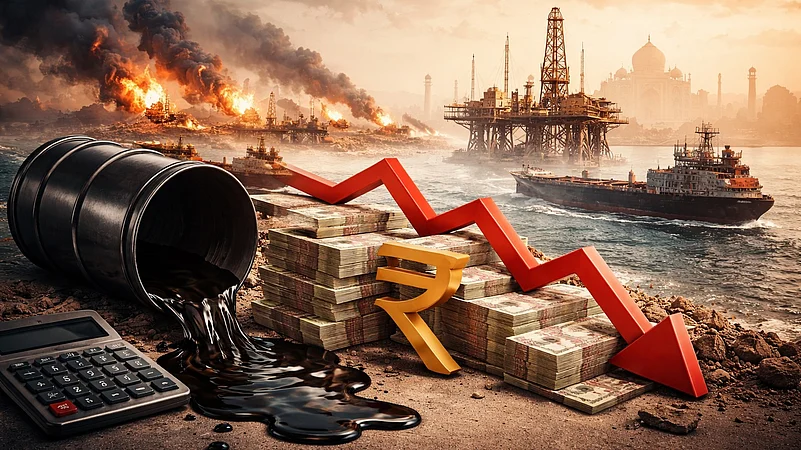
Every $10 per barrel rise in crude oil prices widens India's current account deficit by 36 basis points and pushes domestic inflation up by 35 to 40 basis points. With global crude already volatile and the West Asia conflict showing no signs of abating, that is not an abstract calculation but an increasingly live one.
A study by SBI Research identified crude oil imports and Gulf remittances as the two channels through which an escalating West Asia conflict is most likely to reach the Indian economy, ANI reported. On remittances, the exposure is substantial: India received $138 billion in personal remittances in FY25, a 15% increase on the previous year, with Gulf Cooperation Council countries accounting for roughly 38% of that total. A prolonged disruption to economic activity across the Gulf would put that income stream under direct pressure, with consequences felt in millions of households across the country.

1 September 2026
Get the latest issue of Outlook Business

On energy, India imports close to 90% of its crude oil requirements, and a significant share of global oil trade passes through the Strait of Hormuz. The report does point to a buffer India has built over recent years by diversifying its crude sourcing across more than 40 countries and significantly increasing purchases from Russia since 2022, New Delhi has reduced its dependence on any single supply corridor in a way that was not the case even a few years ago.
The broader warning in the report, however, extends well beyond India. Should the conflict spread unevenly across supply chains, financial markets and national economies, SBI Research cautions that the cumulative effect could trigger a fresh wave of global inflation. The immediate inflationary impact may be limited, it acknowledges, but disrupted trade routes, weakening business sentiment and elevated uncertainty carry consequences that are harder to contain and slower to reverse.
Advertisement
India, the report concludes, is better positioned than most to absorb the shock — but the margin for comfort narrows considerably the longer the conflict runs.