





RBI raises repo rate 25 bps to 5.5%, ending its easing cycle.
MPC shifts stance to “calibrated tightening”, ruling out near-term rate cuts.
RBI projects 5.2% inflation and 7.1% GDP growth for the year.
The Reserve Bank of India (RBI) on Wednesday raised its policy repo rate by 25 basis points to 5.5%, marking the first rate hike by the central bank in more than three-and-a-half years as persistent inflation risks and global supply pressures prompt a shift towards tighter monetary policy.
The decision was taken unanimously by the six-member Monetary Policy Committee (MPC) after its three-day meeting. The last time the RBI raised policy rates was in February 2023.

1 October 2026
Get the latest issue of Outlook Business

Alongside the rate hike, the MPC changed its monetary policy stance to “calibrated tightening” from “neutral”, with four members voting in favour of the change and two against it.


Rate Cuts Off The Table For Now
The change in stance signals that the RBI is no longer considering rate cuts in the near term.
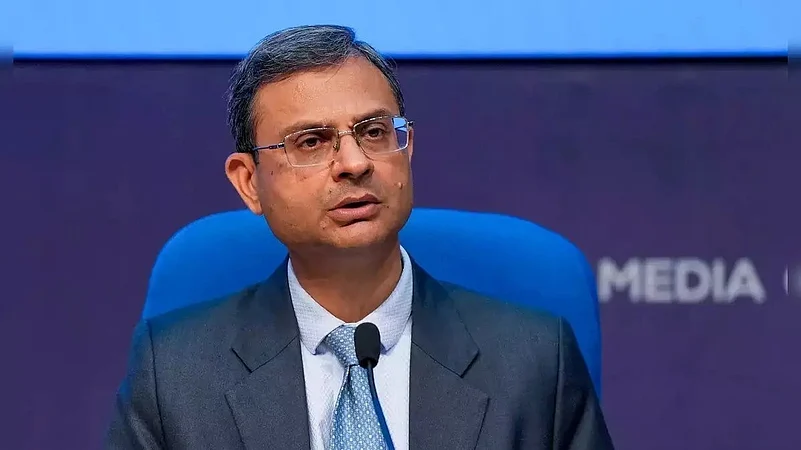
“Given the current conditions, rate cuts are off the table in the near term, and policy action ahead can only be a rate hike or a pause, depending on the evolving conditions and the outlook,” RBI Governor Sanjay Malhotra said.
Advertisement
He said the duration and extent of the rate hike cycle would depend on actual growth and inflation developments, particularly underlying inflation, the extent to which price pressures broaden, second-round effects of supply shocks and demand conditions.
“The duration and extent of the rate hike cycle, therefore, would be contingent on the actual growth, inflation developments, and outlook, especially that of underlying inflation, the extent of broadening of price pressures, and second round effects of the supply shock, as also the impact of the demand impulses,” Malhotra said.
Following the decision, the Standing Deposit Facility (SDF) rate stands adjusted at 5.25%, while the marginal standing facility (MSF) rate and bank rate move to 5.75%.
Advertisement

Inflation Risk
The RBI has projected CPI inflation for the year at 5.2%, with inflation expected to remain elevated through the rest of the year.
The central bank expects CPI inflation at 4.9% in the second quarter, 6% in the third quarter and 5.7% in the fourth quarter.
The latest policy decision comes against a backdrop of the US-Iran war entering its eighth month, persistently higher oil prices and global bond yields reaching multi-year highs.
Malhotra said it remains difficult to distinguish between second-round effects and the indirect impact of supply-side pressures on production costs for energy and other inputs, as both are reflected in indicators such as core inflation and diffusion indices.
“While there is some evidence of elevated inflation expectations and generalization of inflation, there are limited signs of supply-side pressures getting embedded in pricing behavior,” Malhotra said.
RBI Projects 7.1% GDP Growth
Despite the shift towards tighter monetary policy, the RBI has maintained a relatively strong growth outlook.
Real GDP growth for the year is projected at 7.1%.
The central bank expects growth at 7.2% in the second quarter, 6.9% in the third quarter and 6.8% in the fourth quarter.
Malhotra said private consumption remained broadly resilient, supported by continued discretionary spending, while fixed investment remained strong, as evident from several related indicators.
“Some weakness is, however, observed in segments such as non-durable goods and domestic care passenger traffic,” he said.
RBI Leaves Door Open For More Hikes
The MPC’s decision marks a significant shift in the RBI’s policy direction after a prolonged period in which markets had been focused on easing.
The central bank has now explicitly moved away from a neutral stance, while leaving the door open for another rate increase if inflationary pressures become more entrenched.
The MPC said the future path would depend on how inflation evolves, particularly the extent to which supply shocks translate into broader and persistent price pressures.









