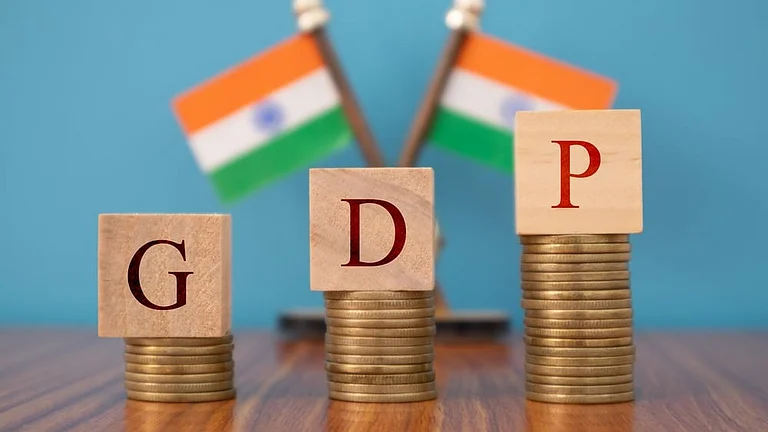
India's gross domestic product (GDP) for the third-quarter has cooled down to 7.8% under the new base year from 8.4% in the previous quarter, according to data released by the Ministry of Statistics & Programme Implementation (MoSPI) today. This is the first series after the government revised the base year to 2022–23, from the previous series 2011–12.
The Second Advance Estimate (SAE) growth rate in Real GDP during FY26 is at 7.6% as compared to 7.1 % in FY25 and 7.2% in FY26. Nominal GDP has registered 11.0% and 9.7% growth rates during FY24 and FY25, respectively.
"The moderation was expectedly driven by the agriculture and the non-manufacturing industrial sectors, including mining, electricity and construction segments," said Aditi Nayar, chief economist at ICRA.

1 October 2026
Get the latest issue of Outlook Business

The manufacturing sector has been the major driver in contributing to the resilient performance of the economy in the consecutive three financial years after rebasing.

Manufacturing GVA expanded by double digits for the fifth consecutive quarter in a row in Q3 FY2026, while services GVA growth inched up to a 7-quarter high of 9.5% from 9.3% in the previous quarter.
The data for FY25 has been revised materially as per the new 2022-23 base. Notably, the size of the Indian economy is estimated to be somewhat smaller than that as per the 2011-12 base; the nominal GDP for FY24 and FY25 is 3.8% each lower than that estimated in the old series, while the SAE for FY2026 is 3.3% lower than the FAE as per the old series.
Advertisement
"This implies that the fiscal deficit-to-GDP ratio would be 15-20 bps higher on average during these years as compared to the previous estimates. More importantly, this would also imply a fiscal deficit target of 4.46% of GDP for FY2027, as against the 4.3% assumed in the budget, assuming a nominal GDP growth of 10% in the fiscal," Nayar added.
New series integrates multiple data sources such as GST statistics, financial results of listed companies, transport indicators, and digital administrative sources.