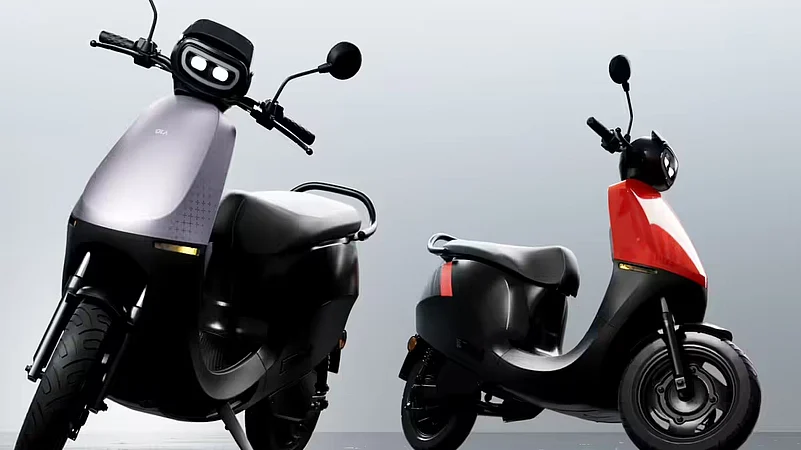
The auto PLI scheme has accelerated production scale among approved electric two-wheeler makers but it has significantly altered competitive dynamics with the cost advantage being used to capture domestic market share rather than build export-ready platforms, think tank Centre for Digital Economy Policy Research said on Friday.
Non-PLI electric two-wheeler (e2W) manufacturers experienced a sharp market contraction, with growth crashing from (+ve) 407 per cent in FY22 to (-ve) 33 per cent in FY24, and further declining to (-ve) 11 per cent in FY25 following the rollout of the scheme, Centre for Digital Economy Policy Research (C-DEP), said in a statement.
PLI-approved OEMs benefit from an estimated 13-16 per cent cost advantage, enabling more aggressive pricing and faster capacity expansion, it added.

1 September 2026
Get the latest issue of Outlook Business

C-DEP has come out with a report which warns that "this cost differential has distorted market structure, allowing PLI beneficiaries to steadily capture domestic market share while marginalising innovation-led players that played a formative role in early market development".

"Although the auto PLI scheme aimed to boost export competitiveness, the data shows a stark contrast between the export performance of PLI-approved models and non-PLI models," it said, adding that 77 per cent of India's electric two-wheeler exports are driven by non-PLI models, while PLI-approved models account for less than one-fourth of total exports despite enjoying a 13-16 per cent cost advantage.
Advertisement
Commenting on the findings, C-DEP President Jaijit Bhattacharya said, "Our analysis indicates that the current design of the auto PLI scheme, while beneficial for scaling production, inadvertently disadvantages innovation-driven companies that are investing heavily in R&D and new technologies." A policy framework that focuses solely on scale risks undermines the long-term competitiveness of the sector and the potential for India to lead globally in advanced clean mobility technologies, he added.
The C-DEP report flagged the risk of India losing key traditional two-wheeler export markets, including Nepal, parts of Latin America, and Africa, to Chinese EV manufacturers like Yadea and Sunra as non-PLI manufacturers are squeezed domestically.
Advertisement
"Without production-linked support, these innovation-led entities face higher capital requirements, limited risk capital access, and structural disadvantages during scale-up, potentially weakening India's long-term technological depth," it said.


The report noted that by December 2025, only Rs 2,321.94 crore had been disbursed against a cumulative target of Rs 3,754 crore -- only 9 per cent of the total outlay had been disbursed against an expected 14.47 per cent.
It recommended opening of a targeted window for innovation-led OEMs that demonstrate strong localisation depth by complying with PM E-DRIVE's Phased Manufacturing Programme (PMP), while also suggesting a first-come-first-serve mechanism to prevent inactive players from hoarding approvals and fiscal space.
It also called for periodic performance reviews to exit non-performing beneficiaries and reallocate fiscal space efficiently.