





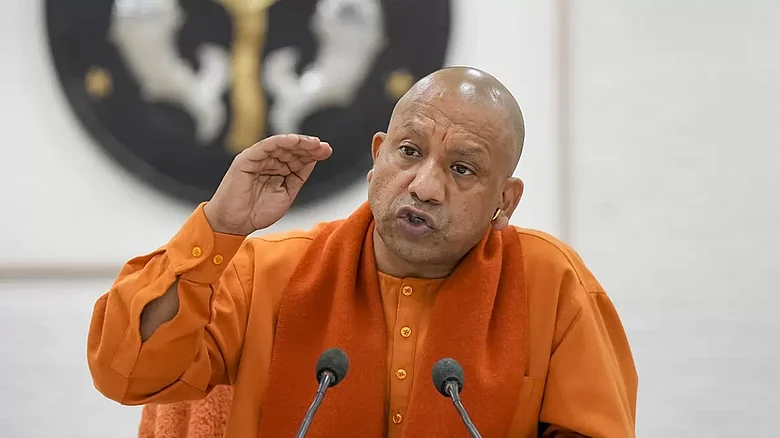
Yogi Adityanath’s Uttar Pradesh is rising as an economy. Its rise is fast and comprehensive. Further, UP’s rise is anchored in fiscal prudence, and thus is not at the cost of the State’s future. And finally, its benefits are available to crores of UP residents as measured via the state’s per-capita income and employment indices.
That is the core message from UP Finance Minister’s FY2026-27 Budget presentation, and the state’s first-ever 300+ page data-rich Economic Survey Report.
Here are some key takeaways from the report, and the budget.

1 October 2026
Get the latest issue of Outlook Business



In 1960 UP was an economic powerhouse. It generated approximately 14.4% of nation’s GDP. However, its share in national GDP started shrinking ever since, and it dropped to 8.7% in 2010-11, and 8.2% in 2021-22. Yogi’s UP has reversed such a trend.
In 2023-24, UP’s contribution to nation’s GDP stood at 8.4% and for last year it is estimated to be 9.1%. Such reversal is directly attributable to UP’s healthy above-average GSDP growth rate.
In 2016-17, UP’s economy-size at 13.3 lakh crore rupees. Today it is 30 lakh crores strong, corresponding to an increase of 127%. And next year it is projected to be 36 lakh crores rupees. That’s a CAGR of 11.7%. Not bad at all!
Advertisement
However, economic growth is of limited value if it does not bring succour to average citizens. Specifically, economic growth is great only if it translates into improvements in per capita income, and reductions in joblessness, and inflation. Let us examine UP’s performance along each of these dimensions.
In 2016-17 UP’s per capita income stood at Rs. 51k. In the subsequent years 9 years, it has more than doubled. That’s good. But it is even better than that if one were to analyse such data differently.
Ever since 1970 UP’s per-capita income expressed as percentage of corresponding national measure had been constantly declining till as late as 2015.
Advertisement
In 1971 an average UP person made 82% of what an average Indian would. By 2015, that fraction had dropped to an abysmal 50%. However, UP’s performance has started improving since then.
In 2025-26 UP’s per-capita income is estimated to be 53.8% of India’s. Such data show that UP’s economic story for the last decade is characterized by two important features: first, that its growth rate has consistently exceeded the national equivalent; and second, that it has been strong enough to offset the moderating effects of its population growth.
The latter feature can hardly be ignored, as UP’s population growth rate has always been significantly above India’s.
Next, consider inflation. For the average citizen, inflation erodes purchasing power. Uttar Pradesh has performed exceptionally well in controlling price levels, outshining several benchmark states in this regard.
In January 2025, UP’s monthly CPI stood at 4.6%, but by October, it had dropped to -1.7%. For comparison, October inflation rates in other benchmark states were 1.3% in Tamil Nadu and 0.9% in Maharashtra.
The state's performance on unemployment indices is also noteworthy. According to the CMIE States of India Report, the unemployment rate among UP’s youth and adults dropped from 5.64% to 2.98% over the last three quarters of 2025.

A remarkable aspect about UP’s economic performance is that it has been able to meet its socio-economic objectives (per capita income, inflation, and joblessness) while simultaneously observing strict fiscal discipline, and principles of economic sustainability.
Its fiscal deficit was a little over 3.1% in FY24-25, and is estimated to be sub 3% in FY25-26. UP has also managed to keep its debt-to-GSDP ratio below the FRBM threshold of 30%.
Over last 8 years, its debt as a fraction of its GSDP has hovered in the 28-29% range. For the coming year, that ratio is targeted to be less than 23%. Finally, Uttar Pradesh is a revenue-surplus state. Last year its surplus stood at 79,000 crores. Such trend is projected to continue in the coming year as well.

Such sustained fiscal discipline has helped Uttar Pradesh gradually increase its capital expenditures over last several years. A higher capex directly translates into stronger infrastructure, more jobs, better health and education indices, and increased investments.
UP’s capex has increased from Rs. 69k crores in 2016-17 to an estimated Rs 165k crores in 2025-26. More importantly when expressed as percentage of its GSDP, UP’s capex has risen from 2.6% in 2016-17 to 5.5% in 2025-26 (estimated).

Clearly, the Yogi-led administration has transformed Uttar Pradesh from one of the BIMARU states into an engine driving India’s journey toward a Vikasit Bharat. Such transformation is multidimensionally improving the lives of its 25 crore residents.
However, the journey has only just begun. UP’s per-capita income still remains at just over half the national average and one-third that of the country's wealthiest states.
Life expectancy in UP still lags behind the national average by approximately five years. Its Gross Enrolment Ratio for higher education is still significantly lower than that of India’s most developed states. Additionally, mobile penetration in UP stands at about 70%, which is notably lower than in states like Karnataka, where it exceeds 110%.

There is only finite time available to UP to achieve these goals and much more. It has to do all of that before its population begins to age. What that means is that it has to emulate or beat the growth trajectory of Shanghai.
That famed Chinese province had clocked a real CAGR of about 14% for over three decades, playing an instrumental role in turning China into a $20 trillion economy. If Shanghai could do it, so can Uttar Pradesh.
UP has spent first half of the last decade in getting its law-and-order situation right, recognizing that economy thrives only in orderly places. It then dedicated the second half of the decade getting its fiscal elements aligned to needs of growing economies. The Economic Survey clearly shows that UP has succeeded in that direction as well.
With these two accomplishments secured, UP has to now leapfrog into an era of hyper-growth. It can do that by focussing on four strategic pillars.
One, it has to make things easy, i.e. really-really easy, for the investors so that the government stops being an inhibitor for RoI. Currently, it takes more than a year in India to get all the governmental approvals, which clearly is a drag for the investor.
Two, it has to understand and capitalize on its strengths. Its principal strengths are; UP is a very large market, it is a state endowed with numerous perennial rivers which can work as waterways, it is a state where the government itself is a super-large consumer of all sorts of high-tech products, it has a highly fertile landmass whose agricultural productivity has all but peaked, its proximity to the national capital, and it being Bharat’s civilisational cradle and center.
Three, it has to rapidly train and educate its youth in very large numbers so that they can meaningfully contribute to UP’s growth story.
And finally, it has to lay out compelling incentives to bring in investment into as many sectors as possible. Currently, Uttar Pradesh resembles Hanuman from the Ramayana, who required a reminder of His immense potential so that He could confidently leap across the oceans. The state has to recognize its own Hanuman-ness and so that it can help Bharat turn Vikasit by 2047.
(The views expressed in this article are personal and do not represent the opinions or positions of any institution or organisation with which the author/s may be affiliated.)









