India–New Zealand FTA opens farm trade via quotas, prices and seasonal safeguards.
Apple, kiwi quotas paired with agri-tech cooperation to lift Indian productivity.
Duties cut within limits; safeguards allow rollback if terms are breached.
Bilateral trade at $2.1bn targets doubling within five years.
As India and New Zealand concluded their long-awaited free trade agreement (FTA) negotiations today, both sides are preparing for a first-of-its-kind cooperation in agricultural technology, particularly in apples and kiwi fruit.
Addressing concerns over the dairy sector, Commerce Minister Piyush Goyal said the issue remains largely theoretical. “New Zealand only sought an assurance that if India were ever to open its dairy sector to another comparable economy—similar in size, income levels and dairy capacity—it would at least have an opportunity for discussion,” he said.

1 September 2026
Get the latest issue of Outlook Business

“This agreement is built around complementarity,” said Petal Dhillon, Joint Secretary in the Department of Commerce and chief negotiator for the India–New Zealand FTA. “We have designed market access carefully, using tariff-rate quotas along with minimum import prices and seasonal restrictions.”
For apples, which currently attract a 50% import duty, New Zealand will receive a quota starting at 32,500 metric tonnes (MT), rising to 45,000 MT over six years. Imports within this quota will face a reduced duty of 25%. Shipments beyond the quota will continue to attract the full 50% duty, along with a minimum import price of $1.25 per kg.
Advertisement
A similar structure applies to kiwi fruit. Against a current duty of 33%, India has offered an initial quota of 6,250 MT, expanding to 15,000 MT over six years. Imports within the quota will be duty-free, subject to a minimum import price of $1.8 per kg, while those outside the quota will face a 50% duty.
Another sensitive segment is manuka honey. While the existing duty stands at 66%, India has offered a quota of 200 MT under the agreement, subject to a minimum import price ranging between $20 and $30 per kg.
Government sources pointed to stark productivity differences between the two countries. New Zealand’s apple yield stands at 53.6 MT per hectare, compared with India’s 9.2 MT/ha. The gap is even wider for kiwi, where India produces just 3.25 MT/ha against New Zealand’s 47.21 MT/ha.
Advertisement
In return for the market access, New Zealand has committed to extensive agri-technology cooperation with India, covering planting techniques, orchard management, productivity enhancement, supply-chain development and packaging.
According to a statement by the New Zealand government, it’s the first country to secure preferential access for apples in any Indian trade pact.
A commerce ministry official said India has retained full safeguards under the pact. “If the agreed requirements are not met, India has the right to withdraw all concessions in these sectors,” the official said.
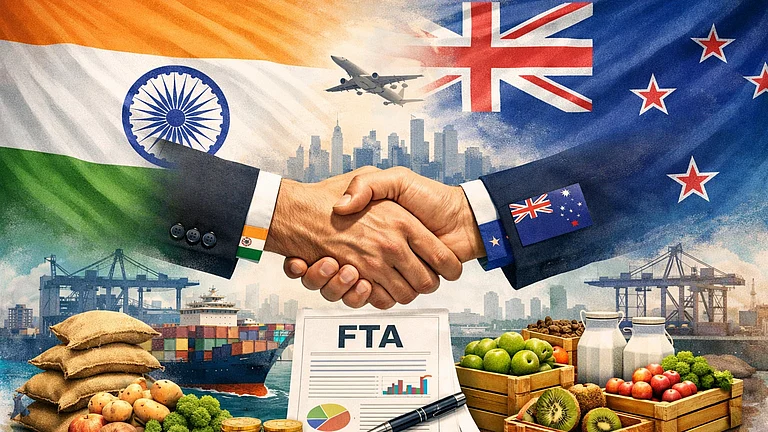
India’s bilateral trade with New Zealand stood at $2.1bn in FY2025. Both sides now aim to more than double this figure over the next five years.
New Delhi-based think tank Global Trade Research Initiative (GTRI) noted that dairy, the most politically sensitive area, remains commercially marginal. New Zealand’s dairy exports to India amounted to just $1.07mn in FY2025, including milk and cream ($0.40mn), natural honey ($0.32mn), mozzarella cheese ($0.18mn), butter ($0.09mn) and skimmed milk ($0.08mn).
“Tariff asymmetry has shaped the deal. New Zealand’s average import tariff is just 2.3%, compared with India’s 16.2%, and 58.3% of New Zealand’s tariff lines are already duty-free. As a result, Indian exporters already enjoy wide access in New Zealand markets,” said Ajay Srivastava, founder of GTRI.