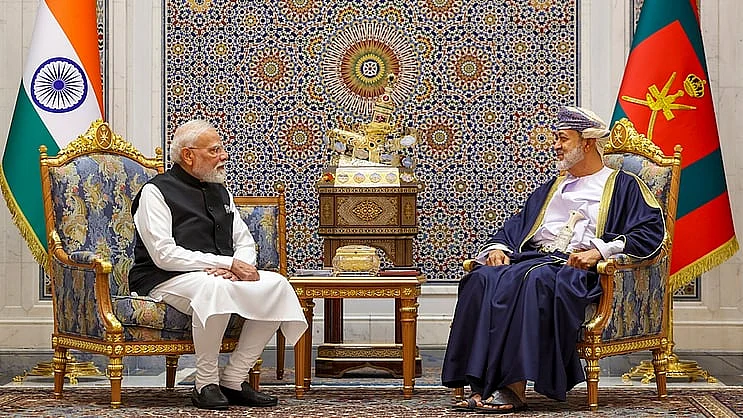
India and Oman on Thursday signed a historic free trade agreement, as Prime Minister Narendra Modi and Sultan Haitham bin Tarik comprehensively reviewed the multi-faceted Strategic Partnership and reaffirmed their commitment to regional peace and stability.
Modi, who arrived in Oman on Wednesday on the last leg of his three-nation tour, was welcomed by Sultan Haitham at Al Baraka Palace in Muscat before their one-on-one talks and the delegation-level meeting.
"Today, we are taking a historic step forward in India-Oman relations, whose positive impact will be felt for decades to come. The Comprehensive Economic Partnership Agreement (CEPA) will energise our ties in the 21st century," Modi said, describing the pact as "a new and golden chapter" of bilateral cooperation.

1 September 2026
Get the latest issue of Outlook Business

He said the agreement will give new momentum to trade and investment, and open new opportunities across different sectors.
During the meeting, the two leaders expressed satisfaction at the excellent state of bilateral relations, spanning trade, investment, defence, security, technology, education, energy, space, agriculture, culture and people-to-people ties.
"The two sides commended the deepening cooperation in the defence sector and agreed to continue working together in this regard, including joint exercises, training, and high-level visits to achieve shared goals and contribute towards maintaining regional security and stability," said a joint statement issued after their talks.
They adopted a joint vision document on maritime cooperation, reflecting their shared commitment to regional maritime security, the blue economy, and sustainable use of ocean resources, it added.


Advertisement
The two leaders condemned terrorism in all its forms and manifestations, reaffirming that no justification can ever be accepted for such acts. They underlined the importance of continued cooperation in this area.
Both sides acknowledged the immense potential to promote trade in areas, including textiles, automobiles, chemicals, equipment, and fertilisers.
The CEPA - signed by Commerce and Industry Minister Piyush Goyal and Oman's Minister of Commerce, Industry and Investment Promotion Qais bin Mohammed Al Yousef - will increase trade between the two countries by reducing trade barriers and creating a stable framework. It will also unlock opportunities in all major sectors of the economy, enhance economic growth, create jobs and boost investment flows.
Advertisement
This is Oman's second FTA with an individual country and the first FTA they have done in about 20 years.
"Both leaders acknowledged that CEPA shall be mutually beneficial to both countries, and they encouraged the private sector of both countries to benefit from this agreement," said the joint statement.
India-Oman bilateral trade was about USD 10.5 billion (exports USD 4 billion and imports USD 6.54 billion) in 2024-25.
While expressing satisfaction at bilateral trade crossing USD 10 billion and two-way investment flows moving forward, Modi underlined that the CEPA will significantly promote bilateral trade and investment, create jobs and open a plethora of opportunities in both countries.
In the last few years, India has signed many FTAs, which are reaping rewards for farmers, traders and exporters. Some of them include the UK (2025), EFTA (2024), Australia (2022), the UAE (2022) and Mauritius (2021).
Modi said he also discussed with Sultan Haitham ways to further boost trade and investment linkages. "Financial services also offer great scope for working together. We talked about how sectors like energy, critical minerals, agriculture, fertilisers and healthcare have rich potential for closer ties," he said.
"We discussed how cultural and people-to-people linkages can be enhanced. This includes student exchange programmes and other such ways to ensure our youth connect regularly," Modi said.
The two leaders also discussed giving a new thrust to energy cooperation through long-term energy arrangements, renewable energy ventures and green hydrogen and green ammonia projects, the Ministry of External Affairs (MEA) said.
Modi appreciated Oman joining the International Solar Alliance and invited it to join the Coalition for Disaster Resilient Infrastructure and the Global Biofuel Alliance.
He noted that the two countries can benefit from agricultural cooperation, including collaboration in the fields of agricultural science, animal husbandry, aquaculture and millet cultivation.
The two leaders also discussed cooperation between UPI and the Omani digital payment system, RUPAY card adoption and trade in local currencies.
They noted that the completion of 70 years of diplomatic relations between India and Oman is a landmark in the bilateral partnership.
The two sides signed MoUs in the field of Maritime Heritage and Museums, Agriculture and Allied Sectors and Higher Education. They agreed on an executive programme for cooperation in millet cultivation and agri-food innovation.
PM Modi thanked the Sultan for ensuring the welfare and well-being of the vibrant Indian community of around 675,000 residing in Oman. They also discussed the rich cultural heritage shared by the two countries.
The two leaders welcomed the alignment between Oman Vision 2040 and India’s goal of becoming a developed nation or Viksit Bharat by 2047, and conveyed their support to each other for meeting the aspirations of their peoples.
The two leaders exchanged views on regional and global developments and reaffirmed their commitment to regional peace and stability. They expressed concern over the humanitarian situation in Gaza and called for safe and timely delivery of humanitarian aid to civilians.
They welcomed the Gaza Peace Plan, reaffirmed their support for efforts to restore peace and stability. They underlined the need for a just and lasting resolution through dialogue and diplomacy, including the establishment of a sovereign and independent Palestinian state, the joint statement said.
PM Modi was conferred with the Order of Oman, the Sultanate's uniquely distinct civilian honour, by Sultan Haitham for his "exceptional contribution" to India-Oman ties and his "visionary leadership".
Modi arrived here on the last leg of his three-nation tour. He earlier visited Ethiopia and Jordan. This is his second visit to the Gulf nation. His visit is of special significance as it marks the 70th anniversary of the establishment of diplomatic relations between the two countries.
Oman is the third-largest export destination for India among the Gulf Cooperation Council (GCC) countries.
India's key imports are petroleum products and urea. These account for over 70 per cent of imports. Other key products are propylene and ethylene polymers, pet coke, gypsum, chemicals, iron and steel, and unwrought aluminium.
The main items of India's exports to Oman include mineral fuels, chemicals, precious metals, iron and steel, cereals, ships, boats and floating structures, electrical machinery, boilers, tea, coffee, spices, apparel, and food items.