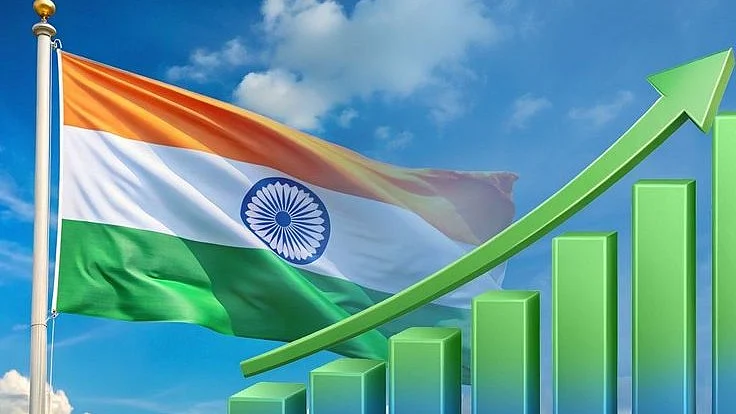
The Indian economy is likely to clock a growth rate of 7.3 to 7.5% in the fiscal ending March 2026, and slow down a bit to 7% in 2026-27, consultancy firm Grant Thornton Bharat said on Wednesday.
According to the First Advance Estimates issued by the National Statistics Office (NSO), India is likely to grow at 7.4% during 2025-26, compared to 6.5% in the previous fiscal year, driven by a strong performance in the services and manufacturing sectors, thus retaining its position as the world's fastest-growing major economy.
During an interaction with PTI, Rishi Shah, Partner and Economic Advisory Services Leader, Grant Thornton Bharat (Economist, Macro Economic Affairs), said that exports are holding up despite US tariffs on Indian imports and other hurdles.

1 September 2026
Get the latest issue of Outlook Business

"I think in this fiscal year, it's a fair assessment, you know, 7.3 to 7.5% and in 2026-26, it would be closer 6.7 to 7% mark," he said.


He also flagged the external factor as a big pressure point for the economy, especially in view of the geopolitical developments.
Shah said issues related to South America and the Middle East may pose challenges to the supply chains.
"Any policy decision that is taken today, the genuine and the actual impact of that will only be known in about maybe a few years from now. So, the idea has to be to actually play a very important part in this new wave of industrialisation. If you see across the world, the advanced economies are now re-industrialising," he said.
Advertisement
On expectations from the forthcoming Union Budget, Shah said it is a directional document and reflects the mindset of the government for the future.
"So the main thrust for this year (should) be on the ease of doing business front," Shah said.
About the rupee's depreciation, Shah said he thinks it will stabilise around the current level of 90 to a US dollar.
Moreover, he added, "We should learn to live with a currency which is slightly weaker. We import most of our important goods, and for a country like ours, I think it serves a purpose to actually have a weaker currency." Shah also opined that the Reserve Bank still has to reduce the repo rate one more time.
Advertisement
"Now, given the fact that inflation has been below the Reserve Bank's lower margin of 4 to 6%, we have been around 4% or possibly lesser than that, despite the volatility in food prices, I think there is a case for maybe one more 25 basis point cut, but nothing beyond that," he said.
The Reserve Bank started its rate-cutting cycle in February last year and has cumulatively reduced the short-term lending rate (repo) by 125 basis points to 5.25%.
The RBI's rate-setting panel -- the Monetary Policy Committee (MPC) -- is scheduled to meet from February 4 to 6.