




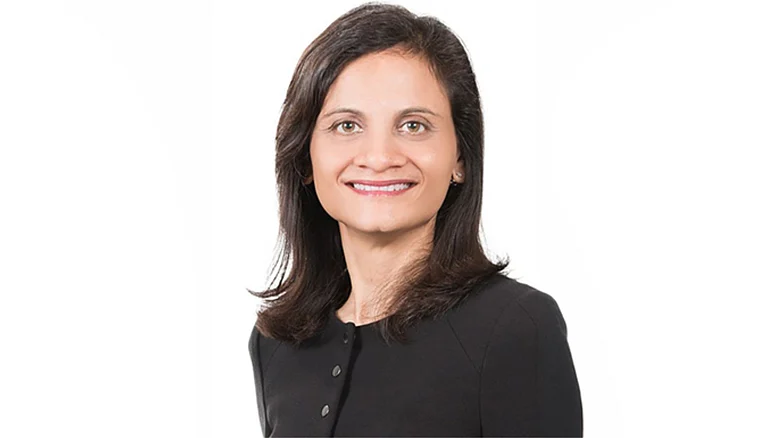

India’s private credit market is entering a growth phase, said Kanchan Jain of Ascertis Credit Group.
With $25–30 billion in AUM, private credit accounts for less than 1% of India’s GDP and about 1.2% of corporate lending.
The segment’s penetration is only about 10% of what is seen in more mature markets.
India’s private credit market has entered a meaningful growth phase, according to Kanchan Jain, Head at Ascertis Credit Group, a multi-strategy private credit platform based out of Singapore. The company held a first close for its fourth fund (Fund IV) at $520 million last November.
Jain says that with total assets under management at $25–30 billion, private credit represents less than 1% of the country’s GDP and only 1.2% of total corporate lending. In relative terms, this is about 10% of the penetration seen in more mature markets.

1 October 2026
Get the latest issue of Outlook Business

"Over the last few years, growth has been driven by structural gaps and limitations in traditional wholesale debt capital, increasing sophistication and growth needs of borrowers, and a deeper understanding of private credit among investors. What is important to recognise is that private credit is not replacing banks, it is complementing them," she told Outlook Business in an interview.
Jain also said she expects the share of private credit in mergers and acquisition activity to increase, even as investors pay a premium compared to more mature markets.
Here’s the edited excerpt of the interview:
Last year, S&P Global noted in a report that India’s private credit market is coming of age, driven by a confluence of low interest rates, ample liquidity and competitive funding from traditional banks. Would you agree with this assessment? Do you believe private credit will emerge as a key alternative funding source for Indian businesses?
Advertisement
India’s private credit market has entered a meaningful growth phase, with significant growth still to come given the level of under-penetration. With total assets under management at $25-30 billion, private credit represents less than 1% of the country’s GDP and only 1.2% of total corporate lending and in relative terms, this is compared to 10% of the penetration of a more mature market.
Over the last few years, growth has been driven by structural gaps and limitations in traditional wholesale debt capital, increasing sophistication and growth needs of borrowers and a deeper understanding of private credit among investors.
What is important to recognise is that private credit is not replacing banks - it is complementing them. Many Indian businesses today are promoter‑led, well‑established, and scaling rapidly. Their capital needs are often complex, requiring flexibility around structure, tenor, end use and timing. These are areas where banks, constrained by regulation and risk frameworks, are not always best positioned to deliver.
Private credit addresses this gap by providing tailored, non‑dilutive capital anchored in a deep understanding of business fundamentals and cash flows. Over time, this will make private credit a permanent and meaningful part of India’s corporate financing ecosystem.
Advertisement

One estimate suggests that about 25% of private credit deals are driven by growth capital. Do you expect growth capital to remain a key driver of deal activity in India’s private credit market over the next few years?
India is in a multi‑year growth cycle, yet corporate credit penetration has not kept pace with economic expansion. India's corporate credit-to-GDP remained flat at c. 57% between 2013 and 2023, even as the economy grew substantially. Banks understandably focused on balance sheet repair during that time and today, India's banking system is in its strongest position in over a decade. That is a foundation of strength. But it also means that corporate India was under-served by the credit system for a prolonged period, and the gap remains wide.
An economy expanding at this pace, with ambitions through 2047 for its infrastructure build-out, manufacturing and services push, and energy & tech transitions cannot be funded by banking capital alone. This requires a step-change in how India mobilises and deploys debt capital.
We are seeing a growing pool of professionally managed businesses pursuing ambitious organic and inorganic growth. Many of these companies need flexible, non‑dilutive capital over and above steady bank capital, that allows them to grow without compromising ownership or long‑term strategy.
Private credit is an essential piece of this financing puzzle, allowing companies across sectors, to pursue their growth ambitions with sophisticated, flexible, non-dilutive capital solutions, making growth capital one of the most durable and important drivers of deal activity in the years ahead.

Ascertis Credit Group has raised $520 million in the first close of Fund IV, targeting $1 billion by December 2026. You have said that the plan is to invest in high-growth businesses with positive cash flows. Can you give more colour on how you identify these opportunities? Are there ample such opportunities in India?
India offers significant depth of opportunity provided you have the right sourcing and underwriting engine.
At Ascertis, one of our key differentiators is our institutional sourcing platform. Over the 12 years of existence, we have consistently worked on building a larger and more granular network of intermediaries across the country. The senior team at Ascertis Credit, with over 140 years of combined experience in the markets, continues to nurture and build proprietary relationships with promoters of leading high-growth businesses. Companies in the mid-market space have become more aware of financing opportunities through private credit. This gives us access to proprietary and semi‑proprietary opportunities well before they become broadly intermediated.
Experience matters greatly in private credit. Our senior investment team has collectively seen multiple cycles, which sharpens judgment around business quality, cash‑flow resilience and downside risk.
Once we have identified deals, we work thoroughly not only to make sure the company has positive high conviction cash flows but also strong governance, disciplined capital deployment and maintains serviceable leverage. Our structures focus on building in significant downside protection through collateral, covenants and contractual returns. Only a small fraction of evaluated opportunities ultimately meets our investment threshold, but that discipline is central to delivering consistent, risk‑adjusted returns.
Yields in India’s private credit market typically range between 14% and 22%, compared to 8-10% for banks and 10-13% for NBFCs. How long can this yield premium be maintained amid rising competition from traditional lenders?
Over time, yield compression is a natural feature of maturing markets, but India is not there yet.
The current yield premium reflects structuring complexity, speed of execution, and the ability to provide capital solutions which traditional lenders cannot. Importantly, the premium is also supported by the nature of the companies we finance- high‑growth businesses with strong forward visibility that require flexible, non‑dilutive capital to fund expansion.
By providing growth capital without diluting ownership, private credit enables companies to pursue ambitious growth plans while preserving long‑term value. This alignment between borrower needs and lender structures creates both pricing power and durability of returns.
That said, discipline is critical. Sustainable returns in private credit come from underwriting quality and risk management, not from competing purely on yield. As long as the industry remains focused on solving real financing gaps with disciplined structures, the pricing differential will remain justified.
Family offices allocate 15-25% of their portfolios to alternatives, with 25-30% of that going into private credit. How significant is this investor segment becoming for deal flow in India?
Family offices are becoming an increasingly important part of the private credit ecosystem, both as investors and long-term partners.
Many family offices have built operating businesses themselves, which gives them a strong appreciation for cash‑flow‑based lending, downside protection, and capital preservation. Private credit return and distribution profile, along with its underlying investment profile,strongly complements other forms of investment strategies in the public and private markets that family offices pursue. This makes private credit a natural fit for their portfolios.
At the same time, large institutional investors such as pension funds, sovereign wealth funds, and insurance capital will continue to anchor the industry at scale. Together, these investor groups create a balanced, resilient capital base for private credit in India.
In your over 30-year career, how have you seen women professionals’ participation evolve in the BFSI sector?
There has always been a decent representation of women in finance, including in leadership roles - but earlier, there were far fewer visible role models, and fewer women in senior decision‑making positions at scale.
When I started my career, women often faced greater scrutiny and had fewer reference points for what leadership could look like. Over time, participation has improved significantly across banks, funds, regulators, and professional services.
What has changed most meaningfully is confidence and aspiration. What can improve further is representation at decision-making levels. Today, many women entering finance see leadership as a natural outcome of performance, not an exception. While representation at the very top will deepen over time, the pipeline is stronger than it has ever been.
What advice would you give to young professionals entering this field?
First, be visible and step forward. Don’t wait to be asked - lean in, take responsibility, and be willing to accept stretch roles and promotions. Growth often comes from doing the work before you feel fully prepared.
Second, build a strong support system. On the personal front, it is important to take help when needed -at home and at work. No one builds a long career alone.
Third, seek guidance. Reach out, ask questions, and have honest conversations. Women often go through certain life and career cycles that require adaptation - both by the individual and by the ecosystem around her.
Finally, create your own path. Careers don’t have to follow a uniform trajectory. There will be phases where you move fast and others where you recalibrate pace - what matters is staying intentional. But flexibility in pace does not mean flexibility in standards. It’s important to adapt while remaining anchored to outcomes.
What steps can the industry take to encourage more female leaders in the financial sector?
The focus must move beyond hiring to retention and progression.
The industry already attracts capable women, but too many drop off before reaching senior roles. Institutions can invest in mentorship, flexible yet career‑protecting work models and leadership pipelines that continue to focus on capability and excellence butdesigned with women in mind.
Real progress happens when opportunity, exposure and accountability come together. If organisations get this right, India’s finance ecosystem can unlock a leadership bench that’s already there.









