Seros, India's largest integrated energy services company, is set to complete drilling of the country's first geothermal resource-mapping well in Ladakh's Puga Valley — a milestone that could put India on the global geothermal map by demonstrating the potential to generate electricity from heat stored beneath the earth's surface.
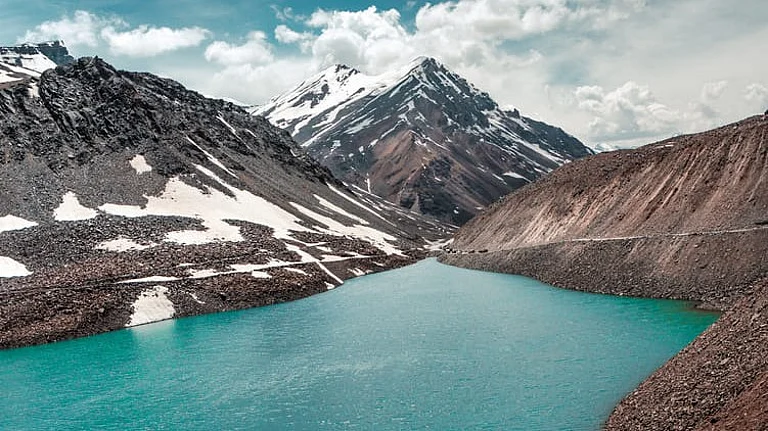
Seros began drilling at Puga Valley in mid-2024, working overtime through a narrow three-month window that opens up when snow clears in the extremely high-altitude cold desert.
After spending one-and-a-half years navigating narrow mountain roads, weak bridges, and undersized tunnels to transport heavy drilling rigs and equipment, Seros completed drilling up to 60 metres during the first drilling season in 2024 and reached 400 metres in the second season last year. The company is now on track to achieve the intended depth of 900–1,000 metres in the current season.

1 September 2026
Get the latest issue of Outlook Business




The first pilot well will be followed by two exploration wells, with the first scheduled to be drilled during this year’s operational window opening in late June or early July and continuing through September, Seros MD and CEO Ashish Agarwal said at India Energy Week.
“The drillings will demonstrate the technical feasibility of harnessing round-the-clock geothermal power in one of the world’s most challenging operating environments,” he said.
The project — executed with the ONGC Energy Centre — marks a critical step in diversifying India’s clean energy mix beyond solar and wind, while laying the groundwork for scalable, low-emission baseload power across geothermal-rich regions of the country.
Advertisement
Agarwal said this is indeed “a milestone in the country’s clean energy transition given the highly technically complex project it is”.

While India’s clean energy push has largely focused on solar, wind and green hydrogen, geothermal energy is emerging as a reliable baseload option.
With subsurface temperatures exceeding 200 degree Celsius, the Puga Valley initiative aims to develop a geothermal power plant at the site.
Experts estimate India has nearly 10 GW of geothermal potential spread across more than 350 locations, which could help balance the grid and support low-emission growth by complementing intermittent renewable sources.
Advertisement
“The Puga Valley project is proof that India can navigate through the most complex challenges to meet its energy requirements with homegrown expertise, true to the spirit of Atmanirbhar Bharat. Geothermal energy is no longer just a concept; it can deliver reliable, round-the-clock power, complementing solar and wind, and strengthening India’s energy security. What we are building here lays the foundation for scaling this untapped resource nationwide and advancing the vision of a Viksit Bharat through cleaner, more resilient infrastructure,” Agarwal said.

Providing an update on project progress, Agarwal said the company has met its initial technical objectives. “Projects of such scale and complexity have a long gestation. We have achieved the objectives set out for the campaign and given proof of concept,” he said.
The first reservoir identified at the site has an estimated generation potential of 10 MW. “The first reservoir has 10 MW potential. Scalability is achievable with the right policy push,” he said.
From regulatory approvals to commissioning, the project is expected to take three to four years.
Agarwal outlined the operational challenges of executing a geothermal project in Ladakh, noting, “The real challenges are altitude — over 4,000 metres, limited working months, subzero temperatures, lack of oxygen and the inherent uncertainty of geothermal drilling.” Puga Valley is an extremely high-altitude cold desert, with narrow mountain roads complicating the transport of heavy drilling rigs and equipment. On site, crews contend with high-pressure steam, fractured and abrasive rock formations, chemically aggressive fluids, hydrogen sulphide (H2S), and extreme temperature differentials between the surface and subsurface. The operating window is limited, and the margin for error is narrow, with miscalculations carrying significant risk.

Seros operated round the clock in subzero temperatures and low-oxygen conditions, adapting its drilling strategies to stabilise wells and ensure safe progress.
The company said the team’s technical capability, operational experience and resilience were critical to executing the project under such conditions.
The project will deploy binary cycle geothermal technology, selected for its compatibility with local reservoir conditions. “We will be using binary cycle technology, which works well for temperatures in the 200–250 degree Celsius range. It’s proven, stable, and environmentally safer for sensitive regions like Ladakh,” Agarwal said.
According to Agarwal, Puga Valley stands out among India’s geothermal prospects. “Puga has the highest confirmed geothermal temperatures in India. By global benchmarks, it compares well with medium-grade geothermal fields in places like Türkiye or parts of the western US,” he said.
Agarwal said geothermal energy could play a meaningful role in Ladakh’s energy mix, particularly in reducing dependence on diesel. “What makes geothermal special is that it runs 24 hours a day, unlike solar or wind. In Ladakh, where diesel is still widely used, even small projects of baseload power make a meaningful difference,” he said.
However, he cautioned that commercial viability is still being established. “It’s early days to establish commercial viability. These projects have long gestation similar to any major breakthroughs,” Agarwal said.
The Puga Valley initiative is intended to serve as a national reference project. “This project is meant to be a proof point for India. If we can make geothermal work here, it becomes much easier to replicate elsewhere with lower risk,” he said.

Cost benchmarks for geothermal power in India have yet to be determined.
Policy support will be critical to scaling geothermal development, particularly in mitigating exploration risk. “The most important support is exploration risk coverage, which today lies entirely with the drilling contractor (Seros). Without this, private investors may not be encouraged to foray,” Agarwal said.
Environmental safeguards have been built into the project design. “The project uses a closed-loop system, meaning geothermal fluids are reinjected back underground. Land use is limited, and water consumption is far lower than most thermal plants,” he said.
International best practices are also being applied. “We’re applying lessons from countries with decades of experience — especially reinjection, pressure management, and keeping the surface footprint small,” Agarwal added.
Once the pilot phase is completed, the focus will shift to extended testing. “Once the pilot runs, the focus will be on 6–12 months of reservoir testing. That data decides whether and how fast we scale up,” he said.
Beyond Ladakh, other promising geothermal sites have been identified in Himachal Pradesh, Uttarakhand, Gujarat, Maharashtra and the Narmada basin. However, broader replication will depend on policy momentum. “Policy push and government initiatives are key. Very early days for private players to show any interest,” Agarwal said.

Seros also highlighted its operational strengths, noting that it operates one of India’s largest onshore drilling fleets, including the only privately owned 3,000 HP rig. The company said its asset base and technical expertise position it as a key enabler of India’s move into new energy frontiers beyond conventional hydrocarbons.
Looking ahead, Agarwal said geothermal energy would play a strategic role in India’s clean energy mix. “Over the next decade, geothermal will be strategic. Its real value is reliable, clean baseload power in places where alternatives are limited,” he said.
Industry analysts said successful execution under such extreme conditions will be critical in attracting investment, securing policy support and scaling geothermal projects nationwide, helping India meet its broader clean energy targets.