Motorcycling can well be considered the modern successor to horse riding. The rhythm, the speed, the thrill, the connect with nature, are all the same, especially if you are off city roads. Of course, with a motorcycle, you can’t leap across ditches, jump over fences (unless there is a ramp and the bike is designed to do so) or ford across a 3ft shallow stretch of water.
The hat has evolved into the helmet, the long leather dusters into riding jackets and the Colt on the waist into a mobile or satellite phone (where such phones are allowed) or a Swiss Army multi-utility tool. The rider’s personal belongings, instead of hanging on heavy haversacks on the sides or the lap are now neatly balanced on either side of the motorcycle in designated carriers known as saddlebags or tied on the back.
The best part: the horse or the motorcycle does most of the hard work, while you soak in nature. You feel numb when it’s snowing, dry and itchy in a sandstorm and wet in the rain. You also smell the sweet petrichor as it wafts through the air as the first droplet hits the dry earth.

1 September 2026
Get the latest issue of Outlook Business

If you are an avid motorcyclist and are not sure which trail to hit next and how to plan your trip, we have a guide for you.
Skill and Safety First
Just like riding, motorcycling also needs skills. The more powerful the machine (higher cc, greater power and torque), the more skill it will require for you to handle it right. A novice rider will not only endanger themselves, but could also turn the machine into a lethal weapon for others on the road. But it’s not just skill, a long ride takes dollops of patience and riding etiquette.
“You need common sense and presence of mind while on the road, especially on long rides,” says Sachin Chavan, an industry veteran who has spearheaded many rides and other motorcycling community initiatives.


The dangers on the road are real. Samik Chakraborty, 43, a supply chain professional in the petrochemical industry based out of Mumbai, who has been on long-distance rides to Ladakh, Kutch and a few other places has a word of caution for those planning long rides. “Do not race on the road with fellow riders or locals; do not overspeed or overtake on blind turns,” he says.
Speeding on turns can lead to a wash out, with the cornering angle too steep to allow for a gentle turn hugging the road. The vehicle slides on the outward curve (in the face of oncoming traffic) or the edge or wall (if it’s a mountain road) to maintain stability or crashes if you brake hard. With extra luggage and weight, handling requires a bit of skill.
According to the Ladakh Traffic Police, the number of motorcycle-related accidents have shown an increase in the Union Territory during the summer season from June-October, when the traffic increases as the landlocked region opens to motorists and motorcyclists who come here in droves.
Planning Comes Next
This is the difference between making your ride enjoyable or agonising. A motorcycling trip requires planning down to the last detail, especially if you are not with an organiser but going with a group of friends or solo. You need to prepare for the unexpected—breakdowns, unplanned stops due to weather conditions—and depend on roadside eateries and homestays with bare minimum facilities in desolate regions. In case you plan to camp, you need to be even more cautious about the weather, the distance from nearest habitation for help, food, water and other safety aspects.
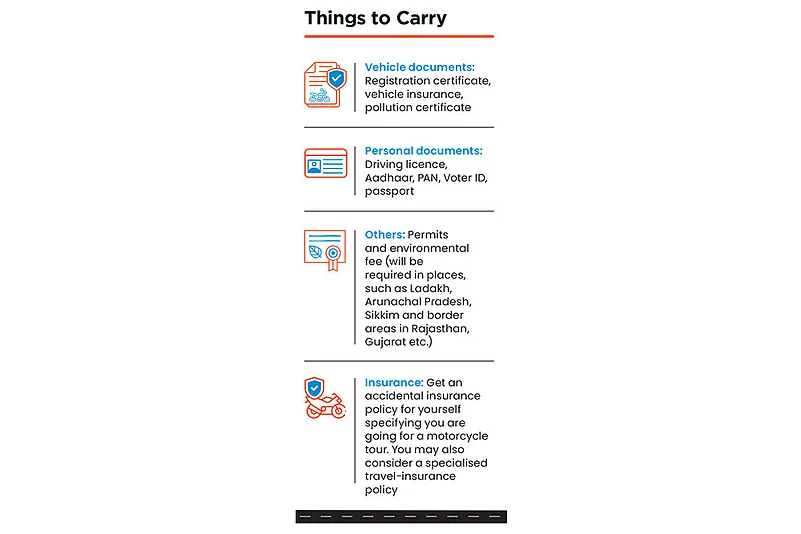
It will, therefore, serve you well if you plan your ride in advance, including taking note of weather and road conditions, the need for permits, accommodation, repair facilities and mobile connectivity. In many places, you will need to get your permit in advance. Some examples are Turtuk in Ladakh, Tawang in Arunachal Pradesh, Vikhagot in Kutch, Longewala in Rajasthan and Gurudongmar in Sikkim.
Chavan recounts how an unplanned trip left him stranded. “Many years ago during the Pune monsoons, I decided to go for a short ride which kept becoming longer and longer. I had recently come back from my first Ladakh ride and my confidence was at its peak,” he says.
He went on a trail which he had done before, but this time, he hadn’t taken the monsoon into account. “I kept getting stuck and moving forward. It was just a natural ‘get on with it’. Finally, I got stuck—no phone, no wallet, no food, no help and no one around for kilometres. Eventually after a few hours of digging with my bare hands, I was able to get back on the road. My bike and I were in one colour—mud. I had to hose myself down at a friend’s place before returning home. I learnt a lot of lessons that day,” he adds.
Experience matters: Many riders, typically start with small rides before going on long-distance rides and their first ride is often unplanned, which serves as a classic blueprint of how a ride should be planned and what should not be done.
“One evening in 2001, my three roommates and I decided to go to Ooty from our college in Manipal. Everything went fine until we reached Mangalore (60km away), when fatigue set in. We had not anticipated this. But we carried forward and completed our trip,” says Chakraborty.
But it was the Goa ride in January 2014 that taught him and his friends how to plan a ride. “We took 20 hours to reach Mumbai from Goa, which should otherwise take 10–12 hours. We started at the wrong time, did not have proper winter wear and were ill-prepared for the cold weather. We were not even carrying proper tools,” he adds.
These experiences helped him hone his planning skills and he was much better prepared when he planned the long haul from Mumbai to Ladakh and back, a staggering 5,500km run, in 2018.
Planning includes prepping the machine, getting the right gear, planning the route, including stays, permits and so on, where needed.
Mechanic skills help: Having some basic mechanic skills comes handy. You may need to change a broken clutch wire or fix a puncture. But simply knowing won’t help. You must practise ahead of time so you don’t panic when you get stuck. Familiarity with tools will help. Your tool kit will only add to the load, so carry only what you require and what you know how to use. In a group ride, you can also share equipment.
Get the Right Machine
Any outdoorsman will tell you that in a survival situation in the wilderness, the best knife is the one you have on you and not necessarily the one built to hack your way out of the woods.
The same goes for motorcycles. Technically, any motorcycle will take you from point A to point B. However, it is advisable you get a machine with a minimum of 350–500cc, if not more. They come with better power, torque, offer more stability and have better endurance.
“The 400cc–40bhp mark is a sweet spot. The machine needs to be safe and haul your luggage and/or pillion. Adventure bikes are best for touring since they allow for a relaxed riding posture and provision to carry luggage. They also have larger fuel tank capacity, are generally built stronger to take the knocks and have a longer suspension for comfort. If you can afford it, the new mid-sized (800–900cc) adventure bikes are best suited for India. They would require a bit more skill and fuel, but the feeling is amazing,” says Chavan.
Prepping is essential: Get your machine serviced ideally 2–3 days before the ride and take it out for a 100–150km ride within the city or nearby. It will help you locate and rectify any problems, such as those related to brakes, timing, throttle, wiring, lights and suspension. On the road, mechanic availability could be next to nil and a breakdown can cause delay and add to the cost.
If the tyres are worn, bald or show signs of cracks or have many punctures, replace them. The same goes for the tube. Carry a spare tube for tube tyres and other essentials.

Know the Cost
Motorcycling is an expensive hobby, but it typically involves a one-time capital expenditure; the recurring costs are minimal. Your motorcycle will be the most expensive equipment but, if maintained well, can serve you for 10–15 years.
A 350cc RE Classic will cost up to ₹2.15 lakh, the RE Himalayan 450 about ₹3.05 lakh, the KTM 390 Adventure ₹3.95 lakh, and the KTM 890 Adventure about ₹15.8 lakh (all ex-showroom, Delhi prices).
You can rent bikes too, but do note that tourist associations in many places do not allow rental motorcycles from other states for sightseeing. So, for a trip to Ladakh, you can ride your rental motorcycle from Delhi or Manali to Leh, but you will have to again rent one in Ladakh, unless the agency in Delhi or Manali arranges one for you in Leh. In such a scenario, you may end up paying rentals for two motorcycles. Instead, it may be better to fly into Leh and then hire a motorcycle there for exploring Ladakh.
For long-duration rentals, you may need to pay a security deposit. “For a 4–5-day trip, we take a refundable security deposit of ₹2,000. The rentals are typically around ₹1,200–1,800 per day depending on the type of motorcycle you are renting,” says Deachen Angmo, who runs a tour and bike-rental agency in Leh.
However, you will have to bear the cost for any damage to the motorcycle arising out of an accident.
The major advantage of using your own motorcycle for a road trip is the familiarity and handling ease that your machine will provide, which a rental will not offer. Besides, even if your trip gets extended due to some unforeseen circumstances, you won’t be in a rush to reach back in time to avoid missing your train or flight. You can manage your ride at your own rhythm on your own bike.
You will also spend on personal gear, but these are one-time investments. Beyond that, there’s the cost of servicing, fuel, food and stay, of which fuel will be the most expensive. Chakraborty's 2,800km-long 10-day ride from Mumbai to Rann of Kutch and back in 2025 cost ₹12,000 for fuel, ₹1,000 per night for stay and ₹500–700 per day on food. He spent a total of ₹28,000.
You also need to budget for your fuel cost in advance. If your motorcycle gives a mileage of 33–35km per litre (kmpl), take the average around 30kmpl while planning your trip. We have taken an average of 30kmpl while calculating the fuel cost for the destinations.
The essence of a motorcycle road trip is that both the rider and the machine should return home in the same condition in which they left, barring a few broken wires, fused bulbs or nicks, tanning and dry cuticles. Ride safe!