

PMO directs environmental agencies to accelerate new studies on air-pollution sources.
Delhi’s clean-air plan remains outdated despite multiple completed source-apportionment studies.
CEEW analysis shows major PM2.5 underestimation due to obsolete emissions inventories.
The Prime Minister’s Office has intervened by directing the Commission for Air Quality Management (CAQM) and Central Pollution Control Board (CPCB) to expedite new studies, reported The Indian Express.
The directives were issued during a high-level task force meeting chaired by the Prime Minister’s Principal Secretary PK Mishra on October 23. The meeting including secretaries from at least eight departments from environment and power to housing and agriculture, and Chief Secretaries of Delhi, Rajasthan, Haryana, Punjab and Uttar Pradesh.

1 September 2026
Get the latest issue of Outlook Business


Why New Studies Matter
Usually, the emissions inventory and source-apportionment studies provide crucial information on the sources of air pollution, their specific contribution to different pollutants, and overall air quality, according to The Indian Express.
The action taken to reduce major sources of air pollution, such as dust, vehicle emissions, municipal solid waste, stubble burning, industries, and thermal power plants, was also evaluated at the meeting.
According to another report published by The Indian Express on November 27, the National Green Tribunal was informed that the national capital’s clean-air plan has not been updated for seven years, despite a new-source appointment study’s completion in 2023.
Advertisement
The city’s decisions on fighting air pollution are shaped by obsolete source profiles, senior advocate Sanjay Upadhyay, amicus curiae in a matter before the NGT, has told the Tribunal in a submission that was made available on November 26.
The amicus also stated in his note that Delhi's Environment Action Plan, which was adopted as the State Action Plan, still depends on measures formulated in 2018. This is true even though the government has since conducted at least three source-apportionment studies, including the 2023 real-time assessment. All states and UTs were instructed to expedite the transition to electric vehicles, increase the number of charging stations, and step up enforcement during a high-level meeting presided over by the Principal Secretary to the Prime Minister.
Advertisement
The concerns about outdated inventories are not limited to Delhi’s action plan but technical assessments also indicate significant forecasting errors.
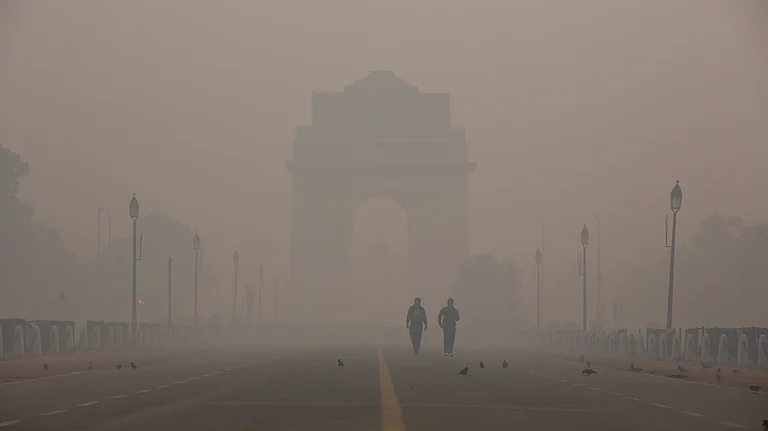
Prediction Errors Spotted
According to a recent study published by the Council on Energy, Environment and Water (CEEW), Delhi’s air pollution forecasting system under-predicts fine particulate PM2.5 levels by as much as 30-35% due to outdated emission inventories, PTI reported on October 8.
Elaborating on the incorrect predictions, Mohammad Rafiuddin, Programme Lead at the CEEW further told PTI, “If the actual PM2.5 level is 100 micrograms per cubic metre, the system reports it as around 65 micrograms per cubic metre. So, it is underpredicting PM2.5 levels.”
An emissions inventory is a database that that lists, by source, the amount of air pollutants discharged into the atmosphere over a year or other time period, according to the US Environmental Protection Agency.
Governments use these inventories to identify major pollutant sources and guide regulatory actions. These inventories are used by governments to identify the main sources of pollution and direct regulatory measures. By applying estimated emissions reductions to emissions inventory data in air quality models, the impact of possible regulatory actions on air quality can be anticipated.