India’s agriculture sector is at a critical crossroads. Climate change is no longer a distant environmental concern but is fast transitioning into a lived reality, reshaping rainfall pattern, eroding farm profitability, degrading soil health, and triggering extreme weather events with increasing frequency.
Recent catastrophes underscore the scale of the challenge: the Punjab floods submerged 4.42 lakh acres of crops and affected nearly 4 lakh people, while pest infestations destroyed 35,000 hectares of soybean along with thousands of hectares of black gram and horticulture in Belagavi, Karnataka. Such events not only cripple seasonal output but also push already vulnerable farmers deeper into financial distress.
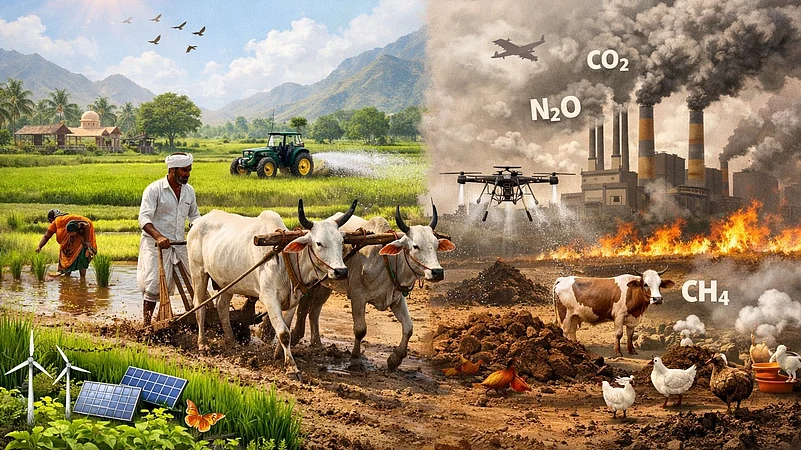
At the same time, agriculture itself contributes significantly to the problem it suffers from. Fertilizer-intensive practices release nitrous oxide; livestock management generates methane; crop residue burning leads to massive air pollution; and millions of diesel-powered pumps add to carbon emissions. Together, these factors make agriculture responsible for 14–18% of India’s total greenhouse gas emissions, placing immense pressure on a sector already struggling with climate sensitivity.

1 September 2026
Get the latest issue of Outlook Business

This dual reality - agriculture as both a victim and a contributor to climate change makes the transition to emission-free farming not merely desirable but urgent. Without decisive action, farmer incomes will shrink further, production volatility will rise, and India’s food security will face increasing instability.
Advertisement
Yet this transition should not be viewed as an environmental burden. It represents a powerful opportunity to strengthen farmer welfare, reduce production costs, modernise farming practices, improve rural health, and create new climate-linked income streams. With the right policies, technologies, and incentives, India can turn this challenge into a pathway for resilience and rural prosperity.
Here's how India can accelerate the transition to improve its agricultural sector.
Strengthening farmer income by building Climate-Resilient Farms
In India, where over 85% of farmers are small and marginal landholders highly dependent on climate-sensitive rainfed agriculture, building climate-resilient farms is crucial for securing and strengthening farmer income. Climate change poses a severe threat, with projections indicating that unadopted rainfed rice yields could reduce by up to 20% and wheat yields by 19.3% by 2050, directly threatening livelihoods.
Advertisement
The shift to climate-resilient agriculture is therefore a dual strategy, focusing on both adaptation and income enhancement. Strategies like using climate-resilient crop varieties developed under ICAR's NICRA program, adopting water conservation techniques like farm ponds, and practicing crop diversification and agroforestry significantly buffer losses from extreme weather events.
Government programs like the National Mission for Sustainable Agriculture (NMSA) and the use of Pradhan Mantri Fasal Bima Yojana (PMFBY), a yield-based crop insurance scheme, are pivotal in creating a supportive ecosystem for these resilient practices, ultimately stabilizing income and reducing the economic vulnerability of the farming community.
Use of clean and efficient technologies to modernise agriculture and reduce cost pressures
The integrated adoption of clean, efficient, and smart technologies is fundamentally transforming Indian agriculture by both reducing high input costs and unlocking significant new income streams, creating a stable, multi-income business model for farmers.
The shift begins with cost-reduction, where the use of solar pumps (e.g., under PM-KUSUM) eliminates the expensive and volatile reliance on diesel, and highly efficient drip/sprinkler irrigation conserves 30% to 70% of water, drastically cutting energy for pumping.
Furthermore, embracing biofertilizers and compost reduces dependence on costly chemical fertilisers, potentially leading to 50% fertilizer savings.
Beyond savings, these low-emission practices generate direct revenue: farmers can now monetize environmental stewardship by earning carbon credits for sustainable practices, while converting crop residue and livestock manure into biogas or organic manure creates a 'waste-to-wealth' circular economy asset.
By commanding premium prices for organic produce and reducing reliance on uncertain crop yields, clean technology ensures farming is not only more environmentally responsible but also significantly more profitable and financially resilient.

Opening New Income Streams Through Low-Emission Practices
By adopting low-emission and regenerative practices, Indian agriculture can transition from being solely dependent on unpredictable crop yields to a multi-income model. This is primarily driven by the nascent, yet growing, carbon credit market, which incentivises practices like no-till farming and methane reduction in rice cultivation, allowing farmers to generate tradable credits and unlock a new revenue stream.
The Indian government's Voluntary Carbon Market Framework (2023) is facilitating this shift, aiming to boost incomes for millions of smallholders by allowing them to monetize carbon sequestration. Concurrently, the domestic market is rewarding sustainability, with organic produce commanding significant price premiums, often ranging from 20% to over 50% in specialty retail, enabling higher profitability despite potentially lower yields.
Crucially, what was once considered waste is becoming an economic asset: crop residue (like rice straw) and livestock manure are increasingly being monetized into biogas, bio-CNG, and valuable organic manure (biofertilizer), creating a circular economy, reducing environmental pollution from stubble burning, and adding value-chain revenue to the farmer's bottom line.
Marico’s Parachute Kalpavriksha Foundation exemplifies this by bridging tradition and technology for more than 65,000 farmers covering almost 2.75 Lakh acres of plantation, halving debt burdens through scheme awareness and fostering entrepreneurial sidelines like agro tourism. It also provides services like Agri Expert on phone, Agri Business Centers (ABC), Water conservation activities by construction of farm pond, classroom training to farmers through Kalpavriksha Knowledge Centre to empower them.

Improving Rural Health by Reducing Agricultural Pollution in India
The transition to emission-free agricultural practices is a critical public health intervention for rural India, directly mitigating the severe pollution caused by traditional farming. The most visible health hazard is crop residue burning in North India, which releases massive amounts of particulate matter and toxic gases; studies show that exposure to this smoke significantly reduces lung function, with women and the elderly in rural Punjab showing a decline of 15-18% in lung function parameters during the burning season.
By enabling residue recycling through machinery and 'waste-to-wealth' conversion, clean tech eliminates this annual source of respiratory illness. Furthermore, the reliance on intensive chemical inputs has led to widespread contamination: agricultural nitrate runoff is a major concern, with groundwater samples in 56% of India's districts found to have nitrate levels exceeding safe limits (45 mg/L), predominantly due to the overuse of nitrogen-based fertilisers.
The shift to biofertilizers directly reduces this chemical exposure for both farmers and the community. Finally, replacing diesel pumps and tools with solar or electric alternatives lowers local air pollution from diesel fumes, collectively transforming the rural environment by improving air, soil, and water quality and significantly decreasing the disease burden.
The need for transition is unavoidable: climate threats are rising, farmer incomes are under pressure, and the agricultural ecosystem is becoming increasingly fragile. Accelerating the move toward emission-free agriculture is therefore not just an environmental imperative, "it is a farmer-first development strategy."
By reducing costs, increasing resilience, enabling new income sources, modernising farm practices, and improving rural health, emission-free agriculture presents a path to a more secure and prosperous future. The faster India embraces this mindset, agriculture becomes a reliable partner in the journey to Viksit Bharat – steady, resilient, and rooted in the well-being of the people who feed the nation.
(Disclaimer: This is an authored article, and the views expressed are solely those of the contributors and do not reflect the opinions of Outlook Business.)