
Netflix’s proposed acquisition of Warner Bros Discovery reflects a classic make-or-buy decision.
By internalising Warner’s assets—HBO, DC Comics and legacy franchises—Netflix recreates a bundled entertainment model.
The key risk lies in cultural integration, as an algorithm-led platform must preserve the creative autonomy and prestige value of Warner and HBO to avoid diluting the very assets it seeks to monetise.
If there is one theoretical presence hovering over Los Gatos and Burbank this month, it is Oliver Williamson. The Nobel laureate, who gave the world Transaction Cost Economics (TCE), provided the most lucid framework to understand why Netflix has agreed to acquire Warner Bros Discovery for approximately $72 billion. The acquisition announcement is not just another episode in the so-called Streaming Wars. Seen through Transaction Cost Economics, it is a textbook make-or-buy decision in a market where contracts have become too fragile and assets too specific to be left outside the firm. At the same time, this is not only a deal sheet. It is a fundamental bet on what kind of stories will get made, and who gets to make them.
From “Build” To “Buy”
For more than a decade, Netflix tried to solve its dependence on Hollywood through a build strategy. It invested heavily in originals, reduced reliance on outside studios, and turned data into an industrial process for commissioning content. That strategy created hits such as Stranger Things and Squid Game, but it could not solve a deeper problem.
Originals are powerful, yet they are not yet multi-generational franchises. According to Williamson, firms integrate when the cost and risk of transacting with others become higher than the cost of owning the asset. That is exactly what happened here. As studios pulled content back to launch their own platforms, Netflix faced uncertainty, hold-up risk, and rising licence costs on the very properties that kept people subscribed. Every contract renewal carried a latent threat.
Advertisement
The moment Warner Bros could earn more by favouring its own service, the bargaining game changed. A resource-based view augments this argument. Netflix’s advantages in technology and data are valuable, but they are imitable. What is not imitable is eighty years of cultural heritage. DC Comics, Harry Potter, Game of Thrones, and The Lord of the Rings are VRIN assets in the classic sense: valuable, rare, inimitable, and non-substituable.
1 September 2026
Get the latest issue of Outlook Business

When the cost of building a substitute for Superman is effectively infinite, the only credible strategic move is to buy the firm that owns Superman. By internalising Warner Bros, Netflix solves both problems at once. It stabilises access to inimitable intellectual property, and it removes one of the only true prestige rivals in the market, HBO.
Advertisement
Rebuilding The Bundle, Owning the Ladder
Strategically, the acquisition recreates the old cable bundle in digital form, only this time under one corporate roof. Netflix now controls the prestige channel through HBO, the blockbuster channel through the Warner Bros film slate, and the volume channel through Discovery and its own reality and genre content. The result is a self-contained ladder of worth that looks very familiar if one has studied alcobev giants such as Diageo or Pernod Ricard. Alcobev portfolios are carefully layered.
Economy brands drive volume, premium labels anchor the middle, and prestige bottles create aura and pricing power. Netflix is now in a position to do the same. Light reality shows and comfort sitcoms become the economy tier that reduces churn. Big global series, such as Stranger Things and Wednesday, become the premium anchors.
HBO occupies the prestige slot, akin to a single malt, characterized by low volume but high signaling value among critics, awards voters, and affluent segments.

The risk is equally familiar. When Ford attempted to extract synergies from Jaguar by placing luxury badges on mass-market platforms, it achieved cost savings but compromised brand meaning. Consumers eventually realised that the supposed prestige car was a dressed-up Mondeo. Tata Motors succeeded with Jaguar Land Rover precisely because it did not do that. It provided capital and distribution muscle but protected the engineering and design culture that made JLR valuable.
Netflix now faces the same fork. If it imposes a volume logic on HBO and demands twenty “good enough” shows instead of five carefully curated ones, it will dilute the very asset it has paid for. If it treats HBO, DC, and the classic Warner catalogue as a prestige house that needs autonomy, it can gradually premiumize the whole platform and justify higher average revenue per user without turning the service into a generic content warehouse.
Better Convenience, Thinner Variety
For viewers, the immediate effect will look positive. In practical terms, it is easier to pay for one subscription that includes House of the Dragon, The Sopranos, The Dark Knight, Friends, and Wednesday, all available to stream side by side. Warner Bros has struggled with debt and stop–start investment in franchises.
Under Netflix ownership, DC and Wizarding World projects are more likely to receive stable budgets and consistent world-building. Warner titles that never travelled well internationally can ride on Netflix’s global discovery engine. The costs show up at the ecosystem level. When one buyer replaces two, the marketplace for risky scripts shrinks. Mid-budget dramas that might once have had a life at HBO or as stand-alone Warner films will find it harder to secure backing.
Data-heavy commissioning tends to privilege recognisable IP and sequels. A logical outcome is a golden age of franchises, including more Batman spin-offs, Wizarding World extensions, and series set within familiar worlds, but fewer idiosyncratic shows of the kind that defined HBO in its prime. This is where the cultural integration problem becomes strategic, not merely organisational.
Netflix has been built as a technology utility that optimises for hours watched. Warner Bros is a studio that lives or dies on creative bets. If Netflix treats Warner and HBO like network nodes that must conform to a uniform algorithm, it will push out precisely the talent it needs. The history of AOL–Time Warner and AT&T–Time Warner is instructive here. In both cases, the logic of the acquirer overwhelmed the logic of the studio, and the value of the combined entity eroded.
Moreover, cinema aficionados who prefer the theatrical run and the collective euphoria in cinemas are in for disappointment, as the exhibition sector faces the sharpest pressure. For a subscription platform, the theatrical window is not the main source of value; it is a delay in releasing a subscriber acquisition asset.
Netflix has been explicit for years that long exclusive windows are not consumer-friendly. With control over the Warner slate, it can afford to treat cinemas as a marketing channel.
A short, high-profile theatrical run for a film such as The Batman becomes a billboard for the Netflix release that follows weeks later. Premium formats such as IMAX and Gold Class, which rely heavily on Hollywood tentpoles, become more vulnerable if even a portion of that slate bypasses cinemas or moves to sharply reduced windows.
The Real Test
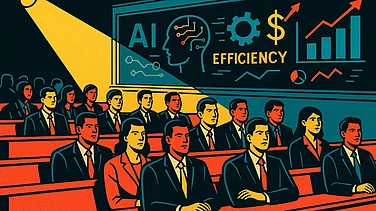
On a whiteboard, the Netflix–Warner Bros deal is a clean application of Transaction Cost Economics and the Resource-Based View. It replaces fragile contracts with firm boundaries and adds irreplaceable cultural assets to a powerful distribution engine. The strategic logic is robust. The harder part cannot be modelled as easily. Can an algorithm-led platform learn to respect a creator-led studio and not simply optimise it into sameness? Can a firm that has spent a decade mastering volume learn to live with the productive inefficiency that genuine prestige work often requires?
Dr. Kiran Mahasuar is an Assistant Professor in the Strategy Area at S.P. Jain Institute of Management and Research (SPJIMR). Views expressed are personal
(Disclaimer: This is an authored article, and the views expressed are solely those of the contributors and do not reflect the opinions of Outlook Business.)