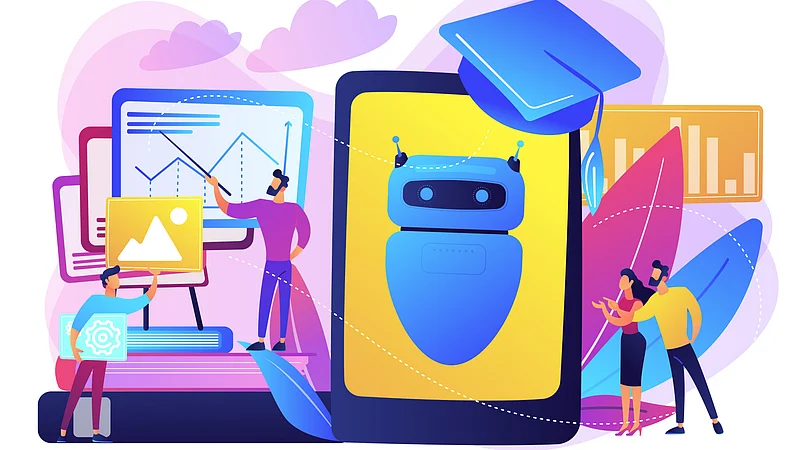

Artificial Intelligence has become an active collaborator in business classrooms.
B-schools are already using AI-powered platforms, chatbots and simulations to deliver personalised, experiential learning.
While concerns persist about over-reliance, AI enhances critical judgement by helping students question more deeply.
Artificial Intelligence (AI) has marched straight into business classrooms—not merely as a silent technological tool but as a new collaborator in the making of globally oriented and tech-driven classrooms shaping future leaders. From modelling market dynamics to curating case studies in real time, AI is a full-fledged participant. The question is no longer whether AI belongs in classrooms, but whether we know how to use it wisely.
Across B-schools, the evidence is already visible. Adaptive learning platforms are delivering personalised lesson experiences set to the learner's pace. Chatbots are addressing student queries while AI tools help complete assignments. AI-powered simulations enable students to experiment with crises, supply chain shocks, market entry strategies, pricing and product launches or marketing campaigns that evolve dynamically—the kind of experiential learning textbooks could never dream of. For an educator, this doesn't mean a loss of control, but rather a revolution in teaching. For students, it's not passive or unquestioned dependency, but engaged inquiry.
1 September 2026
Get the latest issue of Outlook Business

Yet apprehensions are loud. Critics worry that students will stop thinking for themselves—that automation will replace critical insight, deep inquiry, and intuitive analysis. They fear that instant AI-designed answers will annihilate curiosity. But management education has never been about rote knowledge. Its essence lies in critical judgement—the ability to scrutinise data, emotion, ethics and intuition, all simultaneously. AI, when used mindfully, doesn't erase that complexity; rather, it gives students the extended competency to ask better questions, uncover wider patterns, and test ideas without boundaries. In modern classrooms, AI becomes the tool that empowers learners to think both inside and around the problem, not just through it.



Advertisement
Business education stands to gain more from AI than almost any other field. Unlike technical or medical disciplines that function on fixed truths, management thrives on ambiguity—the grey zones between human intent and organisational impact. AI operates effectively there too. It can parse market data while students debate meaning and purpose—a smart collaboration. It can design ethical dilemmas while professors guide moral reasoning. The synergy is indisputable: machines handle the predictable so that humans can focus on the profound. No form of collaboration could yield greater fulfilment to humans.
Instructors, far from being replaced, are being redefined. Unshackled from mundane grading and administrative work, educators can channel their energies into what truly matters—mentoring, moderating complex debates, facilitating empathic conversations, and nurturing the reflective arguments and instincts that no algorithm can replicate. In a B-school, this shift could restore the instructor's pivotal role: not a conduit of knowledge, but a designer of wisdom that echoes beyond the classroom.
Advertisement
Assessment—the bedrock of academic credibility—is perhaps where AI raises the most discomfort. Can a machine grade creativity or ethical reasoning? Perhaps not. Objective answers, maybe. Nonetheless, it can liberate instructors to assess what matters most: the thought process behind an answer, not just its precision, enriched with lived human experience. B-schools are already experimenting with hybrid assessments—AI-assisted analytics and simulations combined with reflective discourses—that measure how students think, not merely what they produce. The result is learning that's both robust and real.
Then there's the bigger question of authenticity—the fear that AI-generated essays or projects blur the line between student agency and software output. That anxiety is real but misplaced. The future of learning isn't about gatekeeping tools; it's about strengthening ethical integrity within them. The task for B-schools is to design assignments that AI cannot do—those demanding human judgement, empathy, personal, story-driven insights, and the courage to navigate uncertainty. While AI can draft a strategy, only a human can choose not only to own a decision but shoulder the repercussions.
And perhaps most evidently, AI democratises business learning. For decades, top-notch case material, networks, and critical analytics have been the exclusive preserve of premier institutions. But today, with AI-driven systems, a learner from a small-town college can access the same insights as a student at Harvard or Princeton. That's not harmful disruption—that's empowering inclusion.

So why, then, the fear? Because AI brings into focus what education has long resisted—that intelligence is no longer defined by memory, but by the capacity to generate meaning. AI challenges both teachers and students to rethink their purpose. It asks: If the machine can summarise, can you synthesise? If it can predict, can you question? Those who can will thrive. Those who cling to old hierarchies of expertise risk irrelevance.
The vision is not to replace human intelligence with artificial intelligence, but to let the two coexist in a nexus of creative tension. When students use AI to brainstorm, critique, and imagine, they are not outsourcing thinking processes—they are expanding them.
The future business leader will not be the one who fears AI, but the one who can use it wisely as a smart companion. The sooner we embrace that in our classrooms, the better equipped we'll be for a world where intelligence—human or otherwise—is never enough on its own, but unstoppable when combined.
(Disclaimer: This is an authored article, and the views expressed are solely those of the contributors and do not reflect the opinions of Outlook Business.)