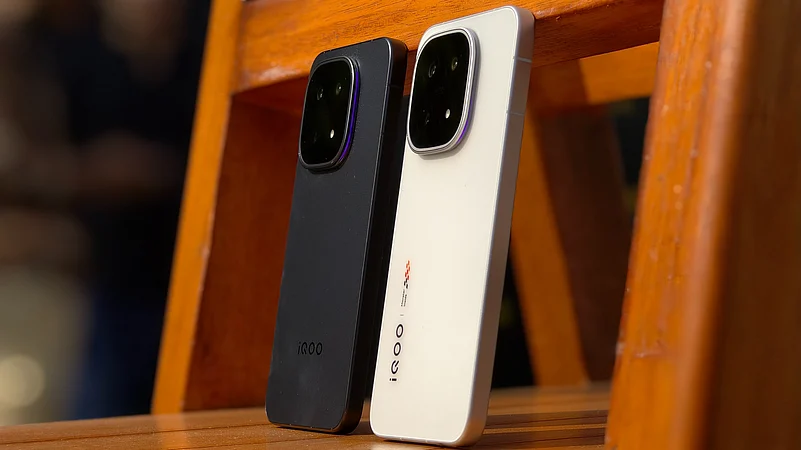

When it comes to flagship launches, some models stand out among the plethora of devices thrown at consumers. Some are instant hits, some fall flat on their head, and then there are those that deserve more time to be seen, heard, and figured out. Yes, I’m talking about the iQOO 15, a line of smartphones that was once a flagship-killer, and is now on par with other flagships. Yes, there is one big drawback, but after using the iQOO 15 for about 2 months now, I can safely say it stands tall among the likes of the Realme GT8 Pro, OnePlus 15, and others.
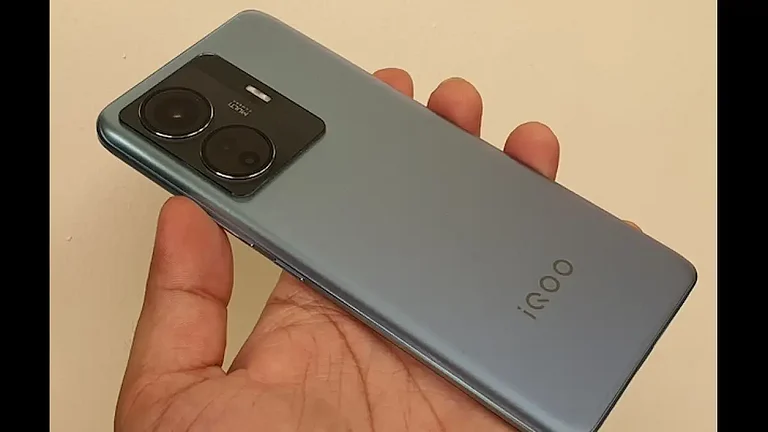
What is the iQOO 15?
The iQOO 15 features a 6.85-inch LTPO AMOLED display (Samsun’gs debut M14 2K LEAD OLED), iQOO’s in-house SuperComputing Chip Q3 (to assist the display in delivering 144p smooth fps), a 8,000mm2 single-layer vapour chamber cooling system (the largest on any smartphone in India), a massive 7,000mAh battery (though not the largest in this segment), 100W fast charging and a triple 50MP camera array.
At ₹72,999, the iQOO 15 is on par with the OnePlus 15 in terms of pricing. Yes, it may look pricey, but it does pack a punch. Let me tell you why.

1 June 2026
Get the latest issue of Outlook Business

The iQOO 15 Packs a Punch
The iQOO 15 stands out (especially over the Oppo Find X9 Series and OnePlus 15) for its clean and restrained look. It may look familiar, but with a flatter frame and rear panel, the smartphone is grippier and just a little more premium than before. There’s the Monster Halo Light, which sits below the camera module (it lights up during an incoming call or when there is a notification, and yes, there are multiple colour options in the settings).
The iQOO 15 isn’t an instant head turner, and with Legend White and Alpha Black as the only two colour options, the company is playing it safe.
The smartphone measures 8.17mm thick and weighs just 215g (the Legend White variant is ever so slightly heavier at 220g). The Legend White variant has a glass back, compared to the fibreglass panel on the Alpha Black model.
The icing on the cake, though not something flashy, is the racing flag strip near the logo on the rear panel’s bottom left-hand side. Oh, and did I mention that it is fingerprint-resistant? Yes, that’s due to the matte finish on the back.
However well the weight distribution has been handled, the iQOO 15 still feels a tad too hefty. With that said, you do get IP68 and IP69 ratings for dust and water-protection.
When you’re using your smartphone for 6-7 hours a day, it is paramount that the display be something you genuinely enjoy looking at. Thanks to the decision to use Samsung’s latest 2K M14 Lead OLED, the display stands tall. It’s got the new light-emitting material and non-polarising display technology. The display is sharp, the text is crisp and clear, the colours are accurate, and most importantly, there will be less strain on your eyes. Even under the sun, the outdoor legibility is fine.
It’s an 8T LTPO AMOLED panel, which means you’re getting a dynamic refresh rate up to 144Hz. That’s higher than the 120Hz average on Android flagships these days. It’ll be buttery smooth for graphics and animation, while you doomscroll, and battery efficiency will also be top-notch. What surprised me is that the device offers up to 6,000 nits of local peak brightness and 2,600 nits in HBM mode. As I said above, outdoor legibility isn’t a problem at all. The smartphone can handle any amount of direct sunlight. I was a bit disappointed with how the smartphone handles the brightness levels. Adaptive brightness, just like on OnePlus smartphones, failed more often than not to adjust quickly enough.
Flat-Out Performance Beast and a Battery Backup to Support It
The iQOO 15 is outfitted with Qualcomm’s latest Snapdragon 8 Elite Gen 5 chipset. For day-to-day performance, the iQOO is no slouch. It’ll run through apps like bread and butter, and can handle anything and everything you throw at it. With snappy animations, fast-loading apps, and a multitasking performer like none other, the iQOO 15 will impress in all things speed.
The Qualcomm SoC is paired with either 12GB or 16GB of LPDDR5X Ultra RAM, 256GB or 512GB UFS 4.1 storage. But it’s the vapour chamber cooling system that is essential to keeping this smartphone faster than others. This helps ensure the smartphone never overheats or has to throttle its performance.
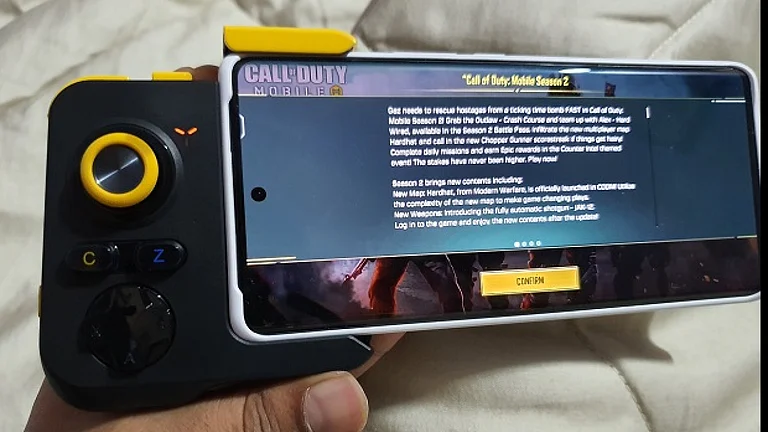
The Q3 supercomputing chip is useful for gaming. I’m not a big gamer, but even I could notice the difference here. This chip uses frame interpolation and automatically adjusts the frame rates. On the downside (or maybe it isn’t so bad), I did notice the smartphone heating up considerably after an hour of continuous gameplay.
With all that power and speed, you'd better hope the battery lasts an entire day. I’m happy to report that with a medium usage pattern, I was able to eke out about a day and a half of battery life. I consistently got over 7 hours of screen-on-time (SoT). Just as with the OnePlus 15, I was impressed by the iQOO 15's battery life. It’s a reliable, all -day performer, and you won’t need to carry your charging (or a power bank) with you.
If you ever do need to charge it, then with the 100W charger (included in the box), you’ll need a few minutes to an hour to fully charge it. The smartphone also supports 40W wireless charging. The wireless charger is also an accessory, but in India, it isn’t even being sold.
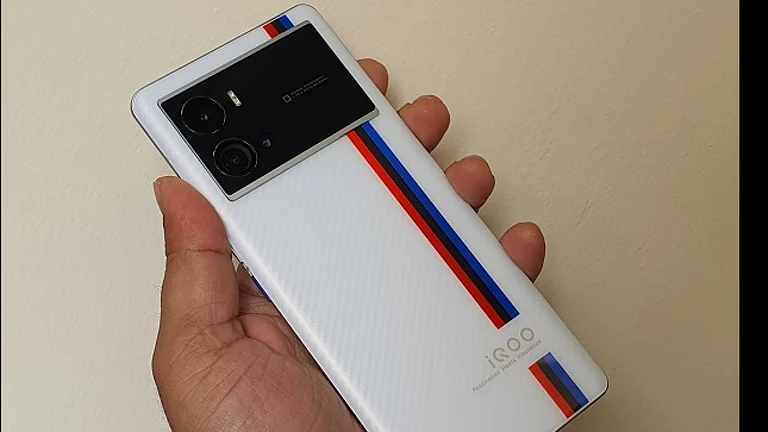
What’s the Drawback
Over the last few months, I’ve had the pleasure of testing out the latest and greatest smartphones from numerous companies competing for your hard-earned money. From Vivo to Oppo and from Google to Apple, I’ve used them all extensively. With a choice at hand, I was clearly spoilt. With that said, there is one drawback of the iQOO 15 that is holding me back from using it as my daily driver.
The simple answer to that is the camera setup. Yes, I was simply not impressed. Instead of the iQOO 15, I kept pulling out the Oppo Find X9 Pro or the Vivo X300 Pro. I even counted, and I’ve taken more photos with the OnePlus 15 than with the iQOO 15 (excluding the numerous photos I’ve taken for testing).
That isn’t to say the camera setup on the iQOO 15 is bad. Even the OnePlus 15 got a lot of flak for taking a step back in its camera performance. But with iQOO selling their most expensive smartphone to date, I expected a lot more.
The triple-camera setup just didn’t impress me. Yes, for daily use it is dependable, but for low-light scenarios, fast-moving shots, or videos longer than 15 seconds, the iQOO 15 just doesn’t cut it. I did like the periscope-style telephoto lens (last seen a couple of generations ago). There’s the 50MP Sony IMX921 primary sensor (with OIS), a 50MP ultrawide lens (the weakest of the bunch) and the 50MP IMX882 periscope (3x) telephoto lens. On the front is a 32MP selfie snapper.
iQOO claims to have improved detailing, contrast, and exposure (even in challenging lighting). While detailing, contrast, and exposure did improve in good daylight shots, that was about it. Highlights weren’t blown out, and the details were good. The problem is that in anything but good lighting, photo quality takes a hit.
It’s good that iQOO has borrowed some camera modes and filters from its parent company, Vivo (which, by the way, is doing a fantastic job with respect to its cameras). There are the Basic Styles (with B&W, Textures, Vivid and Natural filtures), and Personalised Styles as well. There’s also the Street Photography Camera (just swipe up from the bottom), which has different colour styles, some of which I was impressed by.
But then, that’s about it. Yes, there’s no spark to the photos. They simply don’t stand out. Blow them up, and you’ll notice artefacts and noise in the photos.
What the iQOO 15 gets right is in the post-processing. It maintains exposure and dynamic range while avoiding overexposure. Sometimes, though, it acts a little aggressively, and the details are crushed.
Another disappointment was the selfie camera, which sometimes even produced washed-out images.
Portrait photos, which I’m a big fan of, weren’t the best on the iQOO 15. Skin tones weren’t accurately represented, and the photos looked overly processed.
One thing I’ll commend iQOO for is that the focus lock and shutter speed were top-notch, even in low-light. While the smartphone supports 8K video (at 30fps), I wouldn’t recommend it. 4K 30fps had much better video quality.

iQOO 15: Should You Buy It?
The iQOO 15 has seen a big jump in its retail price compared to its predecessor. At ₹72,999, I wish you were getting a whole lot more. It’s hard to recommend an iQOO smartphone at this price point, especially when Oppo and Vivo (iQOO’s parent company) exist. That said, the iQOO 15 does have top-notch hardware, and if it weren’t for the cameras holding me back, I’d genuinely be recommending this smartphone to my peers. Maybe at a more aggressive price point, closer to ₹60,000, I’d have felt better.
Nonetheless, the iQOO 15 shines with its performance, battery life, understated, refined design language, and a display that performs even in the harshest outdoor conditions. I know people who have criticised the charging speeds of the iQOO 15, but honestly, one hour is just about fine, especially when I’m getting a 7,000mAh battery that easily lasts a day and then some.
The iQOO 15 is more of a gaming smartphone than one a photographer should buy. With the iQOO 15R on the horizon, maybe that’ll provide more bang for your buck than the iQOO 15.