
India's 2026 waste rules mandate four-stream segregation, but monsoons expose how poorly the system handles waste.
Nearly 95% of waste is collected, yet only half is scientifically processed—segregation, not collection, is the real gap.
The rules will succeed only if citizens trust that their segregated waste is not mixed downstream.
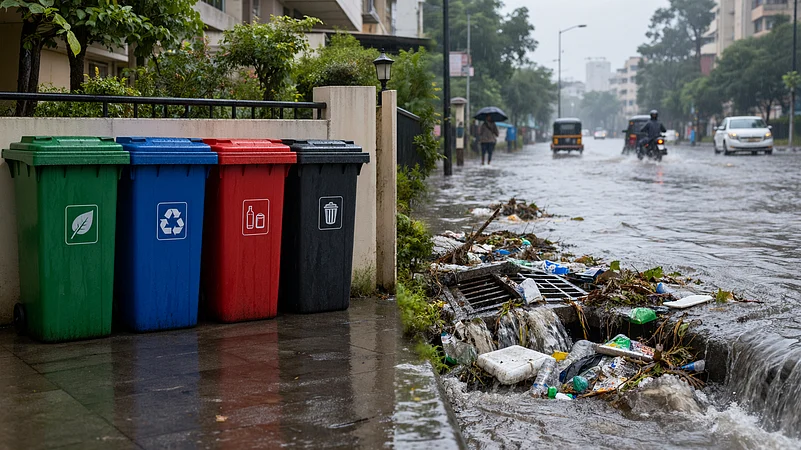
As the monsoon sweeps across India, overflowing drains, waterlogged streets and piles of uncollected waste have once again become familiar sights. Heavy rainfall often takes the blame, but the rains merely expose weaknesses that exist throughout the year. Choked drains clogged with plastic, waste spilling into waterways and overflowing dumpsites reveal a deeper problem: India's waste challenge begins long before the first showers arrive.
It is against this backdrop that India's newly notified Solid Waste Management (SWM) Rules, 2026 assume particular significance. Building on the 2016 Rules that first made segregation at source a legal obligation, the new framework mandates four-stream segregation—wet, dry, sanitary and special care waste—and introduces environmental compensation under the Polluter Pays principle for non-compliance. On paper, it is India's most ambitious waste governance reform to date.

1 September 2026
Get the latest issue of Outlook Business

The challenge is immense. India generates more than 1,70,000 tonnes of municipal solid waste every day, a figure projected to rise sharply over the coming decades.



Updating Rules Vs Changing Behaviour
Walk into any airport, school or office and colour-coded bins are now commonplace. Even so, many people still pause before throwing something away. Does a used sanitary pad go with household waste? Where should a leaking battery, a medicine strip or a paper cup lined with plastic be discarded? Updating regulations is one challenge; changing behaviour is another.
Advertisement
This distinction matters because households are not passive recipients of waste services — they are the starting point of the entire waste management chain. Every day, millions of disposal decisions are made in homes, markets and workplaces. A single banana peel in the wrong bin may appear insignificant, but multiplied across India's cities poor segregation contaminates recyclable materials, undermines composting and reduces the efficiency of downstream processing.
The consequences become especially visible during the monsoon. Rainwater passing through mixed waste generates leachate that can contaminate soil, groundwater and nearby water bodies. Saturated dumpsites become unstable, while lightweight plastics and other litter are washed into rivers, lakes and stormwater drains, worsening urban flooding. At the same time, wet conditions reduce the quality and value of recyclable materials, making recovery more difficult. The rains do not create India's waste problem — they magnify the consequences of an already overstretched system.
Advertisement
Less visible, however, is another consequence. When biodegradable waste is mixed with other waste and buried in dumpsites, it decomposes without oxygen, releasing methane, a greenhouse gas more than 80 times as potent as carbon dioxide over a 20-year period. India's waste sector contributes roughly 14.6% of the country's methane emissions, making waste management not only a sanitation challenge but also an increasingly important climate issue.
Enforcement Gaps
For decades, India's waste systems have remained largely downstream-oriented: collect waste, transport it and dump it. While collection rates have improved substantially, the quality of waste reaching processing facilities often has not. This is reflected in the numbers. Nearly 95% of municipal waste is collected, yet only around half is scientifically processed. Collection is no longer the principal bottleneck; segregation and processing are.
The 2026 Rules seek to change this by shifting the focus upstream. More than half of India's municipal waste is biodegradable. When segregated properly, wet waste can be composted or processed through biomethanation close to where it is generated, reducing transport costs, lowering dependence on landfills and recovering valuable resources. When mixed with dry waste, however, this opportunity is lost.
If India has had waste management rules for over two decades, why do landfills continue to grow?
The answer lies in implementation. Better regulations do not automatically produce better outcomes. Compliance must become practical, measurable and worthwhile—not only for municipalities but also for citizens.
Public awareness remains one of the weakest links. Most people encounter waste rules through occasional awareness campaigns or penalty notices, neither of which is sufficient to build lasting behavioural change. As households transition from three bins to four waste streams, they need clear, consistent guidance on what belongs where. Behavioural nudges, sustained communication and simple messaging will be just as important as enforcement.

Trust Matters
Trust is equally important. Many residents who diligently segregate their waste still see it emptied into the same collection vehicle. When downstream systems fail to respect upstream effort, public confidence quickly erodes. The monsoon, when waste collection systems are already under greater strain, makes such failures even more visible. Citizens cannot be expected to maintain good habits if the system appears to disregard them.
The success of the 2026 Rules will therefore depend on more than legal ambition. Municipalities need measurable targets for segregation, collection integrity, processing and landfill diversion, supported by predictable financing, effective monitoring and stronger enforcement. Equally important is investment in the last mile. Collection workers need the training, equipment and incentives to preserve segregated waste throughout the value chain, ensuring that waste separated at home remains separated until it reaches processing facilities.
Make The City Accountable
Finally, methane reduction should become an explicit objective of urban waste governance rather than an incidental co-benefit. Cities should be assessed not only on cleanliness but also on how much organic waste they divert from landfills, how much methane they avoid and how effectively they reduce the environmental risks that become most apparent during the monsoon. Doing so would strengthen accountability while opening opportunities for climate-linked finance.
India has changed public behaviour before. The Swachh Bharat Mission demonstrated that sustained communication, political commitment and visible outcomes can reshape social norms at scale. Waste segregation can follow a similar trajectory—but only if citizens see that their efforts are matched by an equally accountable system.
As another monsoon tests India's cities, it is also testing whether India's waste management system is ready for the future. The Solid Waste Management Rules, 2026 are an important step forward. But their success will not be determined in the Official Gazette. It will be determined in kitchens, collection vehicles, processing facilities and unclogged drains — and in the trust citizen place in the system every time they approach a bin.
( Pranjali Chowdhary is senior research and policy associate at the Gateway Research Foundation, while Shivang Agarwal is senior fellow at the Institute for Governance & Sustainable Development in Washington, DC. Views expressed are personal.)