
Haryalo Rajasthan improves plant survival to over ninety percent through conservation and rainfall.
Chief Minister urges households to lead water conservation as daily environmental responsibility.
State invests heavily in green economy, climate resilience and sustainable innovation ecosystems.
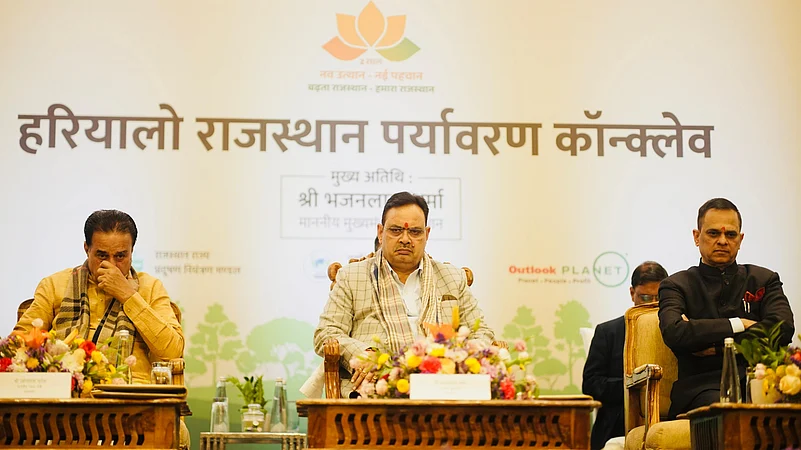
The session on “The Roadmap from Green Budget to Green Economy – 2030 and Beyond.” Hosted in Jaipur on December 18 culminated in a keynote address by Chief Minister Bhajanlal Sharma, who highlighted the State’s long-standing environmental ethos. “We need to take the initiative of water conservation seriously and we must start from homes. Under Haryalo Rajasthan, today over 90% of plants are alive in Rajasthan, contrary to the earlier 50–60%, thanks to rains and water harvesting,” he said.
In August 2024, the Rajasthan government launched Haryalo Rajasthan (Green Rajasthan) a significant environmental initiative that focusses on large-scale tree planting campaigns, urban forest creation and the use of technology such as GIS mapping via the Haryalo Rajasthan app for tracking. It is a component of the broader Mission Hariyalo Rajasthan with ambitious goals like planting 50 crore trees over a five-year period. This initiative is ongoing to make the state greener and enhance its ecology.
1 August 2026
Get the latest issue of Outlook Business

The session in Jaipur on December 18 brought together policymakers, industry leaders and sustainability experts to deliberate on climate action, renewable energy, water conservation and green infrastructure. With ₹27,854 crore allocated for sustainability-driven initiatives, the focus was on building climate-resilient ecosystems, promoting circular economy practices, and fostering innovation in climate-tech start-ups.
Advertisement
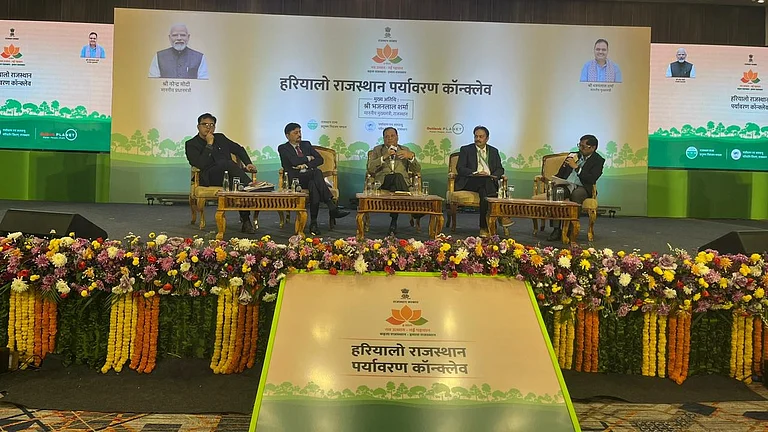
During the session, Sharma traced the roots of environmental stewardship to Rajasthan’s ancestors, noting that mountains, rivers and trees were revered as life sources. He cited historical examples, including Amrita Devi and her daughters, who laid down their lives in the 18th century in the Marwar region to protect khejri trees, underscoring that preservation of nature has always been central to the state’s culture.
Speaking government initiatives, he spoke about Vande Gange, a programme linking water conservation with river revival, and "Karmabhoomi to Matrabhoomi", which studied 40,000 regions to implement groundwater harvesting and deployed 20–25 machines across the State. The government has also invested over ₹20 crore in clean energy and water infrastructure, while prioritising plastic recycling and green start-ups to position Rajasthan as a hub for sustainable innovation.
Advertisement
“Since Rajasthan is the largest state in the nation, how can we strengthen it from the perspective of environment? We need to work on everyday activities, as it is a combined outcome of everyday tasks and not the work of one day,” Sharma added, urging citizens to make environmental responsibility a jan-andolan, or people’s movement, rather than leaving it solely to the government.
With a clear roadmap, extensive investments and citizen participation, Rajasthan aims to integrate growth with environmental conservation, setting benchmarks for India’s net-zero ambitions and ensuring a sustainable legacy for future generations.