

2025 set to become second-warmest year amid global temperature rise.
Record-breaking heat highlights accelerating climate change and greenhouse gas impact.
Extreme weather disasters signal warming trends exceeding Paris Agreement limits.
This could be the first three-year period from 2023 to 2025 could in which the average global temperature exceeded the 1.5 degrees Celsius limit above the pre-industrial period (1850-1900) when humans began burning fossil fuels on an industrial scale.
"These milestones are not abstract – they reflect the accelerating pace of climate change," Samantha Burgess, strategic lead for climate at C3S told Reuters.

1 September 2026
Get the latest issue of Outlook Business

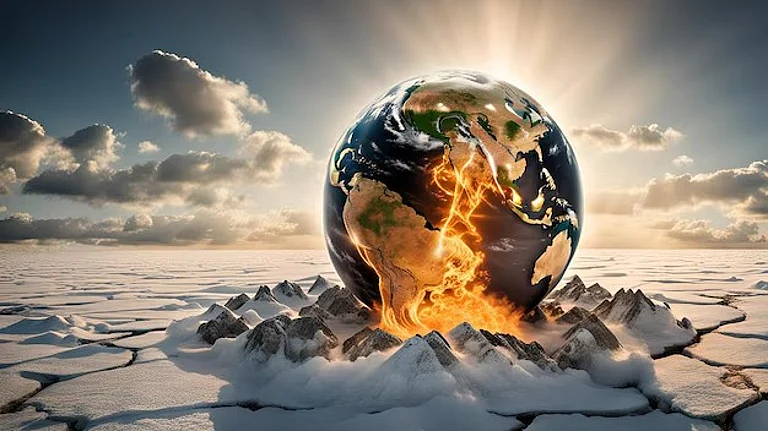
Continuing Climate Heat Streak
The sequence of record-breaking annual and monthly temperatures that started in June 2023 has some resemblance with November 2025, which emerged as the third warmest November on record.
“The global average temperature anomaly for January to November 2025 stands at 0.60 degrees Celsius above the 1991-2020 average, or 1.48 degrees Celsius above the 1850-1900 pre-industrial reference,” C3S stated. This anomaly is similar to what was observed for the entire year 2023, which was the second warmest year ever.
The World Meteorological Organisation (WMO) confirmed that the global mean near-surface temperature in 2023 was 1.45 degrees Celsius above the pre-industrial average.
Advertisement

Escalating Global Warming Trend
According to Reuters, extreme weather continued to impair the world this year. Typhoon Kalmaegi claimed over 200 lives in the Philippines last month. Spain suffered its worst wildfires for three decades because of weather conditions that scientists confirmed were made more likely by climate change.
2024 was declared as the planet’s hottest day on record. Citing scientists, Reuters reported that while natural weather patterns mean temperatures fluctuate year to year, a warming trend has been documented in global temperatures over time. Scientists have confirmed that the main cause of this warming is greenhouse gas emissions from burning fossil fuels.
Advertisement
In January 2025, the WMO confirmed that the past ten years spanning between 2015 and 2024 were the ten warmest years on record.
Despite three decades of global negotiations and implementation of Nationally Determined Contributions (NDCs) to reduce greenhouse gas emissions, countries will not prevent warming from exceeding 1.5 degrees Celsius – the main goal of the Paris Agreement brokered a decade ago. Instead, the world is on track for an extreme 2.3 - 2.5 degrees Celsius of warming, the Emissions Gap Report 2024 revealed on November 4.