India has ~200 top AI researchers compared with 3,000 in the US and 2,300 in the UK; Anandan says 10,000–15,000 are needed for global leadership.
Access to 2,000 GPUs for serious researchers could accelerate progress; India may see 1,000 venture-funded AI-native startups by year-end.
AI could bridge affordability gaps in K-12 learning and fundamentally reshape institutions like IITs, amid a widening teacher-student divide.
India must scale up its pool of top-tier AI researchers if it wants to emerge as a global leader in artificial intelligence, said Rajan Anandan, Managing Director at Peak XV Partners, at the IndiaAI Summit.
Anandan said that while the United States has around 3,000 leading AI researchers and the United Kingdom about 2,300, India has barely 200. “If we can build 10,000 to 15,000 world-class AI researchers, we win,” he said, stressing that talent density will determine leadership in the AI race.

1 September 2026
Get the latest issue of Outlook Business

He added that access to compute is equally critical. Providing 2,000 GPUs to serious researchers could significantly accelerate India’s progress. According to him, empowering researchers with both capital and compute will create the foundation for global competitiveness.
At the application layer, however, Anandan struck an optimistic note. He said India is already ahead in building native AI consumer applications and claimed that by the end of the year, the country could see nearly 1,000 venture-funded, AI-native startups.
“There is enough capital,” he said, adding that founders should focus on building products that are genuinely useful rather than chasing hype.
Advertisement
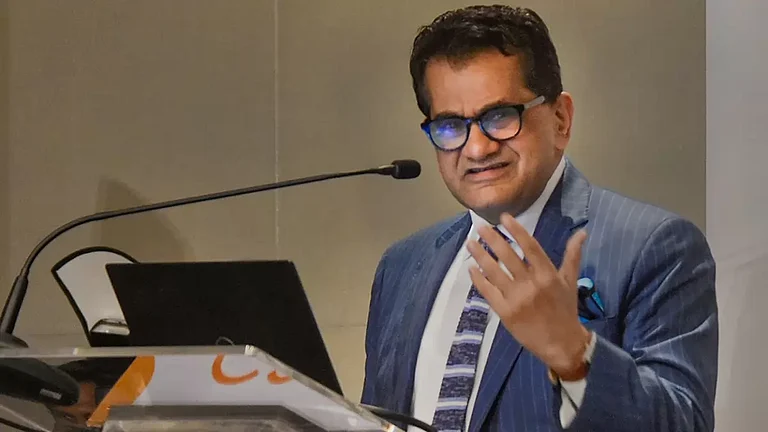
A large part of the discussion at the summit centred on education. Anandan pointed out that despite thousands of crores invested in edtech, only 30 to 50 million students paid for online education in a country with nearly 290 million K-12 learners.
Affordability remained the biggest constraint, he said, arguing that AI could finally make high-quality education accessible at scale.
The panel echoed the view that AI will fundamentally reshape classrooms, improve curiosity-driven learning, and help identify learning gaps more effectively.
Sharing the stage, Vibhu Mittal, Founder of Inflection Point Ventures, said IITs will not teach the way they do today once AI becomes deeply embedded in education.
Advertisement
He compared AI’s impact to that of the printing press, arguing that countries that fail to build their own large language models risk falling behind. AI, he said, can amplify India’s unique knowledge systems, culture and linguistic diversity, particularly in a country where a large share of the population is under 22.
Responding to Mittal’s remarks, Dharmendra Pradhan, Union Minister of Education, said he appreciated the candid reflection, noting that institutions must adapt to technological shifts rather than resist them.
With India facing a persistent teacher-student gap and the edtech sector recovering from setbacks such as the dramatic valuation crash of Byju's, the conversation signalled a broader reset.
Whether AI can deliver on the promise of affordable, high-quality education at scale remains to be seen, but at the summit, the consensus was clear: the future of India’s AI leadership will hinge on talent, compute, and classrooms.