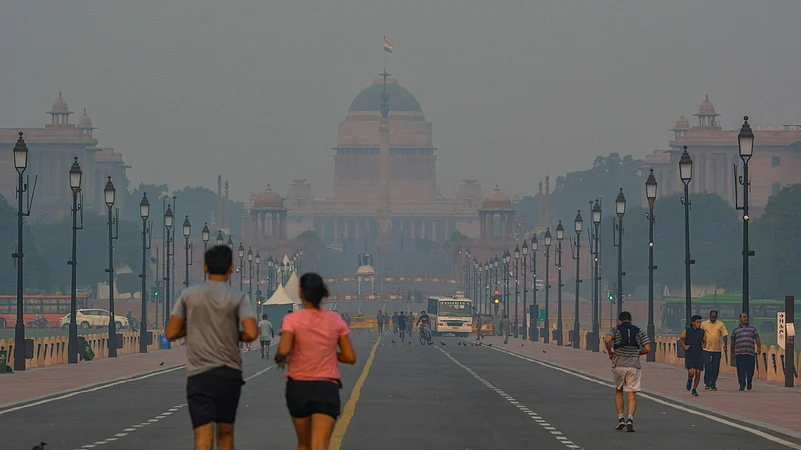

Only 15% of Indians live near real-time pollution monitors.
Over 64% of districts lack continuous air quality monitoring.
Monitoring concentrated in metros, leaving smaller towns unrepresented nationwide.
India, a country of 1.4bn people where both emissions and exposures vary dramatically across a vast and diverse geography, the monitoring network for air pollution has not kept pace with either the scale or complexity of the problem, says the 2026 State of India’s Environment report.
What percentage of India’s population is covered by pollution monitors?

1 September 2026
Get the latest issue of Outlook Business

According to the 2026 State of India’s Environment report, only 15% of India’s population – about 200mn people – live within 10 km of a continuous monitor. The remaining 85% more than 1.2bn people breathe outside any measurable range.
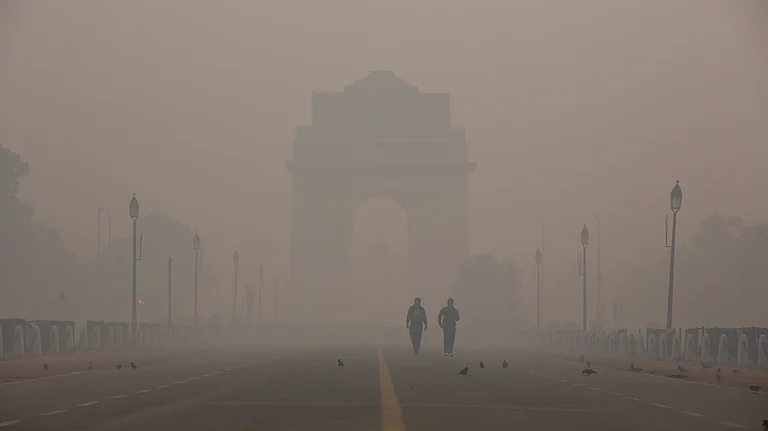
Limitations of India’s Air Quality Monitoring Network
India has two main sets of infrastructure for monitoring. The National Air Quality Monitoring Programme, launched in 1984-85, relies on manual stations that measure air quality twice a week. They offer long-term averages for a limited set of pollutants. More recently, the country has set up Continuous Air Quality Monitoring Stations, which offer real-time, hourly data across multiple pollutants.
Today, India has 562 real-time monitors across 294 cities and 966 manual stations in 419 cities and towns. Kaur points out that these impressive numbers hide the fact that monitoring is concentrated in a limited set of large cities. “Entire districts, industrial belts, and fast-growing peri-urban centres remain outside the monitoring grid,” she says.
Advertisement
Anumita Roychowdhury, Executive Director-Research and Advocacy in CSE and Head of CSE’s Sustainable Urbanisation Programmes, stated in the news release, “This gap in monitoring is not just about missing information, but also about the structural inequity in environmental governance in India. Cities with multiple monitors can demonstrate progress, claim clean air funding, and frame their action plans. But hundreds of smaller towns, many of which experience comparable or even higher levels of particulate pollution, have no real-time data at all.”
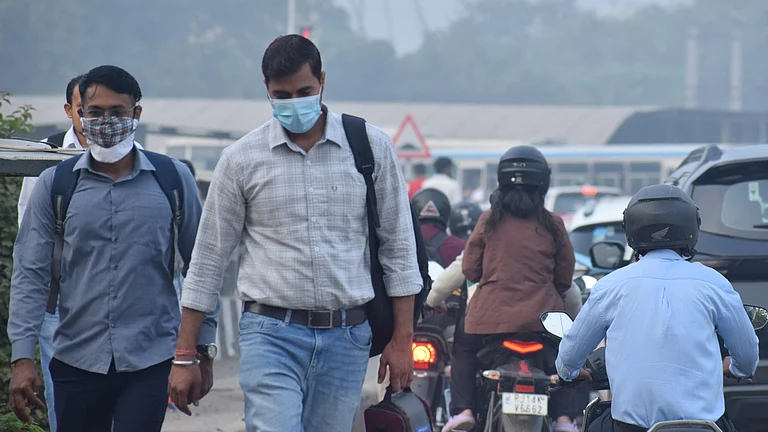
Continuous Air Quality Monitoring Stations in India
In Chandigarh, every resident lives within 10-km of a real-time monitor. Delhi comes a close second, where only 3.5% of the population is outside the measurable range. Puducherry is third best, with almost 50 per cent of its area covered.
Advertisement
Maharashtra has one of India’s largest monitoring networks, but the stations are concentrated around Mumbai, Pune and Nagpur, leaving vast areas unrepresented. In Bihar, only 13% of residents leave within a 10-km radius of a monitor; Uttar Pradesh fares worse, with just 9% of its population covered in that radius. West Bengal monitors only 19% of its population. Densely populated districts like Hooghly, Murshidabad etc., do not have a single real-time monitor.
In the northeast, only Assam boasts of a few stations. The rest of the states have only one-two stations each.
Kaur stated in the news release that “more than 64% of India’s 742 districts have no continuous monitoring at all”.