Chinese President Xi Jinping is scheduled to visit Washington from September 23-25, Beijing confirmed. Chinese Foreign Ministry Spokesperson Guo Jiakun said the two leaders would exchange views on major issues concerning both the countries and global issues.
US President Donald Trump will welcome Xi at Joint Base Andrews on Wednesday. “I’ll be discussing almost everything with him,” Trump said on Sunday.
At the heart of it is how the two leaders will approach and acknowledge the race in Artificial Intelligence (AI).

1 September 2026
Get the latest issue of Outlook Business

The rise of AI and the race toward winning the technological advancement in 21st century has replaced what the nuclear power race was in the last century.
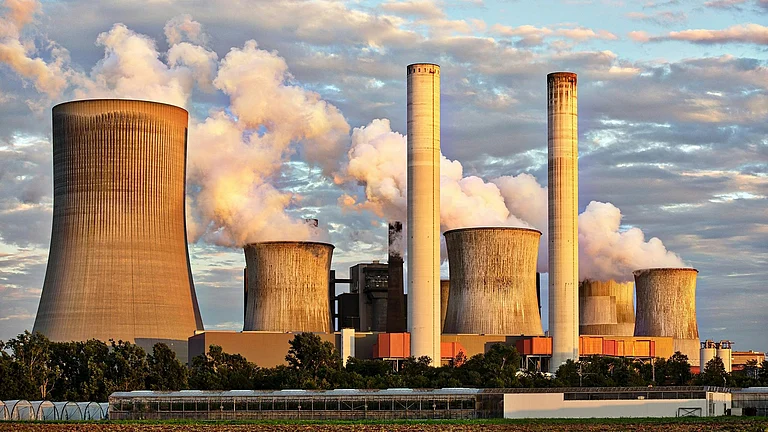



Currently five countries including the US, the UK, France, Russia and China is recognized as “nuclear power states” under the Non-Proliferation Treaty, with India, Pakistan, North Korea and Israel considered to possess nuclear weapons.
The race, spanning from the Silican Valley to Beijing mirrors a similar struggle for power in global politics and geoeconomics. Access to resources makes a state significantly powerful in comparison to its rivals, making the race, be it nuclear or AI, almost existential for a country.
Who Currently Holds the Edge?
By a minor margin, the United States possess an overall edge over the tech race, however, China is increasingly challenging it.
Advertisement
Frontier AI is backed by leading proprietary models, greater private-sector investment and stronger access to advanced semiconductor technology. Companies such as OpenAI, Anthropic and Google remain at the forefront of complex reasoning and high-end AI capabilities.
China, however, is gaining ground through open-weight models, lower-cost AI systems and rapid deployment, with companies such as DeepSeek and Moonshot narrowing the performance gap.
China also has a significant advantage in the physical infrastructure of AI, including manufacturing, industrial automation and robotics.
The AI race is therefore increasingly defined by different strengths: the US leads in frontier intelligence and capital, while China is building an edge in affordability, openness, manufacturing and large-scale deployment.
Advertisement
Why Are States Competing?
The U.S.-China AI race is more of a struggle for relative power in an international system rather than just a contest over technological.
From this perspective, advanced AI, semiconductors, data centres and robotics are dual-use strategic capabilities that can strengthen economic productivity, military power and national resilience.
Washington’s restrictions on advanced chips and efforts to preserve its lead in frontier computing can therefore are an attempt to limit the competitor’s ability to accumulate technological power.
Meanwhile, Beijing’s push for self-sufficiency, open-weight models and domestic manufacturing reflects an effort to reduce dependence on U.S.-controlled technologies.
What’s interesting to note is that the competition also extends beyond the models themselves: control over chip access and resources, computing infrastructure, supply chains, determining the relative gains from the next technological cycle.
The growing use of AI in military systems is also raising concerns over strategic stability and accidental escalation.
AI interference with nuclear command networks or military cyber operations could leave Washington or Beijing with only minutes to determine whether an incident was an attack.
As per a report by Reuters, China has incorporated AI into its existing arms-control framework, with its disarmament ambassador warning that military AI could increase miscalculation and conflict risks while stressing that weapon should remain under human control.
The US, by contrast, has no single agency overseeing AI arms control, with responsibility spread across several national-security institutions.
Yet both sides remain reluctant to impose restrictions that could slow their technological progress: Washington fears excessive constraints could benefit China, while Beijing views US technology controls as efforts to preserve American technological dominance, reports said.
AI in Warfare In A Multipolar World?
For an increasingly multipolar world, the US-China AI rivalry could accelerate the fragmentation of the global technology order.
Rather than a single, integrated AI ecosystem, countries may increasingly align with competing technological standards, supply chains, semiconductor networks and digital infrastructure.
This could give middle powers greater room to pursue technological autonomy by diversifying partnerships, but it could also raise the costs of access to cutting-edge technologies and deepen strategic dependencies.
For countries such as India, the competition creates both opportunities and pressures: they can attract investment and negotiate across competing technology ecosystems, while also facing difficult choices over data, chips, AI infrastructure and digital standards.
What’s concerning is that AI’s proliferation is already blurring the line between civilian technology and military capability.
For instance, a recent report by AP cited Anthropic as saying that Claude chatbot was used by actors in northern Yemen to develop guidance and navigation software for missile programmes, including a hypersonic glide vehicle, demonstrating how advanced AI tools can potentially accelerate weapons development beyond traditional state-led programmes.