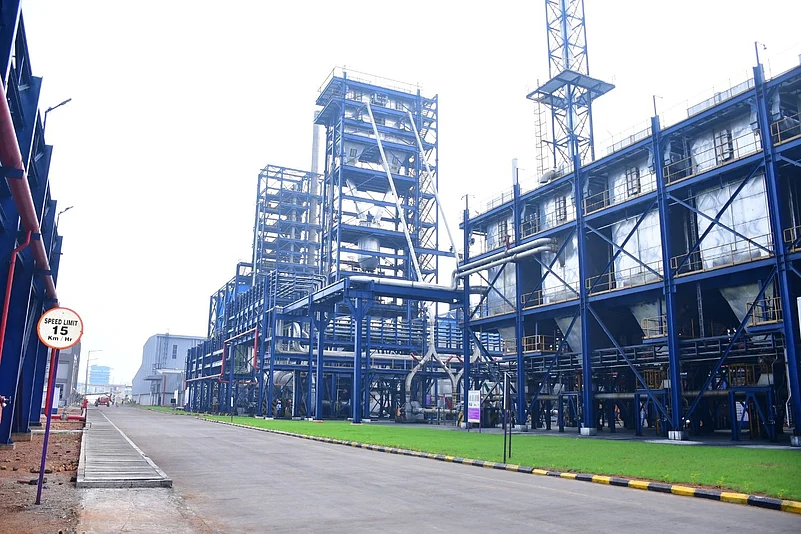
India's chemicals industry is set to outpace economic growth and expand to $230-255 billion by 2030, driven by emerging high-growth segments, according to a report by McKinsey & Company.
The sector, currently valued at $155-165 billion, is projected to grow at a compound annual rate of 8-9% despite global headwinds.
The report identified eight high-growth arenas - including semiconductors, electric vehicles and batteries, renewables, construction, aerospace and defence, auto components, bio-to-X and e-commerce - that could generate an additional $30–35 billion in demand by 2030, growing at around 16% annually.

1 September 2026
Get the latest issue of Outlook Business

Construction-linked chemicals alone are expected to double to $28 billion by 2030, supported by infrastructure and urban development.
India's chemicals sector has delivered a total shareholder return CAGR of about 17% over the past decade, outperforming global peers and benchmark indices. However, the report highlighted a $31 billion trade deficit in chemicals, particularly in inorganics and polymers, indicating significant import substitution opportunities.
To capitalise on the growth potential, the report recommended that companies scale up global operations, pursue partnerships and acquisitions, increase R&D spending, and adopt AI-led efficiencies. Strengthening supply chains and balance sheets will also be critical as the industry navigates global volatility and shifts towards value-led growth, it added.
"India's chemicals industry is entering a defining decade," said a McKinsey statement on the report.
Advertisement
The report, 'From Challenges to Possibilities: Leading India's Chemicals Industry Through Global Headwinds', projects the chemical sector "to expand from $155-165 billion today to $230-255 billion by 2030, potentially outpacing the GDP growth rate." In order to identify the next wave of growth, McKinsey research has identified 18 distinctive arenas of growth at an India level. Of these, eight select arenas could unlock $30-35 billion in incremental chemical demand by 2030.
"India's trade deficit highlights a substantial import substitution opportunity, particularly in inorganics and polymers: India's chemicals trade deficit currently stands at approximately $31 billion (2025), concentrated in inorganics ($12 billion) and polymers ($13 billion) wherein there is an opportunity to build world-scale capacities in select value chains e.g., styrene, acetic acid, polyols," it said.
Advertisement
To capture this growth, companies need strategic levers for value creation. It called for creating global operating capabilities in priority markets, institutionalising programmatic partnerships, turning innovation into a growth engine, strengthening balance sheets and building resilient supply chains.
Despite strong export growth over the past decade, India's share of global trade in chemicals remains limited at 3%, compared to China's over 20%, the European Union's more than 15%, and the United States' over 10%.
M&A intensity in Indian chemicals stands at just 0.9%, compared with the national average of 2.5%. With portfolio rationalization underway globally and asset valuations resetting in Europe, Indian firms have a window to pursue inorganic growth and technology access, the report said.
India's chemical industry invests only 0.5% of its revenue into R&D, significantly less than global peers such as Japan, the US, and the EU - presenting a critical area for enhancement.
McKinsey estimates that AI and advanced analytics could deliver 8-12% EBITDA improvements across procurement, manufacturing, and supply chain functions, without heavy capital expenditure.
"Recent disruptions, including pandemic-related shutdowns and logistics bottlenecks, underscore the need for more resilient supply chains such as distributed warehousing, regional inventory positioning, and vertical and horizontal integration or partnership arrangements," it said.
Nitika Nathani, Partner, McKinsey & Company, said the domestic demand base and geopolitical tailwinds create a meaningful opportunity to build global-scale platforms.




"However, the next phase of growth will depend on disciplined capital allocation, sharper portfolio choices, and sustained investment in innovation and operating excellence. Companies that prioritize structurally advantaged sectors and build global operating capabilities, can position the country not just as a fast-growing domestic market, but as a competitive global manufacturing hub."