West Asia conflict may trigger global sell-offs over Strait of Hormuz oil supply fears, with India particularly exposed, as per experts.
Indian equities already face a fragile start to the year.
Nifty 50 is down 3.70% YTD; Sensex has fallen 4.58%.
Experts are warning that the escalating war in West Asia could trigger broad selling across stock markets in both developed and emerging nations, as fears rise over potential disruption to oil supplies from the Strait of Hormuz. The concern is even sharper for the Indian equity market, which has already had a fragile start to the year.
Year to date, the Nifty 50 has dropped 3.70% to 25,178.65, while the Sensex has fallen 4.58% to 81,287.19. On Friday, the Nifty declined 1.54% and the Sensex fell 1.84%.

1 September 2026
Get the latest issue of Outlook Business

Much of the decline has been attributed to weakness in technology stocks, as traders and industry participants debate the impact of artificial intelligence on India’s IT sector.
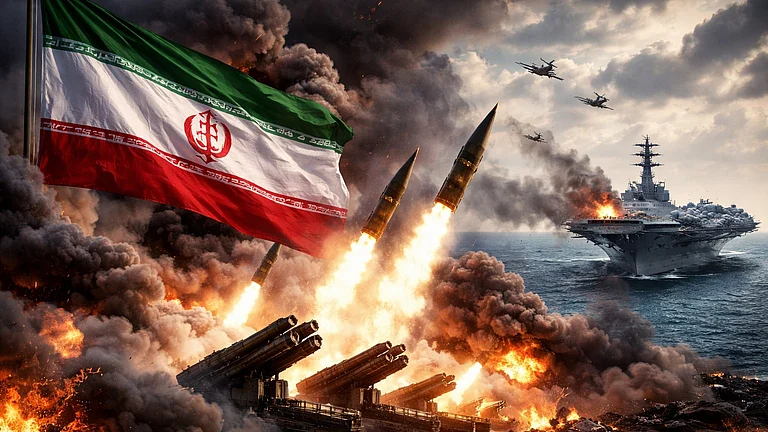

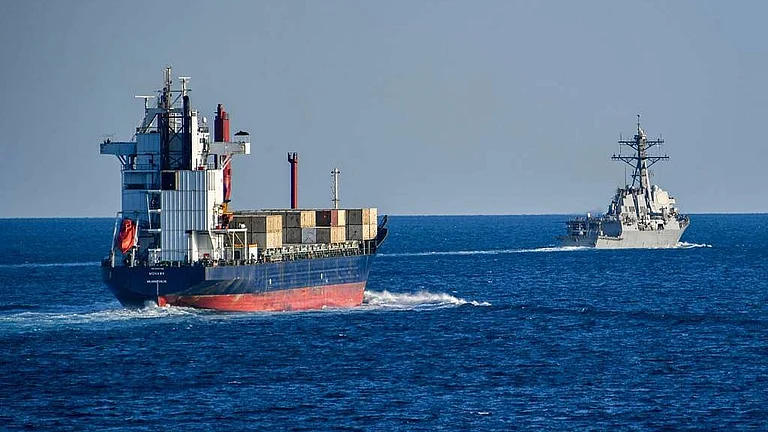

However, in the coming week, the major trigger is expected to come from West Asia, as the conflict could disrupt the Strait of Hormuz, a vital energy choke point through which about 20% of global petroleum liquids and 20% of global liquefied natural gas pass. In FY2025, about 50% of India’s crude oil and 54% of LNG imports were routed through the Strait of Hormuz.

Advertisement
Investor Fear Escalates
The conflict began after joint airstrikes by the US and Israel targeted cities across Iran late on Friday night, reportedly killing over 100 people, including the Islamic Republic’s Supreme Leader Ayatollah Ali Khamenei. In response, Iran has targeted US bases across the Gulf, including in the UAE, Qatar and Bahrain. The escalating war is expected to further dampen sentiment among global investors.
In the US, both the S&P 500 and the Nasdaq Composite ended their last trading session on 27 February in the red. In Europe, the Euronext 100 slipped 0.14% to 1,844.83, France’s CAC 40 fell 0.47% to 8,580.75, and Germany’s DAX edged down 0.019% to 25,284.26. In Asia, South Korea’s KOSPI declined 1% to 6,244.13.
Advertisement
On the flip side, Hong Kong’s Hang Seng Index rose 0.95% to 26,630.54, while mainland Chinese markets were marginally higher, with the SSE Composite Index up 0.39% and the SZSE Component Index gaining 0.06%.

Upside for Commodities
In commodities, oil prices advanced sharply, with WTI crude up 2.78% at $67.02 per barrel, Brent crude rising 2.87% to $72.87, and Murban crude climbing 4.05% to $74.24. Natural gas prices also gained 1.13% to $2.859.
On precious metals, gold and silver prices are expected to remain highly volatile, with a potential gap-up opening in the next session, according to Jateen Trivedi, VP Research Analyst – Commodity and Currency at LKP Securities.
“A sharp escalation in hostilities, with coordinated strikes and retaliatory moves, is fuelling uncertainty and diminishing hopes of a quick diplomatic resolution. This elevated geopolitical risk can drive investors towards traditional safe-haven assets like gold and silver, and we are widely expecting a gap-up opening for bullion markets,” he said.
He added that as global equities and risk assets come under pressure, capital typically shifts into precious metals, which act as a hedge against uncertainty.
“Earlier moves have already pushed gold and silver prices higher in recent sessions, and this momentum could continue if the conflict intensifies further. Energy markets are also responding, with crude oil prices rising on fears of supply disruption through key routes like the Strait of Hormuz, which further adds to risk-off sentiment and supports bullion interest. However, the impact may not be uniform, if there are diplomatic developments or indications of de-escalation over the weekend, precious metals could see profit-taking after an initial spike of 3–6%,” Trivedi added.

Key Trigger to Watch in the Coming Week
Experts have warned that a US and Israel attack on Iran would likely trigger broad selling of risky assets across both developed and emerging markets.
“We would expect the ongoing rally in US Treasuries, oil, gold and silver to extend. For India, the impact is typically magnified: higher crude oil prices widen the current account deficit, stoke domestic inflation, pressure the rupee, and could lead to FII outflows as global investors reduce risk exposure,” said Nachiketa Sawrikar, Fund Manager, Artha Bharat Global Multiplier Fund, on Saturday morning.
“The conflict in the Middle East has triggered a risk-off situation in financial markets. It remains to be seen how the conflict will evolve and impact crude and currency markets,” said Dr VK Vijayakumar, Chief Investment Strategist, Geojit Investments Limited.
On foreign institutional investment in India, he noted that investors are likely to wait and watch how the situation evolves before making further commitments in emerging markets.
FIIs were buyers on most days in February, marking a shift in their investment strategy towards India. As per NSDL data, total FPI investment through exchanges in February up to the 27th stood at ₹19,782 crore. Additionally, FPIs invested ₹2,832 crore through the primary market, taking total investment in February (up to the 27th) to ₹22,614 crore.
“There are variations in sectoral investments in February. FPIs sold heavily in IT stocks due to the Anthropic shock and the continuing weakness in the segment. However, they were buyers in financial services and capital goods,” said Dr Vijayakumar.
He added that improved GDP growth in India and bright prospects for corporate earnings in FY27 augur well for FII flows.
“Large-cap valuations are fair, warranting investment. AI-triggered disruptions in the IT industry have created a loss of confidence in IT stocks, resulting in significant selling in the segment. Money is moving towards financials, capital goods and automobiles,” he said.