US–Israel strikes on Iran trigger regional conflict disrupting key Indian trade routes.
Hormuz and Bab-el-Mandeb chokepoints threaten 56% of India’s export corridor.
Rerouted shipping may add 15–20 days, raising freight, insurance and oil prices.
Potential closure of Hormuz risks choking 35–50% of India’s crude imports.
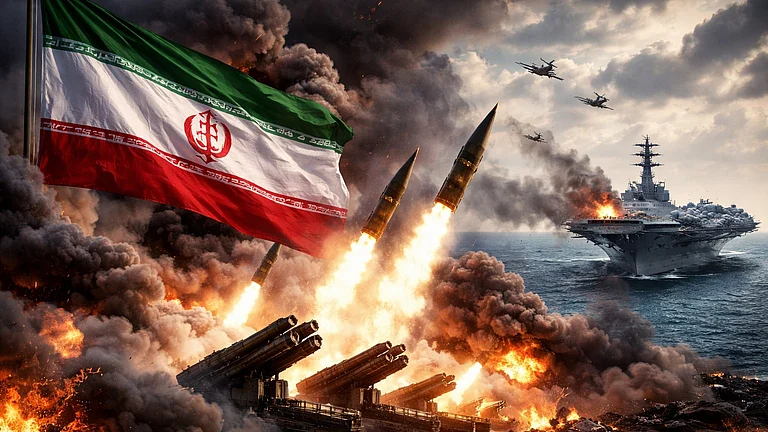
It began, as these things often do, with the sound of missiles. On the last Saturday of February 2026, the United States and Israel launched coordinated military strikes on Iran — a move that had been feared for years but still managed to shock the world when it finally came.
Tehran didn't take it quietly. Within hours, drones and missiles were flying in all directions, hitting American military installations dotted across the Gulf — in Qatar, Kuwait, and the UAE. Dubai, the region's commercial centrepiece, also came under attack.

1 October 2026
Get the latest issue of Outlook Business

In New Delhi, the Commerce Ministry didn't wait around. A high-level meeting was convened for Monday, pulling together exporters, shipping lines, freight forwarders, and officials from across.

How India is Exposed?
The geography alone telling enough why India is exposed. Two waterways sit at the heart of this crisis: the Strait of Hormuz and the Bab-el-Mandeb Strait. Between them, they form the corridor through which Indian goods travel to the Gulf, North America, and Europe. Together, those three markets absorb roughly 56% of India's merchandise exports — nearly $244bn worth of goods annually.
Advertisement
Anything that disrupts those sea lanes doesn't just inconvenience exporters; it hits the very engine of the country's trade. And disruption is already under way.
Air routes are being rerouted. Insurance premiums are climbing. Freight rates, which had actually been contracting at the start of 2026, are set to be revised upward when major shipping lines publish their new monthly rates.
SC Ralhan, president of the Federation of Indian Export Organisations, has been candid about the situation — if ships are forced to abandon the Red Sea route and swing around Africa via the Cape of Good Hope, transit times to Europe and the United States stretch by 15 to 20 days.


Advertisement
That's not a minor inconvenience; it's a logistical headache that compounds costs at every stage of the supply chain. Crude oil is where the pain becomes most acute. Iran has reportedly moved to close the Strait of Hormuz to shipping — a move that, if sustained, would choke off somewhere between 35 and 50 per cent of India's crude oil imports.
Iraq, Saudi Arabia, the UAE and Qatar all route oil through those waters. The Global Trade Research Initiative warn that oil prices could surge to anywhere upto $100 a barrel, directly widening India's import bill and stoking domestic inflation at a time when the economy can ill afford it. Indian exporters remember what happened last time.
A study from Atlas Institute of International Affairs shows between 2023 and 2025, the Israel-Hamas conflict pushed freight rates sharply higher and forced ships off the Red Sea entirely. Back then, though, the tensions stayed relatively contained. This time, nobody is making that assumption. What makes 2026 different is the scale of involvement. Four countries — the US, Israel, Iran, and, by proximity, the UAE — are now directly caught up in it.
The ripple effects are spreading fast, and Indian businesses that export everything from leather goods to pharmaceuticals are watching the situation with undisguised anxiety. The next few weeks will tell us just how long India can hold its breath.
[With inputs from PTI]