₹28,748cr incentives disbursed under PLI; 836 applications approved.
Cumulative investments hit ₹2.16 lakh cr; exports up ₹8.3 lakh cr.
Electronics leads with 146% mobile output growth since FY21.
Strong gains across pharma, autos, telecom, textiles and solar PV.
The government has disbursed a total incentive of ₹28,748 crore and approved 836 applications across 14 sectors as of December 31, 2025 under the Production Linked Incentive (PLI) Scheme. In a statement, the commerce ministry called it an indication of sustained momentum in investment inflows, production expansion, export growth and employment generation across targeted sectors.
The ministry informed that cumulative investments under the scheme exceeded ₹2.16 lakh crore and sales stood at ₹20.41 lakh crore. Furthermore, it has recorded a total exports growth of ₹8.3 lakh crore with generating 4.39 lakh direct and indirect jobs.

1 September 2026
Get the latest issue of Outlook Business

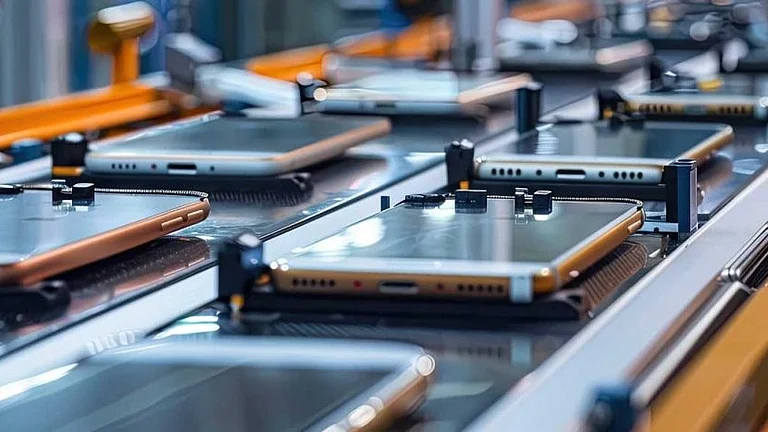
The government announced PLI schemes for 14 sectors with an outlay of ₹1.97 lakh crore in 2021. Out of 14 sectors, Electronics, particularly mobile manufacturing, has been the biggest success, with production rising 146% from ₹2.13 lakh crore in FY21 to ₹5.25 lakh crore in FY25.
The statement said that mobile phone imports have declined by nearly 77% since FY 2020–21, while over 99% of domestic demand is now met through local production. Manufacturing has expanded beyond assembly to include printed circuit board assemblies, batteries, camera and display modules, enclosures and other critical sub-assemblies, enabling deeper integration with global value chains, it added.
Advertisement
Gains Across Sectors
The government highlighted significant progress in several other sectors, including pharmaceuticals and medical devices, automobiles and advanced automotive technology, telecom and networking products, food processing, white goods, textiles and solar PV modules.
Under the pharmaceuticals PLI, India has achieved first-time domestic manufacturing of 191 bulk drugs, enabling import substitution worth ₹1,785 crore and raising domestic value addition to 83.7%. The scheme has also accelerated indigenous development of biosimilars, monoclonal antibodies and new chemical entities, strengthening export competitiveness and supply chain resilience. Local manufacturing of medical devices—ranging from imaging systems to implants and diagnostic equipment—has reduced import dependence through adoption of globally benchmarked quality systems.
Advertisement
In the automotive sector, investments have been catalysed in electric mobility, power electronics and advanced safety systems. Reported sales under the scheme touched ₹32,879 crore in FY26, indicating early momentum in technology-led manufacturing and supplier ecosystem development.
Telecom and networking product sales have grown six-fold over the base year (FY20), with exports touching ₹21,033 crore. A major milestone has been BSNL deploying India’s indigenous end-to-end 4G technology stack, placing India among a limited group of nations with full domestic capabilities.


In food processing, PLI-linked projects have attracted more than ₹9,200 crore in investments. Adoption of advanced technologies—such as ARBBM spice-processing systems, Tetra Recart packaging and automated seafood-processing equipment—has improved efficiency, quality and export-readiness.
In white goods, domestic manufacturing has begun for key components including compressors, motors, copper tubes and LED drivers. Domestic value addition is expected to rise to 75–80% by 2028–29, strengthening India’s component ecosystem.
The textiles PLI has driven a shift towards high-value man-made fibre and technical textile products, supported by integrated logistics and scale manufacturing at PM MITRA Parks.
In renewable energy, PLI Tranches I and II target 48 GW of fully integrated solar PV manufacturing capacity, backed by nearly ₹52,942 crore in investment commitments—significantly reducing import dependence in the solar ecosystem.