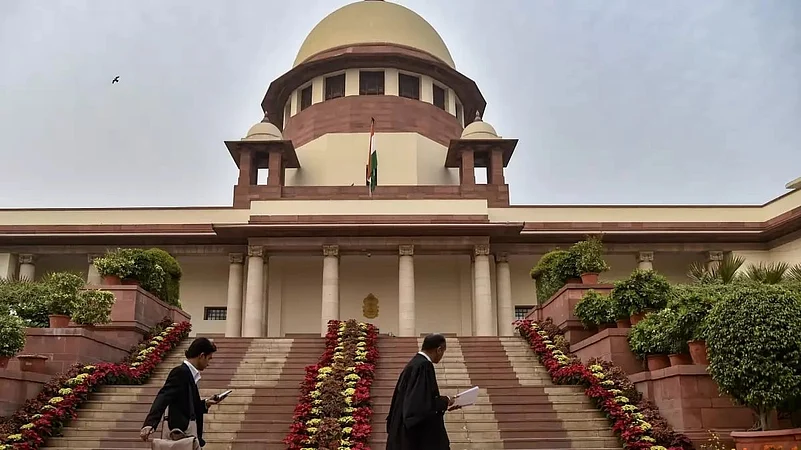

The Supreme Court ruled that telecom spectrum is public property and cannot be transferred under the Insolvency and Bankruptcy Code.
The verdict came in the Aircel insolvency case, where lenders had argued spectrum rights should move to a new buyer.
The court said insolvency law cannot override telecom regulations, as spectrum remains under government control.
In a major ruling, the Supreme Court has held that telecom spectrum cannot be treated like a regular company asset during bankruptcy proceedings.
The judgment came in the long-running insolvency dispute involving the now defunct telecom operator Aircel, its subsidiary Aircel Cellular and Dishnet Wireless. The case centred on whether telecom companies going through insolvency can transfer their spectrum to a new buyer under a resolution plan.

1 September 2026
Get the latest issue of Outlook Business

The above mentioned companies had voluntarily entered the insolvency process under Section 10 of the Insolvency and Bankruptcy (IBC). They had received telecom licences in 2006 under Unified Access Service Licence (UASL) agreements and later bought spectrum through government auctions.




During the insolvency process, the right to use this spectrum was treated as one of the company's assets.

The apex court has now ruled in favour of the Department of Telecommunications (DoT), making it clear that spectrum is a public resource and does not belong to private companies.
Advertisement
A bench led by Justice PS Narasimha and Justice Atul Chandurkar said spectrum is a limited and valuable national resource and described it as "material resource of the community", Bar and Bench reported. Because it belongs to the public, its ownership and control must remain with the government for the benefit of citizens. The court added that the IBC cannot be used to change who controls or owns such a resource.
This comes as the National Company Law Appellate Tribunal (NCLAT) in 2021 had said spectrum could be transferred only after clearing government dues. This order was challenged before the SC by the Centre and lenders, including an SBI-led committee of creditors.
Advertisement

Lenders had argued that the right to use spectrum is an intangible asset, similar to other company assets, and should be transferred to a successful bidder under the IBC process. However, the government maintained that spectrum is only given on licence and remains under state control. If dues are unpaid, it must revert to the government.
Notably, the court broke its judgment into three parts; first, it explained the legal nature of spectrum. Secondly, it identified the key legal questions and lastly, it examined how insolvency law interacts with telecom regulations.
The bench concluded that spectrum cannot be treated like normal corporate property. Since it is allocated through auction but ultimately remains a public resource, insolvency law cannot override telecom laws governing it.