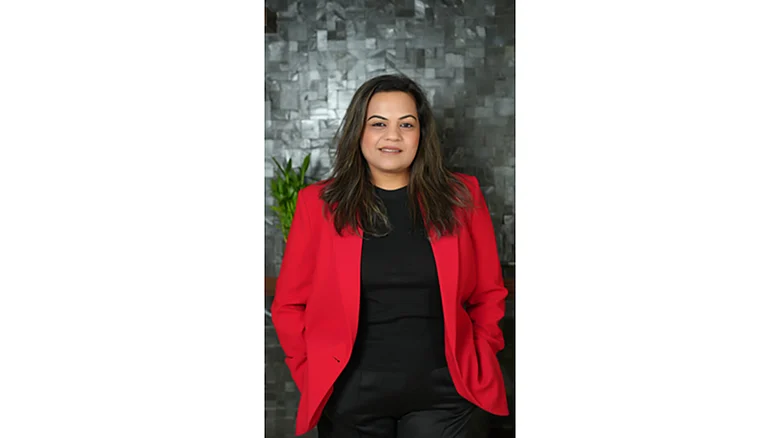

Views workspace design as an experience-driven responsibility that shapes employees’ daily lives and productivity.
Built IndiQube on the idea of flexible office infrastructure, a model that gained strong validation after the pandemic.
Believes business success ultimately depends on fundamentals such as unit economics, scale, and operational discipline rather than gender narratives.
Encourages women entrepreneurs to think bigger, stay connected to their careers through life stages, and build enduring institutions.
In an interaction with Outlook Business for International Women's Day, Meghna Agarwal of IndiQube reflects on building and scaling a flexible workspace company while navigating entrepreneurship and family life. She speaks about the responsibility of designing workplaces that shape employees’ daily experiences, why flexibility in office infrastructure became even more relevant after the pandemic, and the importance of focusing on business fundamentals such as scale, unit economics, and execution.
Agarwal also discusses funding bias, career interruptions many women face during motherhood, and why clarity, continuity, and ambition are essential for women who want to build enduring companies rather than simply participate in the ecosystem.

1 October 2026
Get the latest issue of Outlook Business

As a woman who has built and scaled IndiQube, do you feel a different sense of responsibility when it comes to creating spaces where people work every day?
I don’t think of it as a “woman” responsibility, honestly. I think of it as a founder’s responsibility. But yes, maybe there is a certain sensitivity that comes naturally.
For me, creating a workspace is not just about tables and chairs. It is about how someone feels when they enter. Do they feel welcomed? Do they feel safe? Is the space functional? Is it clean? Is it thoughtful? These things matter a lot to me. When you are building offices for thousands of employees, you are indirectly impacting their daily life. They spend more time in the office than at home sometimes. So the responsibility is not small. It is about lighting, hygiene, music, layout, accessibility, even how the reception greets someone. These small details define experience. I don’t consciously say that I am doing this as a woman. But I do believe women are often naturally more detail-oriented and sensitive to the environment. That might reflect in the way spaces are designed and maintained.
At the end of the day, though, business fundamentals still matter. The space has to make financial sense. The model has to scale. The operations have to be tight. Experience without execution will not survive. So yes, there is responsibility. But more than being a woman leader, it is about being clear about the kind of organization and experience you want to build.
Advertisement
Post-Covid, what surprised you most about how enterprises behaved once office spaces reopened?
First, Covid was challenging, but it was not like we faced insurmountable obstacles. We knew it was a temporary phase. What was more disturbing during Covid was the narrative being built that offices would not exist anymore, that everyone would permanently work from home. We knew this narrative was wrong. Like with schools people said online education would take over. But school is not just about education; it’s about social needs, collaboration, team building. The same applies to offices. Even if it’s hybrid, offices will exist.
During Covid, there was a lot of technology hiring. Companies were literally giving BMWs as joining bonuses. We have a recruitment arm, so we had first-hand data. We knew companies had hired double the workforce compared to the office space they had. Even during Covid, we were collecting 85-90% of our rent because 85% of our clients had more than 300 seats. So we knew they would not leave us. Post-Covid, demand came back with vengeance. Pre-Covid, Bangalore absorbed 15-18 million sq ft. Post-Covid, it absorbed 20–22 million sq ft. This year, it will be close to 100 million sq ft, a record. It was not surprising to us. It validated our thesis. IndiQube was built on flexibility not just co-working, but flexibility in office space like Airbnb did for homes or Uber did for transport. The more uncertainty in the world be it Covid, tariffs, wars or whatever, despite that the more flexibility grows. Companies don’t want to put capex into fixed offices. So our thesis came true. It was more validating than surprising.
Advertisement
As a woman entrepreneur in this industry, what challenges did you face?
I think we give too much importance to the “woman” aspect. Once you go public, you are not a woman instead you are a number. If I deliver, I deliver. If I don’t, I get dumped. There is no love there.The challenges I faced were business challenges like educating the market about flexibility, scaling from one building to 100+, ensuring consistent experience, tech, team ramp-up, fundraising, capital efficiency.
Even if gender bias happened, it never registered in my mind. I never think like that.
If a man had built the same business, would it have received more recognition?
There are male-led competitors in this industry. If they propagate more on social media, that’s their choice. I don’t know how chest-thumping helps business. It may help personal branding, but does it translate into business? I’m not sure.
My focus is clear on business growth and scale.
However, one concern I have with women entrepreneurs is that we don’t think big enough. We think small, stay in our cocoon, and focus too much on male-female narratives. Men think big and talk big and sometimes they do small things. Women often execute big but don’t think they’re thinking big. If women think scale, funding will follow. Yes, bias exists. But if the model is right, unit economics are right, TAM is large and you will get funded.
Do female entrepreneurs bring a unique perspective to consumer businesses?
Yes, especially in products like hygiene or athleisure. For example, in a hygiene startup I invested in (husband-wife founders), the woman brought the sensitive perspective on why hygiene matters for women’s health long-term. That improves the product. If you are designing sports bras and you are a woman, you understand the consumer better. But that doesn’t automatically give an edge. Business fundamentals still matter be it unit economics, TAM, moat. Gender alone doesn’t give an advantage.
What about funding disparities?
Yes, bias exists. 200% it exists.
I personally invested in a female-led company called Autocracy Machinery, phenomenal product. But I have not seen two identical companies, one male-led and one female-led where the male got funding only because he was male.
Bias is there. But if fundamentals are strong, funding eventually comes. Even in my BD team, only 25% are women because BD is 24/7, 365 days. Many women prioritize family responsibilities, small kids, aging parents, and pregnancy. This builds bias over time. But fundamentally, business quality matters most.
75% of working women face a 1-2 year career setback after maternity. What should be done?
This is a genuine problem. No matter how advanced we become, as of now women are the ones who give birth. It’s not like men can do that, obviously. Once you give birth, your newborn definitely needs you for that one to two years, and your body also needs recovery time. So this is a very real issue.
Yes, many women do experience a setback of one or two years. I think one important thing is to take a sabbatical for a few months, but not leave completely. Coming back after total detachment becomes difficult because inertia sets in. Instead, continue in some form even two to four hours in a hybrid model. Many companies are very supportive today. Government policies also provide support, and if you are good at your job, companies are willing to accommodate hybrid arrangements.
Continuity is very important. At different life stages be it marriage, aging parents, pregnancy, continuity can be at risk. But even during a sabbatical, you should keep upskilling yourself. I am also a mother of two, and both my pregnancies were very tough. I was bedridden. I could have chosen to give up completely and focus only on raising my children. But I chose to stay connected to my professional world, no matter how hard it was. Clarity is also extremely important. Are you working to build a career, or just to keep yourself busy? When you have clarity that you want a career, you communicate that to your professional ecosystem. You tell them you may be away for a few months but you will return. You ask them to keep you updated. You stay engaged. There will be stages where personal life takes priority. For example, today I am working from home because of unfortunate personal commitments . But I am still working, I am doing this interview and attending meetings. Similarly, when I was on a roadshow for three months, I prioritized work while my child stayed at home.
So it is about communication, prioritization, clarity, and continuity. In today’s world, being born a woman is actually a boon compared to earlier times. There is more support, more policies, and more awareness. But ultimately, you must decide what you want and stay connected to your professional life instead of giving it up completely.
How did you balance entrepreneurship and family life?
There is no work-life balance. You navigate both. Like I said earlier,iIt’s about clarity. I was clear about the life I wanted. Coming from a small town background, I could have ended up very differently. But I chose consciously. When you are clear, 50% of the problem is solved. Then you prioritize based on life stage. When I got married, I took a short sabbatical. During tough pregnancies, I prioritized health. During scaling and roadshows, I prioritized work. It’s not a sacrifice, it's a conscious choice.
When you look ahead, what kind of legacy do you want to build not just as a founder, but as a woman who chose to think big?
I don’t think too much about legacy in a dramatic way. For me, it is about building something meaningful and sustainable. If I can create an organization that scales, that stands the test of time, and that gives opportunities to thousands of people, that itself is a legacy. Coming from a small town, with no business background, no corporate exposure in the family, reaching here itself shows what clarity and persistence can do. If that story inspires even a few women to think bigger, to not limit themselves, that is enough. I want IndiQube to be known as a strong institution and not a startup that came and went, but a company that changed how offices are consumed in India. And personally, if people say that she did not complain, she did not blame circumstances, she just kept building, that is good enough for me.
At the end of the day, it is not about being a woman founder. It is about being a serious founder. And serious founders build serious businesses.