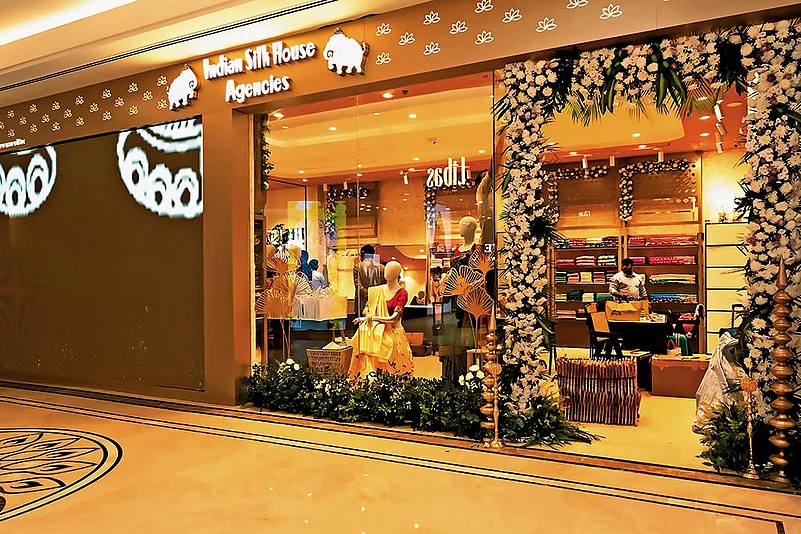
The story begins in Kolkata with Sumati Chand Samsukha, who in 1971 opened Indian Silk House, a saree shop. Over time the modest showroom would become a trusted household name. In those days textile retail was fragmented and opaque; Samsukha built his business on simple but radical principles: quality, fair pricing and transparency with customers about what they were buying and where it came from.
Later as Samsukha’s sons—Dilip Kumar and Tarun Kumar—joined him, the business grew. Soon a new showroom was opened on Rashbehari Avenue, adding “Agencies” to the name. The location serving south Kolkata’s growing urban and upscale population quickly became a landmark for silk sarees.
In 1998, the Rashbehari showroom passed into the hands of Pratibha Dudhoria, Samsukha’s daughter. Known across Bengal as Pratibha di and affectionately as Pruaji in Banaras, she became the brand’s emotional and operational anchor.

1 October 2026
Get the latest issue of Outlook Business

“She learned everything from my grandfather when she was just 13,” says Darshan Dudhoria, chief executive of Indian Silk House Agencies, of his mother. “Understanding artisans, understanding weaving, understanding why you don’t turn yourself into a polyester mill, that came from her.”
Under Pratibha’s leadership, Indian Silk House Agencies expanded steadily. New stores were opened both in Kolkata (Maniktala, New Market and Gorabazar) and other towns in West Bengal (Barasat, Purulia and Malda). The company would also branch outside its home state: to New Delhi, Lucknow, Patna and Raipur.
Even as the saree market became increasingly price-driven and synthetic-heavy, the brand resisted shortcuts. Sarees were once rooted in pride and emotion, but are now often reduced to commodities, rues Darshan. This makes the brand’s long-running fight about protecting their meaning as much as selling them.

Back to the Roots
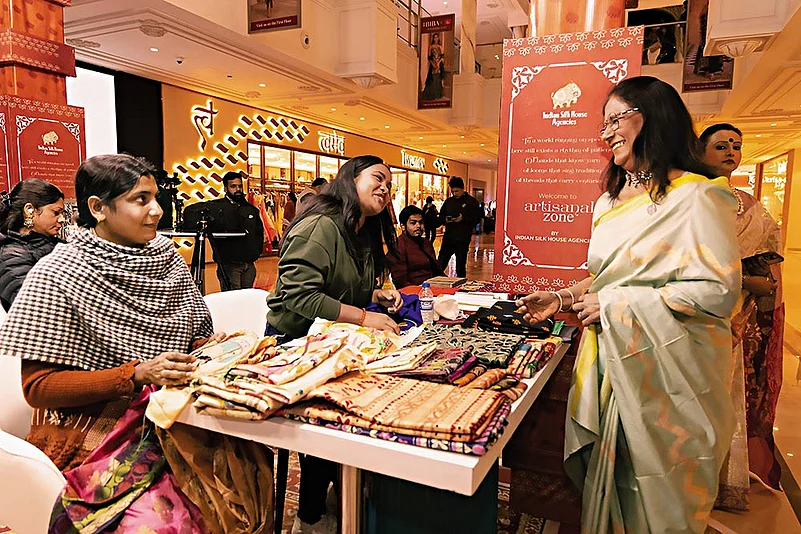
On a September afternoon in Delhi, Tajkira Begum, from Kalna a small town in West Bengal stood inside the bustling Indian Silk House Agencies store at Chandni Chowk. It was her first visit to Delhi, and the journey from her village to the heart of India’s capital felt both thrilling and daunting.
Until then, her life had revolved around looms, threads and the intricate patterns of kantha-stitch embroidery, an art she practiced daily, sustaining herself and the families of the women she employed.
Accompanying her were her two children, a reminder of the personal stake intertwined with her craft. The trip had been fully arranged and funded by Indian Silk House Agencies, part of the brand’s ongoing effort to support artisans within their 5,000-strong network. Though she was an independent artisan, not an employee, the opportunity to showcase her work in Delhi was recognition of both her skill and the livelihoods she helped uphold in her village.
Inside the store, she conducted a live demonstration of kantha-stitch embroidery, carefully explaining the process, the patterns and the tradition. Curious customers gathered, watching the slow, deliberate motions of her fingers transform threads into art. For many, it was a first glimpse into the world of rural artisans, the hands and stories behind the silk sarees that fill urban stores.
“When artisans are brought face to face with customers, the relationship with craft changes. People begin to see a saree not as a product, but as labour, skill and living tradition,” says Rta Kapur Chishti, former chairperson of the Crafts Council of India.
Moments like these—artisans connecting to metropolitan markets—capture what Indian Silk House Agencies is all about, says Darshan. They also explain why, even after 54 years, the business still feels urgent: the joy, he adds, is in scaling with technology without losing the artisanal soul.
An Heir Returns
Darshan Dudhoria did not grow up dreaming of running a saree business. Trained as a corporate lawyer in London, he imagined a very different future. “I always thought I’d do something else,” he admits. “Politics, maybe.”
But legacy has a way of calling. In 2014, he returned to India and joined the family business armed with spreadsheets, strategy frameworks and a professional outsider’s lens.
What he found surprised him. There wasn’t a single computer in the business. Billing, sourcing and accounts were all handled manually, and his early suggestions to digitise were met with disbelief, as if he were proposing to replace sarees with robots.
That first computer installation became a quiet but decisive turning point.
Over the next decade, Indian Silk House Agencies underwent a transformation few heritage retailers manage. From manual ledgers, it moved to deep-technology systems, AI-driven inventory planning and data-backed sourcing without losing its artisanal core.
In 2015, Darshan launched the brand’s e-commerce arm, allsilks.com. Scepticism was high. Who, after all, would buy a ₹30,000 Banarasi saree online? The answer, it turned out, was plenty of people. In its first year, with a three-member team and no prior tech expertise, the platform clocked ₹3 crore in sales, serving customers in the US and beyond.
He says the team had no formal technology background; they simply knew that success would depend on telling the product’s story honestly.
That belief paid off again during the pandemic. As physical retail stalled, Indian Silk House Agencies’ e-commerce revenues grew fourfold, driven by trust built over decades.
Today, the brand works with over 15,000 artisans across 62 weaving clusters, offering more than 15,000 handloom designs spanning Banarasi, Kanjivaram, Baluchari, Tussar, Chanderi and contemporary silk blends. It operates close to 60 stores across 51 cities in 12 states and plans to open nearly 400 stores in the next four years.
The challenge, Darshan says, is not expansion instead it’s integrity. While legacy businesses must evolve to survive, change without values is its own kind of failure.
That philosophy has led to unusual initiatives: exchange old sarees for discounts and donate them to tribal communities; revive dormant looms in villages where 98 out of 100 handlooms had fallen silent; take artisans to metros so customers can see the hands behind the fabric.
Warp and Weft
Darshan’s worldview shifted decisively during extended stays in Murshidabad, his ancestral region once responsible for nearly 5% of the world’s GDP during the Mughal era. There, spreadsheets gave way to slower, longer-term thinking.
“When someone tells you, ‘My daughter went to school because of this’ [employment at Indian Silk House Agencies] it changes you,” he says. “Excel doesn’t measure that.”
This belief also shaped his restoration of Bari Kothi, a 250-year-old ancestral property transformed into East India’s first grand heritage hotel, creating livelihoods for over 150 local families.
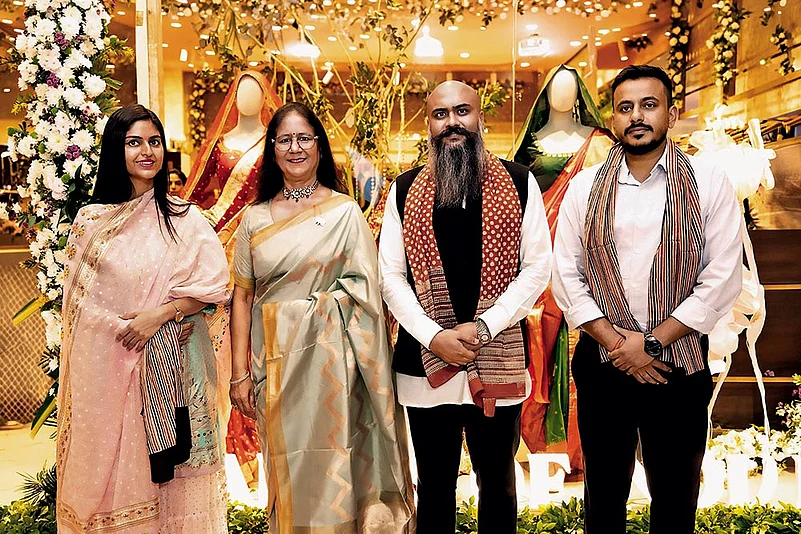
Indian Silk House Agencies today is a women-led, omnichannel retailer straddling heritage and modernity. Its leadership Pratibha, father (Sudip) ), his sister (Lipika) and Darshan continue to steer it as a family-run enterprise, with plans to bring in independent directors as it institutionalises further.
Yet, for all its ambition, the brand’s purpose remains grounded. “My grandfather was doing in his time what Amazon does today; connecting makers to consumers,” Darshan says. “The tools have changed. The intent hasn’t.”
As Indian Silk House Agencies carry sarees into new cities and new generations, its enduring strength lies in something far older than retail strategy: the belief that craft, when respected, can outlast time.