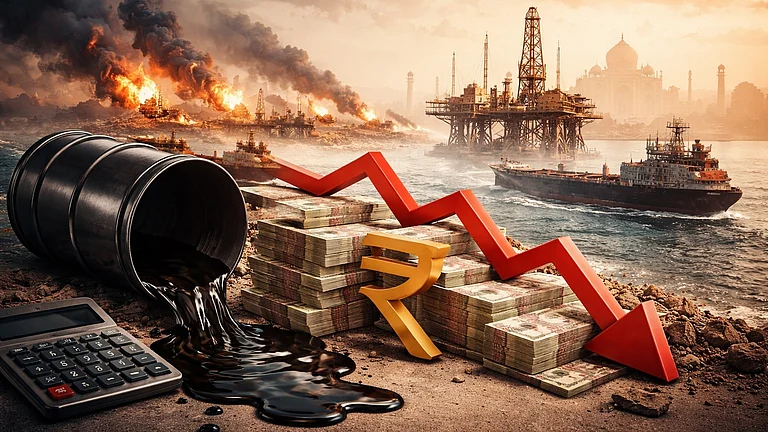
Crude oil prices fell a little over 2 per cent to Rs 8,396 per barrel in futures trade on Friday amid signs of a potential US-Iran agreement and easing geopolitical tensions dampening fears of prolonged supply disruptions.
Crude prices for May delivery decreased by Rs 180, or 2.1 per cent, to Rs 8,396 per barrel on the Multi Commodity Exchange.
"Crude futures declined after US President Donald Trump expressed optimism over a potential agreement with Iran, easing concerns over prolonged supply disruptions," Kaveri More, Commodity - Technical Research at Choice Broking, said.

1 October 2026
Get the latest issue of Outlook Business

Trump indicated that Tehran may accept terms, including abandoning nuclear ambitions, reopening the Strait of Hormuz, and offering "free oil," though there has been no official confirmation from Iran.
In the international market, oil futures remained below USD 100 per barrel as investors turned hopeful about a near-term resolution to the conflict in West Asia.
West Texas Intermediate (WTI) for the May contract fell 1.02 per cent to USD 93.72 per barrel on NYMEX, while Brent oil for the June contract dipped nearly 1 per cent to USD 98.41 per barrel in New York.
More said that additional pressure on crude prices came after a 10-day ceasefire between Israel and Lebanon was announced, reducing immediate geopolitical risks.

Advertisement
On the outlook, she said the short-term trend remains pressured, with price action largely driven by ongoing geopolitical updates.
However, investors remain cautious as the Strait of Hormuz continues to remain effectively closed under a dual blockade, while concerns persist after International Energy Agency Executive Director Fatih Birol warned that restoring disrupted oil and gas output could take up to two years.
Birol described the ongoing conflict as "the greatest energy security threat in history," noting that global oil production would drop by 13 million barrels per day, more than double the amount that was lost during major oil crises in 1973 and 1979.
Advertisement
He added that the shortfall in gas supply has compounded the shock, making the crisis more severe than the European energy disruption following Russia's invasion of Ukraine.