
Supreme Court to hear Aravalli definition case on December 29, bench of three judges.
Revised definition may expose nearly 50% of Aravalli Hills, risking mining entry.
New mining leases paused until Management Plan for Sustainable Mining is finalised.
Amid ecological concerns over the recent redefinition of the Aravalli Hills, the Supreme Court took suo motu cognisance of the matter on December 27, 2025 and decided to hear it on December 29, according to the Live Law website.
The matter would be heard by a bench comprising three judges, Chief Justice of India Surya Kant, Justice J K Maheshwari and Justice A G Masih. In a judgment on November 20, the court accepted the recommendations of a committee of the Ministry of Environment, Forest and Climate Change, defining the ‘Aravalli Hills’ as any landform with an elevation of 100 m or more above the local relief and an ‘Aravalli Range’ as a collection of two or more such hills within 500 m from each other.

1 October 2026
Get the latest issue of Outlook Business

“Any landform located in the Aravalli districts, having an elevation of 100 metres or more from the local relief, shall be termed as Aravalli Hills... The entire landform lying within the area enclosed by such lowest contour, whether actual or extended notionally, together with the hill, its supporting slopes and associated landforms irrespective of their gradient, shall be deemed to constitute part of the Aravalli Hills,” the court had agreed with the Ministry panel.
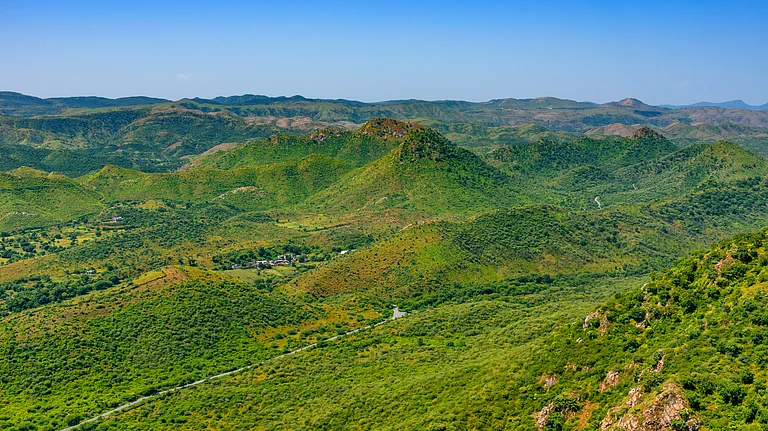
The panel further defined the Aravalli Range as, “Two or more Aravalli Hills, located within a proximity of 500 metres from each other, measured from the outermost point on the boundary of the lowest contour line on either side, shall constitute the Aravalli Range”.
Advertisement
A Down To Earth report revealed that nearly 50% of the Aravalli hills would be exposed if the accepted definition is applied, with most of the impacted area in Rajasthan. In addition, the report stated that it opens a backdoor entry for mining of critical strategic and atomic minerals. These environmental concerns intersect with mining policy, as parts of the Aravalli region contain minerals governed by special legal provisions.

Mining Implications and Policy
These atomic minerals are notified in the First Schedule of Mines and Minerals (Development and Regulation) Act (MMDR Act, 1957). This exception is recommended considering their strategic and defence significance and national security considerations and the fact that they are critical for overall economic growth and development, according to the central government committee’s report.
Advertisement
The report mentions the clause of ‘No new mining leases be granted’. This effectively pauses the granting of new mining leases until guidelines under the Management Plan for Sustainable Mining are finalised.