There are two ways to think about what a company stands for. For a shareholder, the easy answer is profit. Companies need to reward shareholders, invest, hire people, pay taxes, and the economy benefits along the way. The harder path for a company is to put a larger national purpose first and treat profit as what makes that purpose possible.
This is one of the debates at the centre of the public feud in the nearly $300bn Tata group, which has built its identity on pairing profit with a larger national purpose over more than a century. What’s unusual about Tata Sons is that it is majority-owned by philanthropic trusts, privately held and sits above a group of independently run companies.
Senior advocate Harish Salve, who is advising Tata Sons chairman N Chandrasekaran, has argued that the commerce and charity must be seen separately. Tata Sons and its companies work for maximum returns to shareholders, while charity is pursued by the Trusts.

1 September 2026
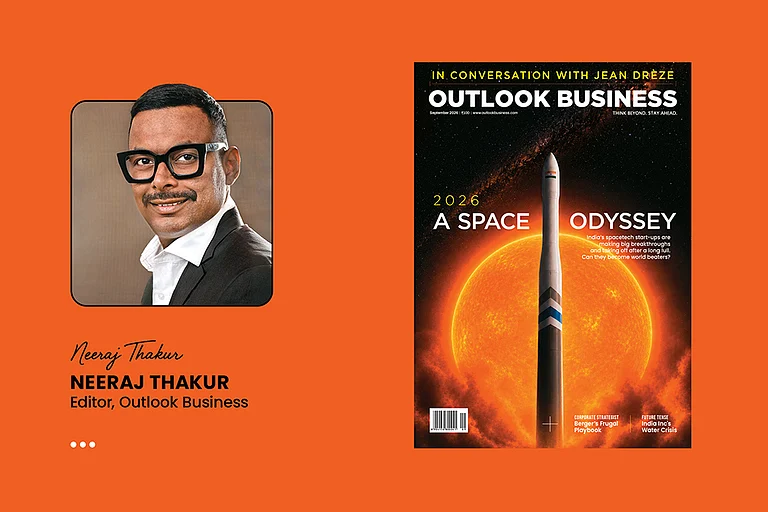
Get the latest issue of Outlook Business

Countering that view, Abhishek Manu Singhvi, the counsel for Tata Trusts, contends that the two functions form a “hyphenated relationship” that cannot be isolated from one another.
Our story “Trust Issues” traces how that tension has exposed the fault lines in Tata's century-old ownership structure.
The trigger of the fracas was the issue of listing Tata Sons publicly. As the Tata group has grown larger and more central to India’s economic ambitions from semiconductors to energy, the government has grown increasingly conscious of the risks of leaving its apex holding company private. And many within the storied conglomerate echo the sentiment.
They are not wrong. India saw the danger of opacity with the crisis at IL&FS, whose sprawling network made it difficult to see where risks were building before its collapse sent shockwaves through the Indian financial system.
The House of Tata is too big to fail, and every precaution must be taken to set guardrails against any such possibility.
The Tata question is, at its heart, a classic tug-of-war over corporate control that often roils businesses—big or small. Should the promoters or top management keep a tight leash on everything? Or must they devolve their powers and divest their stakes?
There are no easy answers. What makes sense at one point can become untenable at another; different times and circumstances demand different strokes.
Meanwhile, our cover story ‘Remaking of Hero’ on the country’s largest two-wheeler maker, Hero MotoCorp, looks at that challenge of control from a different perspective.
Hero’s 40% hold on India’s two-wheeler market a decade ago has now narrowed to 28%. Even though the company’s strength lies in commuter motorcycles, the country’s landscape is changing.
Premium motorcycles are growing as incomes rise, as are scooters while India urbanises and electric vehicles as the shift to clean mobility gathers pace. Exports have also become a bigger opportunity. So, Hero has chosen to decentralise.
It has created four independent business units around these, with dedicated leaders and resources. The point is to give each growth business a leader who owns the strategy and answers for the results.
Tata and Hero are dealing with different problems but both raise a similar question: as companies grow, where should power sit and who should be accountable for the decisions that follow?
Moving away from the corporate world, our new section “The Face-Off” provides a space to incisive scholarly voices to debate burning economic issues.