


When global innovation finds home in Bengaluru and Karnataka, it scales for the world, said Chief Minister Siddaramaiah late last year, setting the tone for what the next technological decade is going to look like for the state.
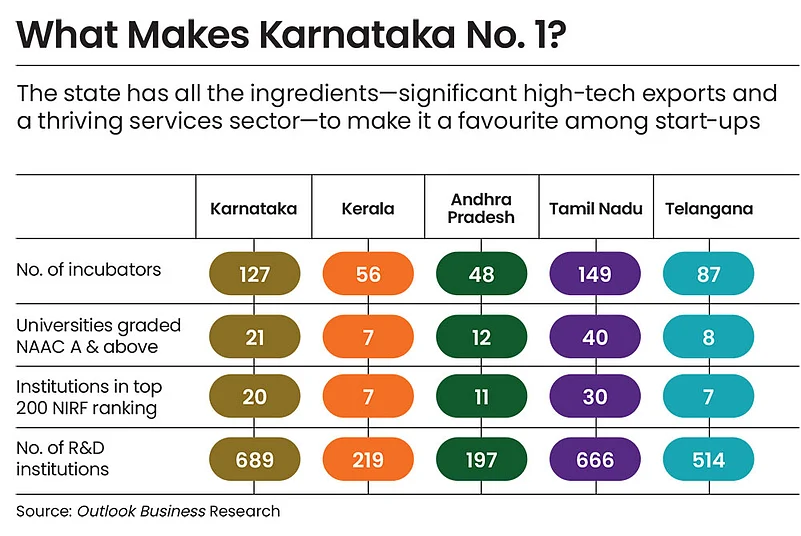
Karnataka is already a favourite among start-ups, given its position as the country’s top information technology (IT) software hub. And, once again, it clinches the top spot in the Outlook Business Outperformers 2026 rankings. With its dominance in software exports and global IT services, the state secures an overall score of 83.3 and first place among peers for starting up.
Now, the state has made a clarion call to become an IT hardware hub too. Of course, this shift won't be easy. But Karnataka has all the ingredients—significant high-tech exports and a thriving services sector—to make it happen.

1 September 2026
Get the latest issue of Outlook Business

As India pushes into electronics manufacturing, electric vehicles (EVs) and semiconductors, the state is positioning itself as the nerve centre of design, engineering and systems integration. This is also a competitive response.
“This is a conscious choice. Karnataka is not trying to compete on who can offer the cheapest factory floor. Historically, manufacturing has followed where design decisions are made, because that’s where long-term value gets anchored,” says BV Naidu, chairman of the Karnataka Digital Economy Mission.
Design Dominance
Karnataka accounts for roughly 10% of India’s electronics production and commands about 40% of the country’s electronic design activity, along with nearly half of all electronic product companies.
The state is also home to more than 100 fabless chip-design firms, making it India’s largest hub for semiconductor design.
“Karnataka’s dominance is less visible in factory counts and more embedded in IP [intellectual property],” says Ashok Chandak, president of the India Electronics & Semiconductor Association (IESA), an industry body. “Design capability is what anchors long-term manufacturing decisions.”
Global chipmakers such as Intel, Qualcomm, AMD and Broadcom have operated design centres in Bengaluru for years. Over the past decade, that talent has spilled into start-ups working on niche IP blocks, analog chips and AI accelerators. Now, to back its design strength, Karnataka is building infrastructure for outsourced semiconductor assembly and test (OSAT) and chip-tooling.
State officials say that the design-led approach is deliberate. Semiconductors, they point out, are a long game. While fabs are critical, they are also capital-intensive and largely irreversible bets. “For us, success is a steady expansion of OSAT capacity, equipment suppliers and design-led start-ups choosing to scale within the state,” says Naidu.
Still, industry veterans caution against overselling. “Design scales faster than fabs,” says Pankaj Mohindroo, chairman of IESA. “A chip fab is a 20–30–year commitment. What it is doing right is building an ecosystem that makes such a commitment plausible in the future,” he adds.
That same design-first logic underpins Karnataka’s push into electric mobility with the state now home to more than 45 EV start-ups. Naidu puts it bluntly: “These are design- and engineering-intensive layers, and that’s where Karnataka has scale. Assembly can move, but systems capability tends to stay where the engineering talent is.”
Several firms are developing motor controllers, inverters and thermal-management systems locally, even if final vehicle assembly happens elsewhere. “An EV today is closer to a computer on wheels than a traditional automobile,” says Tarun Mehta, co-founder of EV manufacturer Ather Energy. “That plays directly to Bengaluru’s strengths.”
Though Karnataka does not yet match its competitors in manufacturing volume, it is offering a design-to-manufacturing proximity. But labour costs are higher and logistics advantages favour coastal states.

Winning Strategy
Karnataka’s pitch is that complex electronics benefit more from engineering depth than cheap assembly labour. At the core is talent density—specialised engineers who understand how software, electronics and mechanical systems interact.
However, there are real risks like execution lag. Investor summits generate deals, but converting them into factories, supply chains and jobs takes years. There is also the danger of getting stuck in the 'design-only' layer, capturing intellectual value but not enough jobs or export volume.
At the Invest Karnataka summit, US-based semiconductor equipment maker Lam Research announced a $1.2bn investment in semiconductor equipment manufacturing and R&D, showing confidence in India’s chip ambitions. Also, the state has earmarked land for electronics and semiconductor clusters near Mysuru and Tumakuru to woo companies.
If Karnataka succeeds, the payoff could be substantial. In a decade, it could anchor a significant semiconductor and EV ecosystem—with an end-to-end capability.
And it seems that Siddaramaiah is willing to get aboard this train of the whole is greater than the sum of its parts and shape Karnataka into more than a state that houses India’s IT capital.


