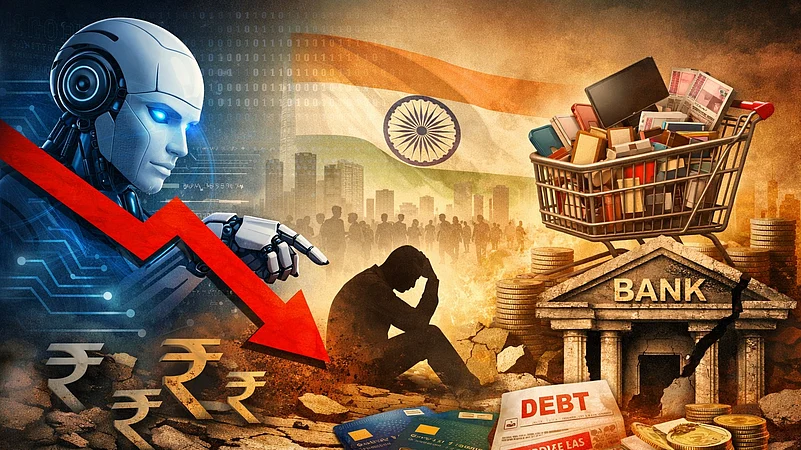

AI-driven disruption is already slowing hiring and wage growth in India’s key employment sectors
Consumption is increasingly being sustained by credit, not income, raising financial system risks
Without broad-based wage growth, inequality could widen and undermine India’s consumption-led growth story
There was much jubilation around India hosting the AI Impact Summit in New Delhi, with the Narendra Modi government presenting the event as evidence of India leading the world through the transformative AI transition. It was as much a display of economic ambition as of political confidence.
Yet Chief Economic Adviser V Anantha Nageswaran made a different kind of headline, warning that “for India it is a stress test of our state capacity,” and that “we risk widening inequality at precisely the moment of greatest change.”

1 September 2026
Get the latest issue of Outlook Business

The government’s top economist has reason to worry. The IT industry, long the entry point for India’s middle class into stable, upwardly mobile lives, is already showing signs of strain.
Employee cost growth in the Indian IT industry has fallen sharply, from 19% year-on-year in 2022–23 to just 5% in 2024–25, according to a study by CareEdge Ratings, a rating agency in India. This marks a clear break from the 15% annual average recorded between 2018–19 and 2022–23.
“The lower employee cost in the IT sector seems to be a combination of weak salary growth and muted headcounts,” noted the study.
Advertisement
The slowdown matters because the sector remains one of the largest employers in the organised non-financial economy, directly employing around 5.8 million people, according to NASSCOM, roughly 1.7 times the central government’s workforce of 3.5 million.
Given how the Indian IT and services sector is integrated into the global economy, economists point out that the initial impact of AI is likely to be a decline in projects outsourced to India.
“Some of this is already visible, with fewer projects flowing into Indian firms, leading to job losses, particularly in roles that can be automated,” says Nitin Bharti, an economist and researcher specialising in wealth inequality, education and development in South Asia.
Advertisement
Bharti echoes the concern expressed by Nageswaran, arguing that the benefits of AI’s productivity boom will be concentrated at the top of India’s income and wealth pyramid.
“The top 0.1%, those controlling major platforms, networks and intellectual property, will continue to consolidate wealth. There may be some redistribution within the upper tier, with the top 1–2% gaining access to scalable digital assets such as startups, creator platforms and algorithmic trading. Beyond this, overall wealth inequality is likely to widen,” Bharti explains.
Not just the IT sector, experts believe AI is set to take a heavy toll on employment opportunities for the young workforce, particularly those relying on entry-level roles across sales, customer support, software development and marketing, among others.
“We believe AI’s most significant impact for investors will be through labour disruption, beginning with entry-level roles,” noted Jefferies, a US-based multinational investment bank, in a 2025 study.
On Borrowed Time
Even before AI became the defining theme across economies, job creation and real wage growth in India had already begun to lag behind rising aspirations. According to Naukri JobSpeak Index data, job growth, which averaged 11% annually between 2009-10 and 2019-20, has slowed sharply to just 3% in the post-pandemic period.
A separate analysis by Marcellus Investment Managers, examining wages at Nifty 50 companies, the country’s largest firms by market capitalisation, finds that average wages have declined in real terms over the past nine years, after adjusting for inflation.
Ironically, even as the government celebrates the shift of household savings from bank deposits to equity markets, corporate India has not reciprocated with stronger wage growth, leaving banks to bridge the gap by extending credit to sustain consumption.
This has, in turn, led to a rise in debt-fuelled consumption in India. According to the RBI’s Financial Stability Report (FSR), retail credit, excluding mortgages, has surged, nearly trebling since March 2019.
An increasing share of this borrowing is being used to finance consumption rather than the creation of productive assets, altering the risk profile of the banking sector itself. Non-housing retail loans now account for 55% of household borrowings, while housing loans lag at 29%.
This should worry those betting on India’s consumption story. Because with AI poised to disrupt the labour market, economists believe real wage growth could weaken further.
“If you look at countries in East Asia like Japan or Korea that have very rapidly falling populations, people say, well, that is okay. There will be all these retired people and nobody working, but we will just get robots,” said James A Robinson, co-winner of the 2024 Nobel Prize in Economics, in an earlier interview with Outlook Business.
“That is what is frightening as an economist. These changes are going to have huge impacts on society because the market works—and what does the market do? It pushes down people’s wages," added Robinson.
It essentially means that if wages do not rise, this party may not last very long. Non-performing assets (NPAs) in the retail loan segment of private sector banks have already climbed from ₹26,439 crore in 2021 to ₹36,536 crore in 2025.
And while the broader narrative of declining gross NPAs in India’s banking sector has been reassuring, it has relied heavily on write-offs and modest recoveries.
The central bank is clearly alive to these risks. Before leaving the Reserve Bank of India to take up a role in the Prime Minister’s Office, former Governor Shaktikanta Das had cautioned banks against reckless exuberance in meeting consumer demand.
“Excess leverage through retail loans, mostly for consumption purposes, needs careful monitoring from a macro-prudential point of view,” Das said while announcing the monetary policy decision in August 2024.
The RBI, which has not hesitated in the past to rein in unsecured lending, will have to step in if this debt-fuelled consumption story begins to pose risks to India’s financial system, experts believe.
Consumption Crash
Ever since global uncertainties have risen, India has been trying to leverage its large domestic consumer market by putting more money into the hands of taxpayers through tax cuts.
“Given that private final consumption expenditure constitutes nearly 60% of India’s GDP, it has a strong bearing on India’s overall growth outlook. A sustained recovery in consumption is also vital for a meaningful pick-up in private sector capital expenditure,” note economists at CareEdge.
At a time when global trade is disrupted and uncertainties weigh on private investment sentiment, India, which needs an average annual growth rate of 8% over the coming decades to achieve its national goals, is betting on its consumption story.



AI, which promises productivity and efficiency, may yet emerge as the ultimate villain in this story.