Nearly 444 international flights to be cancelled Sunday due to Middle East airspace curbs, says civil aviation ministry.
410 flights were cancelled on February 28 amid ongoing restrictions.
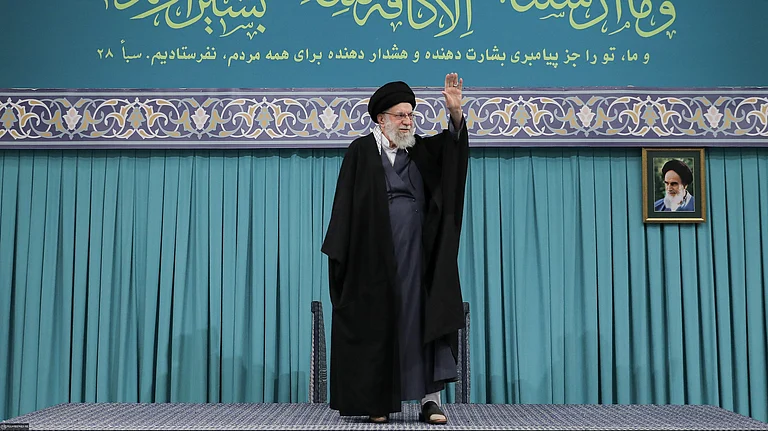
The curbs follow Israel-US attacks on Iran, where Supreme Leader Ali Khamenei has reportedly died; Tehran has vowed retaliation.
Indian airlines are set to cancel 444 international flights on Sunday amid airspace restrictions across parts of the Middle East, the civil aviation ministry said.
“Due to airspace restrictions over Iran and parts of the Middle East, 410 flights of domestic carriers were cancelled on 28 February, and 444 flights are expected to be cancelled on 1 March,” the ministry said in a post on X early Sunday morning.

1 October 2026
Get the latest issue of Outlook Business

The disruptions follow attacks on Iran by Israel and the US, in which its Supreme Leader, Ali Khamenei, has reportedly died. Tehran has vowed to avenge the attacks, in which reports claim that more than 100 people have been killed.


On Saturday, Civil Aviation Minister K. Rammohan Naidu reviewed the situation with senior officials, focusing on passenger safety, operational continuity and real-time coordination.
The Directorate General of Civil Aviation (DGCA) has advised airlines to avoid the airspace of 11 countries until 2 March. These include Iran, Israel, Lebanon, the UAE, Saudi Arabia, Bahrain, Oman, Iraq, Jordan, Kuwait and Qatar. The regulator is coordinating closely with airlines to ensure compliance with safety and operational norms.
Advertisement
Major airports have been placed on operational alert to manage possible diversions and facilitate passengers. Senior officials have been deployed on the ground to oversee airline coordination, passenger support and crowd management. The Passenger Assistance Control Room continues to monitor concerns and ensure timely resolution, the ministry said.
Airlines have announced multiple cancellations and suspensions. Air India Express has extended the suspension of its westbound international flights until 23:59 hours on 1 March. Akasa Air has suspended services to and from Abu Dhabi, Doha, Jeddah, Kuwait and Riyadh until 2 March. SpiceJet has also cancelled flights to the UAE.
Advertisement
Separately, Air India has cancelled 28 international flights scheduled for 1 March, PTI reported. These include services from Delhi and Mumbai to London Heathrow, Amritsar to London Gatwick, and Delhi and Mumbai to New York. Flights on the Mumbai–Newark, Delhi–Chicago, Delhi–Toronto, Delhi–Frankfurt, Mumbai–Frankfurt and Delhi–Paris routes have also been cancelled. Return flights from these destinations to India have been scrapped for the same day.
In a post on X on Saturday, Air India said the cancellations were part of its ongoing assessment of the evolving situation in the Middle East and were taken in the interest of passenger and staff safety.
“We will continue to closely monitor the situation and share further updates based on our risk assessments,” the airline said.
Rival IndiGo also issued an advisory saying it is closely monitoring updates related to Iran and surrounding airspace.

US–Israel’s War With Iran Triggers Global Disruption
Airspace closures by Israel, Qatar, Syria, Iran, Iraq, Kuwait, Bahrain and a temporary partial shutdown in the United Arab Emirates have triggered widespread disruption across global aviation networks, reported Associated Press. The disruption has stranded hundreds of thousands of passengers, rerouted flights and forced the shutdown of major transit hubs such as Dubai, Abu Dhabi and Doha.
The resulting restrictions have led to the cancellation of more than 1,000 flights by key regional carriers, including Emirates, Qatar Airways and Etihad Airways, which collectively handle around 90,000 passengers daily through these hubs, the news agency said, citing data from aviation analytics firm Cirium.
Rerouting of flights around the conflict zone has added hours to journeys, increased fuel consumption and operational costs, and is expected to push up airfares if disruptions persist, while also placing additional pressure on Saudi Arabia’s air traffic control systems managing diverted traffic.
Airlines across the world have suspended or rerouted services to several Middle Eastern destinations, including Tel Aviv and Doha, with at least 145 aircraft diverted mid-air to alternate airports such as Athens, Istanbul and Rome.