
For years, the start-up journey followed a familiar script. A founder spotted a market gap, built through uncertainty, raised capital, scaled the company and eventually aimed for an initial public offering (IPO).
We celebrated founders who stayed with their companies from inception to listing, treating longevity as the ultimate measure of success. India is now learning that this script is the exception, not the rule.
Across India's start-up ecosystem, founders are stepping away from the businesses they created much earlier than expected. Some are taking liquidity through strategic acquisitions. Others are handing over operational control as companies mature. Increasingly, some are leaving to build again, particularly in artificial intelligence (AI), convinced that the next wave of value creation lies elsewhere.
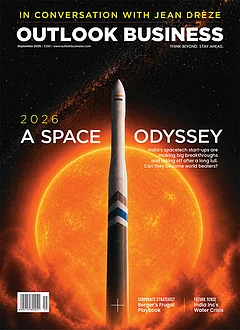
1 September 2026
Get the latest issue of Outlook Business

It is tempting to interpret these exits as founder fatigue or declining ambition. It’s the opposite. This is not just fatigue. It is a structural shift. Founders today are no longer building just one company. They are building entrepreneurial careers.
Maturing Ecosystem
A successful founder is just as likely to become an angel investor, launch another company or back the next generation of entrepreneurs as they are to spend the next 20 years running the same business.
Entrepreneurship has become a cycle of building, learning, exiting and building again. That is a sign of a maturing ecosystem, not a weakening one. A start-up begins as an extension of the founder's will.
India's next chapter to be measured by the enduring companies it builds, not by how how many it creates
In the early days, the founder is the product manager, recruiter, fundraiser, salesperson and culture builder. But as the company grows, the role changes completely. Governance, leadership hiring, board management and long-term strategy replace product sprints and customer calls.
The founder who excels at finding the product-market fit is not automatically the person who enjoys institutionalising a business. The real question is not whether a founder should stay forever. It is whether they remain the best person to lead the company's next phase.
AI has accelerated this shift. It is changing something even more fundamental than technology. It is changing founder psychology. Every few months, new models emerge that redefine what products can be built and how quickly they can scale.
A founder building a software-as-a-service (SaaS), consumer, fintech or logistics business now faces two difficult questions. Will AI disrupt what I am building today? And perhaps more importantly, am I solving the biggest opportunity available? That urgency is creating a level of self-reflection we have rarely seen before. AI has not created founder exits. It has compressed entrepreneurial decision making. The recent wave of founder departures reflects this changing mindset.
Some founders are stepping away because their companies require a different kind of leadership. Others are pursuing entirely new opportunities created by AI. History tells us that every major technology shift creates a new generation of entrepreneurs. The internet did. Mobile did. AI will too.
The Next Big Thing
Some of the founders leaving successful businesses today may well build the defining companies of the next decade. At the same time, acquisitions are no longer viewed as second best outcomes.
For years, Indian founders believed success meant building independently until an IPO. Today, strategic acquisitions are increasingly recognised as rational milestones.
Large companies understand that acquiring technology, talent, brands or specialised capabilities is often faster than building them internally.
For founders, an acquisition can provide liquidity, broader distribution and the opportunity to build again with greater experience. This is a healthy evolution.
Successful exits recycle capital, create experienced operators, produce angel investors and strengthen the broader entrepreneurial ecosystem. India needs more exits because every successful founder who exits becomes a potential backer, mentor or employer for the next generation.
Ecosystems do not compound through capital alone. They compound through experience. However, founders and venture capitalists do not always optimise for the same outcome.
A founder may view a strategic acquisition as life changing.
An investor may believe the company is capable of becoming 10 times larger. Neither perspective is wrong. They simply reflect different incentives.
Investor Philosophy
At All In Capital, we invest in founders, not job titles. Great founders evolve with their companies. Sometimes that means remaining CEO for decades. Sometimes it means bringing in experienced leadership while continuing to shape product, culture or vision.
The strongest founder-investor relationships are built on alignment, not assumptions.
There is another trend we should be careful about. As an ecosystem, we have become exceptionally good at celebrating speed. Fast funding rounds. Fast growth. Fast acquisitions. Fast exits.
But building enduring companies requires patience. The challenge for founders today is not simply identifying the next opportunity. It is deciding which opportunity deserves the next decade of their lives.
Capital is no longer the biggest constraint for great founders. Clarity is. The real risk is not that founders are leaving too early. The real risk is that we begin celebrating liquidity more than longevity.
India undoubtedly needs more acquisitions, more recycled capital and more second-time founders. But it also needs companies that compound for decades and become institutions capable of outliving their founders.
India's next chapter will not be measured by how many start-ups it creates. It will be measured by how many enduring companies it builds. Some founders will stay for decades. Others will build, exit and build again. Both journeys deserve respect.
Ultimately, the best founders are not remembered for how long they stayed. They are remembered for building companies that no longer needed them to succeed.
The writer is co-founder and partner, All In Capital