
Whenever there is a major new scientific discovery or invention, we marvel at the opportunities that it opens up and at the ways in which it can improve our lives. But we can also feel quiet misgivings about new risks that might emerge, particularly for the most vulnerable among us.
When X-ray technology was first invented, it allowed doctors to look inside the human body and diagnose diseases. But we soon learnt that excessive X-ray radiation can be harmful, especially to babies and pregnant women. We now have warning signs outside such facilities, protective gear for radiologists and safer alternatives in airport security screenings.
When mobile technology was first harnessed for online education, it broadened access to educational resources, especially when combined with language translation software.

1 October 2026
Get the latest issue of Outlook Business

But it also created conditions for mobile addiction and mental-health challenges among adolescents. We are now seeing greater awareness about this among parents and teachers, and even some countries enacting new laws for the online safety of children.
Solar power has become a cost-effective way of producing clean electricity without harmful emissions, but people are concerned about the new piles of e-waste that could get generated over the next few decades as solar farms scale up.
Will this e-waste get dumped in villages and will toxic metals leach into the groundwater from landfills? India’s Central Pollution Control Board has included solar waste in its norms for e-waste handling and recycling. Similarly, there is growing unease about the energy and water footprint of new artificial intelligence (AI) technologies.
AI Unease
Whether it is manufacturing semiconductors or cooling data-centre servers, there is trepidation about the commercial exploitation of our finite water resources that are essential for life.
Though harnessing AI technologies early can open up new economic opportunities, it should not create new risks for the most vulnerable people in the most vulnerable places.
According to Google’s Environmental Report for 2026, a few of its data centres consume as much water as 6–9 golf courses. Imagine if these were to come up in water-stressed places.
Even as usage efficiency grows, the total demand for AI workloads may grow even faster, increasing the exploitation of water
Three-fourths of India’s 278 data centres are located in just five states—Maharashtra, Tamil Nadu, Telangana, Karnataka, and Uttar Pradesh—and more than half are in water-stressed areas. Hyperscale data centres are being built in districts like Hyderabad which already extracts 98% of its available groundwater, and Chennai, which extracts 122%, i.e. more than can be replenished by rainfall, according to Central Ground Water Board data.
Chip-fabrication hubs are coming up in water-stressed areas like Mohali where groundwater extraction is 117%, Noida where it is 105%, and Ahmedabad where it is 78%. There are only a few areas with major AI investments, like Visakhapatnam, where ground-water extraction is less than half of what is annually replenished through the monsoon.
By all accounts, the efficiency of water use in data centres is improving. Giants like Microsoft and Nvidia have announced new designs which replace evaporative freshwater cooling with new coolants, closed loops and chip-level cooling.
There is ongoing R&D for waterless semiconductor manufacturing that uses plasma or gases. Advanced non-water small modular reactors can use other coolants.
But can the technological choice for a new upcoming project be left to be determined by the market? If water is not priced appropriately, will companies automatically deploy the most efficient available technology in a new market?
And even as water use efficiency grows, the total demand for AI workloads may grow even faster, cancelling out efficiency gains and increasing the exploitation of water.
Known as the Jevons Paradox, this phenomenon is often seen in other sectors also like transport infrastructure, where building flyovers cannot keep up with the growth of traffic.
Even with highly efficient new technologies that minimise water use, it will be safer for state governments to attract AI investments to locations with relatively abundant water.
Even if current water supply and demand is balanced, climate change will affect future water supply and demand in different ways.
Higher temperatures will increase evaporation from water bodies. More intense rainfall will fall on hardened ground, washing away without recharging groundwater. Farmers will need more irrigation access to cope with erratic monsoons.
Preparing for climate change will require more investment in watershed development, micro-irrigation and reservoir capacity.
Giant Measures
AI companies need to play their part in the watersheds where they operate. One example is Google’s wetland rejuvenation projects near its data centres in Singapore and Taiwan, and micro irrigation and reservoir repair in Chile.
Climate change will also affect thermal and nuclear power plants used to power the growing energy demand from AI. NITI Aayog's recent report on Scenarios for Viksit Bharat and Net Zero presents a conservative estimate that if current trends continue, the electricity consumed by data centres in India will grow from 100 terawatt‑hour (TWh) in 2030 to 400TWh in 2047 to 700TWh in 2070, increasing total electricity demand by about 6–7%.
Currently, power plants in India draw about 30bn cubic metres of water per year for cooling, much of which is returned after use. A few power plants use seawater and treated wastewater.
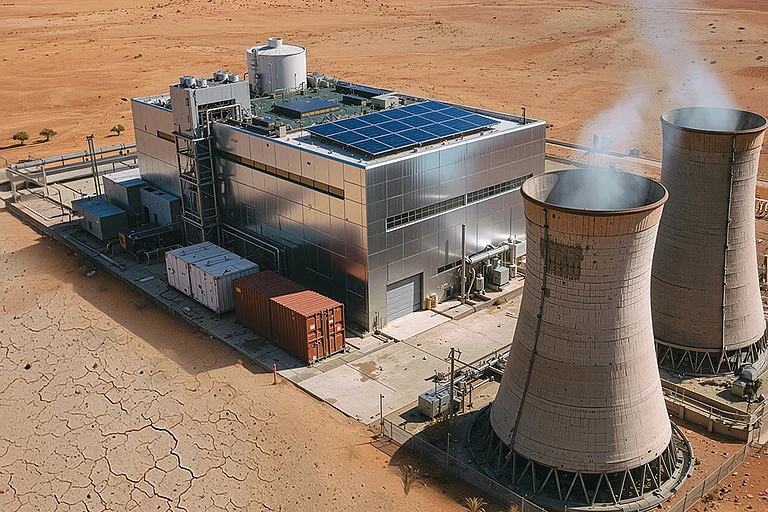
But climate change will make surface water and seawater warmer. For example, in this year’s heatwave in Europe, nuclear power plants in France, Hungary and Romania had to shut down because rivers ran dry or river water became too hot to use.
Higher surface water temperatures could lead power plants to extract more groundwater from aquifers, increasing competition with agricultural and urban users. Instead, governments can mandate companies to climate proof their energy supply by investing in wastewater treatment and renewable energy.
The Way Forward
Since water is a state subject, state governments can reveal and regulate the hidden water footprint of AI. They can specify norms around efficiency, sitting and consultation. They can mandate companies to generate clean electricity, pay for transmission costs and recycle water. State governments can require industry collaboration on R&D for waterless technologies.
Companies for their part can make local communities more resilient to climate change, not as charity, but as part of their project plans. They can invest in human capital by partnering the Pradhan Mantri Skilling and Employability Transformation through Upgraded ITIs scheme, a $6bn workforce development programme.
Together such measures can protect the most vulnerable places and people while taking strides towards our economic goals.
The writer is a climate-change researcher