On the outskirts of Chennai, at a JK Tyre factory, hundreds of tyres move across conveyor lines every day with little human intervention. Driverless carts transport raw materials across the shop floor. Cameras and sensors inspect tyres at every stage of production, while software monitors the manufacturing process in real time, flagging even minor deviations before they become defects.
The plant, among JK Tyre & Industries’ most advanced manufacturing facilities, has become the centrepiece of its next phase of growth. It is expected to receive nearly 90% of the company’s recently announced largest-ever capital expenditure programme of almost ₹5,000cr.
It is an ambitious investment for a company that already manufactures around 35mn tyres a year across 11 plants in India and Mexico. The company is India’s second-largest tyre maker by volume after MRF. Yet size has not translated into superior profits. The new investment is not just about making more tyres but making higher-value ones.
1 September 2026
Get the latest issue of Outlook Business

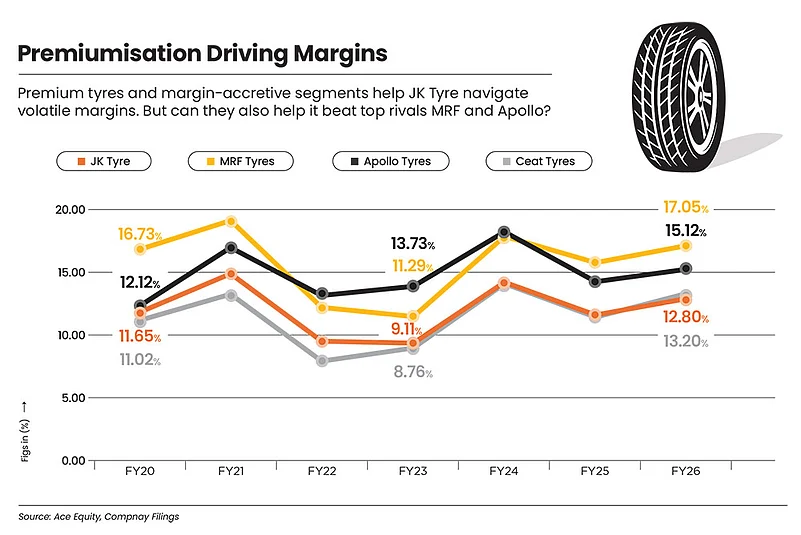
JK Tyre finds itself in a peculiar position, both enviable and challenging. For all its manufacturing scale, the company has not quite matched its market leadership with comparable profitability.
In 2025–26, JK Tyre reported revenue of ₹16,384cr with operating margin of 12.8%, a measure of the profitability generated from its core operations. Apollo Tyres, despite producing fewer tyres, reported higher revenue and margin. Ceat too reported higher margin in FY26 despite its earnings below JK Tyre’s. MRF led the industry with a margin of 17%.
Simply put, while JK Tyre sells more tyres than most of its rivals, it earns less from each unit. That is the equation JK Tyre is trying to change.
Over the past five years, under managing director, Anshuman Singhania, the company has steadily shifted its strategy from chasing volumes to improving the value of every tyre it sells. The question now is whether JK Tyre can improve its economics in an industry that is becoming more competitive, less forgiving of scale and increasingly driven by technology and pricing power.
A Different Road
Until the early 1970s, most cars ran on bias-ply tyres. These were durable, cheaper to make, but wore out faster and lost grip at higher speeds. Radial tyres, pioneered by Michelin, solved those problems, and improved fuel efficiency. But they required manufacturers to invest heavily in new factories and machinery.
JK Tyre embraced that transition early, becoming the first company to introduce passenger car radial (PCR) tyres in India in 1977. In late 1990s, it extended radial technology to trucks and buses.
While commercial vehicles (CVs) became JK Tyre’s largest business, passenger vehicles remained a smaller contributor. At the time, there was little reason to change that balance. Today, there is.
For much of India’s automotive history, truck and bus drove the tyre industry’s fortunes. CVs accounted for nearly three-fourths of the tyre market in 2017, reflecting an economy powered by road freight, industrial activity and limited private-car ownership. Today, while CVs still account for an estimated 55–60% of the industry’s value, their dominance eased as the playing field underwent a structural reset.
Sports utility vehicles now account for the largest share of India’s passenger-vehicle market. Larger vehicles need larger tyres, which yield higher revenue and healthier profit margins than the tyres fitted on entry-level cars. Electric vehicles (EVs) are adding a second push, demanding more tech-advanced tyres that give lower rolling resistance and quieter cabins; fleet operators, meanwhile, are prioritising fuel savings and tyre life over purchase price alone.
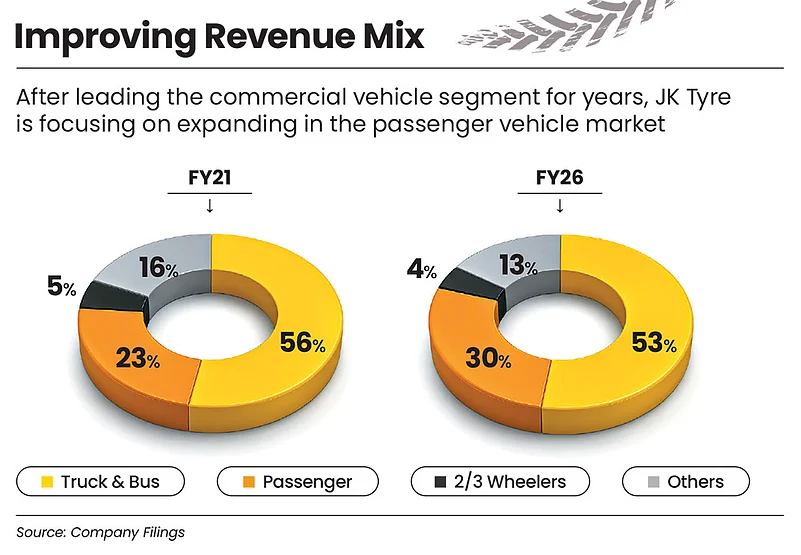

For JK Tyre, this shift presents an opportunity to rebalance a portfolio that has long been anchored in CVs.
Between 2020-21 and 2025-26, the revenue contribution of PCRs surged in JK Tyre’s balance sheet, while the CVs contribution declined slightly. The company ultimately wants PCRs to contribute 40–45% of revenue over time. During the same period, the higher-margin replacement business increased from 61% to 64% of sales.
Premiumisation represents both the market opportunity as well as the strategic direction, believes Singhania. Capacity expansion, branding and R&D have increasingly been aligned behind that objective.
That shift is backed by real money. Between 2022–23 and 2025–26, JK Tyre spent about ₹2,700cr expanding standalone capacity. The centrepiece was a multi-phase expansion of its PCR plant in Banmore, Madhya Pradesh, inaugurated in January this year. That plant alone now produces roughly 10.5mn tyres a year.
But scale alone doesn’t determine profitability, says Harshvardhan Sharma, head of automotive retail practice at Nomura Research Institute. “Margins are influenced by several structural factors, including the balance between OEM [original equipment manufacturer] and replacement sales, passenger versus commercial vehicle exposure, domestic versus export mix, plant utilisation and the ability to pass through raw material cost increases. Companies with stronger replacement franchises and higher brand equity generally enjoy greater pricing power than those competing primarily on volumes,” he adds.
Even as JK Tyre is repositioning its portfolio, it is competing against rivals who have spent decades building stronger positions in key segments. Ceat has a deeper presence in two-wheelers, while Apollo enjoys greater scale in passenger vehicles.
JK Tyre is betting that premium products, tech and disciplined execution can narrow the profitability gap
Margins are a function of market share within different segments such as passenger vehicles, CVs and two-wheelers, says Sunny Agrawal, head of fundamental research, SBI Securities, a brokerage. “If you have embedded market share… that becomes relatively easy. You have a strong dealer network, a strong brand.”
He goes on to add that JK Tyre has to build that market for itself, which means spending more on distributor incentives and advertising just to gain ground.
The company has already begun expanding its distribution, adding more dealers in 2025–26 than in any previous year, particularly across Tier-II and -III towns.
Auto-analytics firm JATO Dynamics India president, Ravi Bhatia, agrees that closing a 400–600 basis point Ebitda margin gap requires not only product-mix improvement but also sustained gains in brand perception and dealer economics in the premium segment. “This is achievable but remains a multi-year task.”
The challenge doesn’t end with product mix. The company must deal with constant external volatilities like raw-material prices. In the past few years, when the company improved use of its existing manufacturing capacity and expanded distribution reach, rubber prices had eaten away its margin gains.
Crisil, a credit-rating agency, says natural rubber prices rose about 30% in 2024–25, while India Ratings, another research firm, expects pressure on margins to persist into 2026–27 following higher crude-linked input costs after the US-Iran conflict.
Yet JK Tyre has chosen not to defer investment. “We have not delayed our expansion, nor have we put it on hold,” says Singhania. “Demand in India remains steady.”
Rivals Apollo, Ceat and MRF are all pursuing similar opportunities through premium products, technology and manufacturing investments. Apollo is expanding its PCR capacity in Hungary and Andhra Pradesh; Ceat has budgeted ₹1,400–1,500cr a year through 2027–28; MRF has outlined spending above ₹2,000cr in 2026–27.
The Tech Bet
Inside an echo-free chamber on the outskirts of Mysuru, engineers at JK Tyre try to hear something most drivers never notice: the sound a tyre makes rolling over the road. Usually, the engine noise drowns it out. EVs have changed that. Battery packs have also made EVs heavier, while their instant torque puts far greater stress on the tyre. Engineers now have to design tyres that are quieter and more durable, without compromising grip or safety.
“If your tyre life was 35,000–40,000km, it’s now drastically reducing by at least 10,000km,” says Puneet Gupta, India director of automotive data provider Mobility Global. “As soon as you press the pedal there’s a lot of kick and a lot of resistance. These companies have to work on tyres with less resistance.”
The echo-free chamber is one part of JK Tyre’s research ecosystem. At the Raghupati Singhania Centre of Excellence, spread across nearly 22 acres in Mysuru, more than 250 scientists and engineers work on everything from advanced materials and tread compounds to vehicle dynamics, digital simulation and AI.
“EV manufacturers are asking for much lower levels of noise and vibration. That is becoming an important part of product development,” says Singhania.
The company has invested over ₹1,000cr in the facility and continues to spend around 1.5% of its annual revenue on R&D.
The bigger commercial question is whether better technology can command better prices. “Innovation today spans EV-specific tyres, connected tyres, predictive maintenance, telematics and data-driven fleet management. Over time, competitive advantage is likely to come from combining manufacturing excellence with software and lifecycle services, rather than product performance alone,” says Sharma.
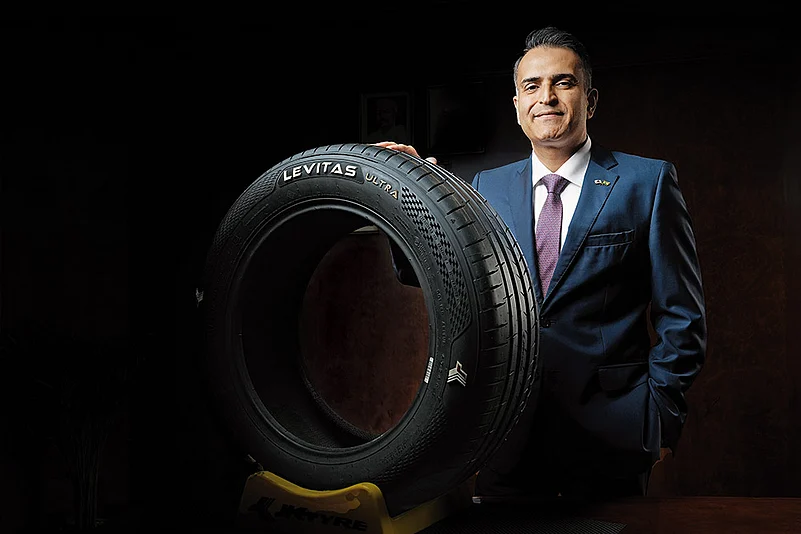
The strategy is visible across JK Tyre’s products, from Levitas Ultra for performance enthusiasts, Puncture Guard that enables tyre to operate for its full lifespan without needing to stop and Smart Tyres that relay pressure and health data in real time.
“The challenge is to keep innovating,” says Singhania. “The customer today expects much more from a tyre than they did 10 years ago.”
The approach is equally visible in commercial vehicles, which still generate most of JK Tyre’s revenue. Rather than selling just tyres, the company is increasingly selling operating efficiency through fuel-saving tyres, predictive maintenance and fleet management services.
In India, there are about 1,800 commercial fleets. JK Tyre’s MD says the company already caters to about 1,500–1,600 of them across large and small segments. “Our focus is on offering a comprehensive mobility solution.” Instead of simply supplying tyres, it takes responsibility for monitoring tyre health, improving maintenance schedules and helping fleet operators extract more mileage from every tyre.
Fleet data feeds back into product development while making it harder for rivals to replace JK Tyre. Singhania describes the business as one of the company’s strongest competitive advantages and believes it can grow nearly six-fold over the next three to four years. JK Tyre has also tried to build an edge somewhere far less obvious: the racetrack.
During an earnings call last year, an investor asked JK Tyre’s management why the company hadn’t signed a celebrity to build its brand, the way MRF had with Virat Kohli or Ceat had through cricket sponsorships. “Every company has its own philosophy of endorsements,” Singhania replied. “Our core has always been motorsport.”
For more than four decades, JK Tyre has invested in racing championships, rallies, karting and driver development. Motorsport, for the tyre manufacturer, is as much an engineering laboratory as it is a marketing platform.
The Levitas Ultra range, for instance, draws on engineering developed through the company’s Formula 4 programme, and racing-tested materials and tread compounds have since found their way into premium passenger tyres.
If the anti-echo chamber in Mysuru is one kind of laboratory, the racetrack is another.
The Execution Test
Over the past two decades, JK Tyre has been integrating businesses, improving factories and expanding into new markets.
In 1997, it acquired financially distressed Vikrant Tyres, its first proof that it could turn around a broken asset. In 2008, when most Indian tyre makers were focused on the domestic market amid the global financial crisis, JK Tyre paid ₹250cr for Mexico-based Tornel, a wager aimed at securing a manufacturing foothold closer to North America. That subsidiary now generates ₹2,138cr in revenue, dominates Mexico’s PCR replacement market, and counts retail giants Walmart, Soriana, Chedraui and Coppel among its clients.
Acquisitions have given JK Tyre capabilities it would have taken years to build organically
The pattern repeated itself in Cavendish Industries, a tyre manufacturer. JK Tyre acquired and rebuilt from under 100 tonnes of daily output to several times that, now supplying premium products to leading OEMs at efficiency levels comparable with the company’s established sites.
Together, the three acquisitions gave JK Tyre capabilities it would have taken years to build organically—from premium passenger tyres in Mexico to modern domestic manufacturing bases.
That execution record is being tested again. JK Tyre has added capacity where demand is growing fastest, deepened its export focus and begun building for the EV era. It is entering this phase with a healthier balance sheet than it had a few years ago.
Apollo, Ceat and MRF have accelerated their own investments too, which means execution, not strategy, is now the real differentiator.
CARE Ratings has flagged a net debt-to-profit before interest, lease, depreciation and tax ratio above 3.5x as a trigger for a negative rating action. JK Tyre’s ratio touched 3.53x in 2024–25, meaning its largest-ever capex commitment was approved while sitting essentially on that line.
Singhania is confident the arithmetic works in JK Tyre’s favour. “The way we are funding our projects, that debt profile could be self-funding because the product lines are high-profitability product lines,” he says.
Profitability in the tyre business, Bhatia points out, depends on getting several moving parts right at the same time—converting new capacity into profitable growth rather than volume, strengthening brand pull in premium passenger tyres where MRF still leads and maintaining financial discipline through a record capex cycle.
JK Tyre has shown it can build factories, integrate acquisitions and adapt to changing markets.
The bigger test is whether those capabilities finally translate into sustained profitability.