It began with an unexpected LinkedIn message. A well-wisher, keen to see Tamil Nadu strengthen its industrial base, reached out to TRB Rajaa, the state’s industry minister at the time, with an urgent warning, “I know you’ve been talking to VinFast, but they’re now on the verge of choosing another state.”
Until then, Tamil Nadu had been engaging with the Vietnamese electric-vehicle (EV) maker for months. But the message revealed something far more significant: negotiations had entered their final stages and a rival state was close to sealing the deal.
Rajaa did not wait. As soon as word reached Chennai that the deal was slipping away, he boarded the next available flight to Vietnam. “The day before I reached, they had almost finalised the investment with another state,” recalls Rajaa. “Their representatives had met that state’s leadership the previous night and had virtually concluded the negotiations.”

1 September 2026
Get the latest issue of Outlook Business

Over the next three days, Tamil Nadu intensified its engagement with VinFast and worked across departments to resolve key issues, including land availability and the state’s final offer.
The effort ultimately paid off. In 2024, VinFast invested ₹16,000cr in Tuticorin, one of India’s biggest EV manufacturing commitments.
“The real differentiator was the ecosystem. We already have a mature automobile manufacturing base supported by a strong network of MSMEs [micro, small and medium enterprises],” says Rajaa. “Large manufacturers weren’t operating in isolation—they were backed by a deep supplier ecosystem.”
The Great EV Land Grab
The VinFast episode is an illustration of how cut-throat the contest for EV manufacturing has become.
According to a report by industry platform India Energy Storage Alliance (IESA), India’s EV market could expand twelvefold, reaching annual sales of 30.4mn units by 2032 under the high-growth National EV (NEV) scenario, driven by stronger policy support, greater localisation of manufacturing and a wider charging-infrastructure network.
The automobile industry already contributes around 7% of India’s GDP and supports over 30mn jobs; the electric transition threatens to redistribute that pie among states willing to fight for it.
The inter-state rivalry is further intensified by the absence of a national-level policy or body to manage the EV sector
When Ola Electric began scouting for land for its ambitious EV hub, Uttar Pradesh, Maharashtra, Gujarat, Karnataka, Telangana and Tamil Nadu pitched to host the project.
Tamil Nadu emerged victorious due to its strong automotive ecosystem. In 2023, Ola committed ₹7,614cr for manufacturing electric cars, two-wheelers and lithium-cell gigafactories.
The inter-state competition is further intensified by the absence of a national-level policy or body to manage the EV sector. “A dedicated policy, or at least a well-defined national target, is essential to guide investments, shape programmes and provide certainty to the industry,” says Amit Bhatt, managing director for India at the International Council on Clean Transportation (ICCT), a non-profit research organisation.
In this vacuum, states have become the de facto architects of India’s EV shift; and they are building to very different blueprints.
Different Strokes
Broadly, Indian states have followed two distinct EV policy models, with a third now beginning to emerge. The first is the manufacturing and investment-led model, adopted by Tamil Nadu, Gujarat, Maharashtra, Telangana and Karnataka.
Tamil Nadu’s EV Policy 2023 aims to make the state Southeast Asia’s preferred EV hub, targeting ₹50,000cr in investments and 1.5 lakh new jobs. Instead of offering a single incentive, the policy allows companies to choose benefits that best suit their investment plans.
Eligible manufacturers can avail 100% state goods and services tax (SGST) reimbursement for up to 15 years, turnover-linked or capital subsidies and special capital subsidies of up to 20% for advanced chemistry cell (ACC) battery manufacturing.
The policy also treats R&D expenditure, technology transfer and intellectual property-related investments as eligible costs, encouraging companies to build a complete EV ecosystem in the state.
Gujarat has positioned itself as a battery and supply-chain hub through its Industrial Policy 2020 that classifies EVs and their components as a Sunrise Thrust Sector. Projects get higher capital subsidies of 12%, 10% or 6% of eligible fixed-capital investment (excluding land), depending on the location. The policy also replaced SGST-linked incentives with an investment-linked capital subsidy and removed the overall cap on incentive amounts.
“Tamil Nadu and Gujarat lead EV manufacturing, backed by strong policies that continue to attract EV and battery investments,” says Jaydeep Mukherjee, professor at Great Lakes Institute of Management, Chennai.
Some states such as Odisha have also adopted a consumer adoption-led model. Here the priority is not factories but buyers: purchase incentives, tax waivers and charging infrastructure designed to put EVs on the road.
For instance, Odisha offers subsi-dies of up to ₹20,000 for electric two-wheelers (e2W), ₹30,000 for electric three-wheelers (e3W) and up to ₹1.5 lakh for electric four-wheelers (e4W), alongside 100% exemption on road tax and registration fees for eligible battery-operated vehicles.
Similarly, Telangana offers full exemption on road tax and registration fees for all battery EVs, including e2W, e4W and commercial vehicles.
Telangana also provides exclusive discounts of 10–20% on EV purchases for over 5 lakh state government employees. In addition, commercial EVs such as taxis, auto-rickshaws and goods carriers are eligible for the same tax waivers, while existing auto-rickshaws can receive a 15% retrofitment incentive of up to ₹15,000 to convert to electric.

Two Theories of Change
However, these two EV strategies rest on very different theories of how a transition happens. The manufacturing-led states are, in effect, betting on supply: build the factories; jobs, supplier networks and the local market will follow.
Within this, for states with established automotive clusters, the electric transition is less an environmental project than an industrial-survival one: if the internal combustion engine (ICE) is on its way out, the states that host its supply chains must capture the technology that replaces it or watch decades of industrial capital depreciate. They are keen to build up the entire EV ecosystem, including manufacturers, component suppliers, testing facilities and skilled talent.
A state like Odisha, without a legacy automotive base, is unlikely to outbid Tamil Nadu for a gigafactory; its subsidies are better understood as a clean-air and fuel-import-substitution play than a jobs strategy
“This industrial clustering strengthens the supply chain, improves operational efficiency and makes the state a more attractive destination for EV investments,” says Charith Konda, energy specialist, India Mobility and New Energy at the Institute for Energy Economics and Financial Analysis.
The adoption-led states are betting on demand. Their reasoning is that if enough people buy EVs, companies will naturally invest in dealerships, charging networks, service centres and perhaps, eventually, manufacturing. But that last link in the chain is far from automatic, and for some states it may not even be the point.
A state like Odisha, without a legacy automotive base, is unlikely to outbid Tamil Nadu for a gigafactory; its subsidies are better understood as a clean-air and fuel-import-substitution play than a jobs strategy.
“Companies typically base their investment decisions on a combination of factors, including logistics and connectivity such as proximity to ports in Tamil Nadu, the availability of a strong supplier ecosystem like the Mumbai–Pune automotive cluster, state policy support and incentives, infrastructure and access to skilled talent,” says ICCT’s Bhatt.
Delhi: The Third Way
Then there is Delhi, which fits neither template; and may be pioneering a third.
On June 29, the Delhi government approved a new EV Policy with an outlay of ₹15,000cr, running until March 2030. Like the adoption-led states, it offers carrots: a 100% road tax and registration fee waiver for electric cars priced up to ₹30 lakh, among other incentives. But its distinguishing feature is the stick.
New petrol and CNG three-wheelers and N1 trucks will be barred from registration from January 1, 2027, and petrol two-wheelers from April 1, 2028.
Instead of relying on incentives alone, Delhi is using regulation to force the transition—the approach that has driven mass adoption in Europe and China, where hard deadlines have been set for ICE vehicles. Such mandates send an unambiguous market signal: manufacturers that do not sell EVs will simply cede the market to rivals that do.
“Two-wheelers account for nearly two-thirds of Delhi’s registered vehicles, making them central to reducing vehicular emissions,” says Delhi chief minister Rekha Gupta in an interview with Outlook Business.
“Our policy provides a phased transition until 2028, giving consumers and industry adequate time to adopt affordable and reliable electric alternatives.”
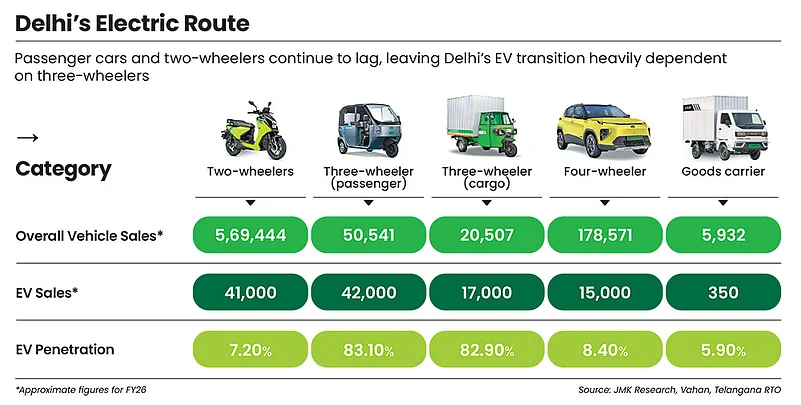
Delhi can afford this approach. It has no automotive manufacturing base to protect, an air-quality emergency that gives regulation political cover and—at 8.4% electric-car penetration—a market already warmer than most.
Delhi’s first EV policy, launched in 2020, relied primarily on fiscal and non-fiscal incentives such as purchase subsidies, tax waivers and charging infrastructure to encourage consumers to switch to EVs.
While this approach helped kick-start EV adoption, it fell short of driving mass-scale transition. The policy had set a target of 25% EV sales by 2024, but it currently stands at around 11–12%.
The limitations of a subsidy-led approach are becoming evident: governments cannot indefinitely subsidise every vehicle, and such policies place the responsibility for adoption largely on consumers.
The new policy seeks to address this by shifting part of the responsibility to manufacturers, restricting the registration of certain new ICE vehicles and pushing automakers to expand their EV offerings and compete more aggressively in the electric-mobility market.
But the model carries its own risks. The bans will bite only if the charging network scales in time. Delhi is aiming to instal 32,000 public EV charging points across the city from 9,000 now. And Delhi does not exist in isolation: a buyer facing a two-wheeler ban in the capital can register the same petrol vehicle in Gurgaon, Noida or Ghaziabad.
“It is a potential loophole. The long-term solution is to extend similar policies across the entire NCR,” says Bhatt. Delhi could also deter this by imposing environmental charges on vehicles registered outside the city, adds Bhatt.
“Our strategy is centred on expan-ding a differentiated EV portfolio that addresses diverse consumer needs, while simultaneously investing in scalable manufacturing, a resilient supplier ecosystem and advanced battery technologies,” says Bharath Rao, co-founder and chief executive, Emobi, an e2W start-up.
The Scoreboard
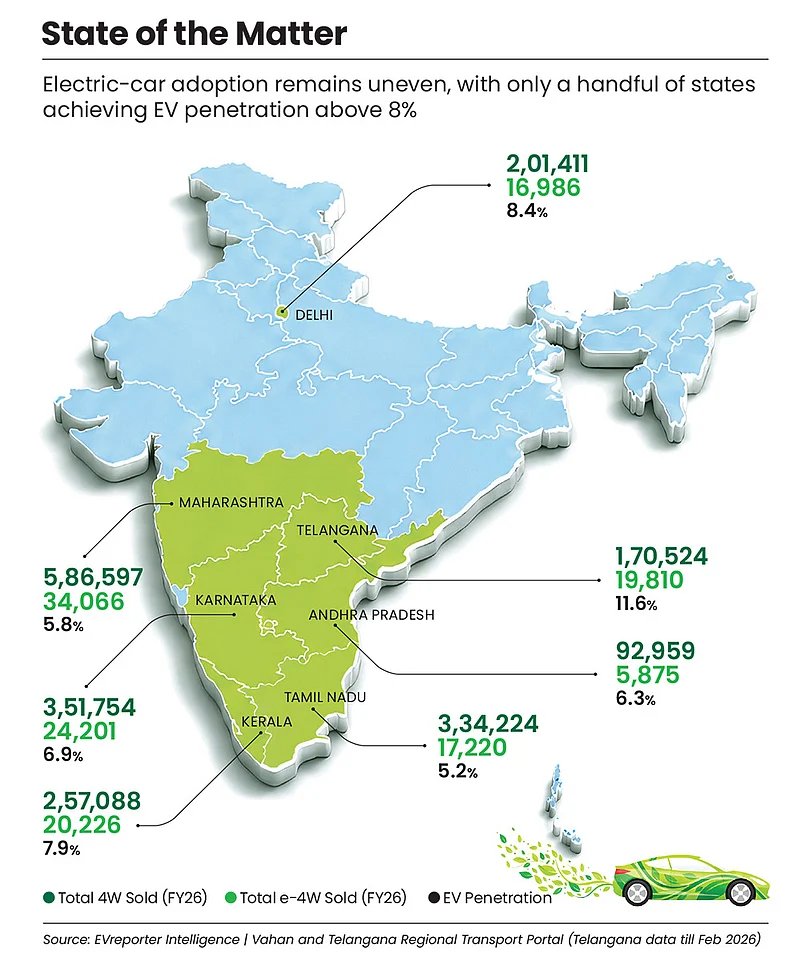
So, how have the two bets paid off? The data suggests a paradox: the states that make EVs are not necessarily the states that buy them. According to vehicle registration data for 2025–26 from the Vahan dashboard, Telangana leads electric-car penetration at 11.6%, having registered 19,810 electric cars out of 1.71 lakh PV sales.
Delhi follows (16,986 out of 2.01 lakh). Maharashtra, despite recording the highest absolute electric-car sales at 34,066 units, has only 5.8% penetration because of its large overall market. Odisha also recorded 5.8% (5,307 out of 92,245); and Tamil Nadu, the country’s self-declared EV manufacturing champion, stood at just 5.2% (17,220 out of 3.34 lakh).
Tamil Nadu has already attracted more than ₹40,000cr in EV manufacturing investments and has built a comprehensive EV ecosystem spanning vehicle manufacturing, batteries, components, charging infrastructure and R&D.
In comparison, Gujarat has attracted an estimated ₹25,000–30,000cr in EV-related investments by leveraging its established auto-mobile manufacturing base, ports and supplier network to draw major players such as Tata Motors, Maruti Suzuki, MG Motor and battery manufacturers, making it another key EV manufacturing hub.
The pattern that emerges is revealing. Manufacturing-led policies appear to deliver on their own terms, investment and industrial activity, without necessarily electrifying the home market. Adoption-led policies lift penetration but create markets that may well be served by factories in other states. Each model, in other words, succeeds at its own objective and largely fails at the other’s.
“EV adoption is driven by consumer awareness and charging infrastructure,” says Mukherjee, adding that states with stronger charging networks have so far shown higher adoption.
According to government data, Karnataka leads the country with 6,096 operational public EV charging stations, followed by Maharashtra (4,166), Uttar Pradesh (2,316) and Delhi (1,957) as of March 1, 2026. Tamil Nadu follows closely with 1,780 charging stations.
Infrastructure, indeed, remains the binding constraint for the adoption model everywhere. India has installed 27,737 public EV charging stations as of March 2026, of which 22,753 are operational. In comparison, India added 22.7 lakh new EVs in 2025 alone.
The government has sanctioned ₹912.5cr for public charging under Faster Adoption and Manufacturing of Electric Vehicles (FAME-II), with ₹655.43cr utilised so far.
E-Laboratories
India’s EV shift does not require every state to run the same experiment, and there is a case that the variety is precisely the point. Manufacturing states are testing whether supply-side industrial policy can build globally competitive clusters. Adoption states are testing how far subsidies can move consumers. Delhi is testing whether mandates can do what money cannot.
In a country of this size and diversity, that is federalism functioning as a laboratory. The states that succeed will write the playbook that others copy; much as Midday Meal Scheme that was introduced by the Madras Municipal Corporation (in present-day Tamil Nadu).
The initiative was later launched as a national scheme on August 15, 1995. “States that have provided consistent, well-funded demand-side support have sustained EV adoption, while abrupt policy changes have led to market slowdowns. Long-term policy certainty is essential,” says Emobi’s Rao.
But experiments need someone to read the results. The missing layer remains a coherent national framework: long-term adoption targets, a predictable roadmap for the phase-out of purchase incentives, uniform charging standards and Centre-state coordination that prevents the transition from fragmenting into 30 incompatible regimes.
“Countries that have achieved large-scale EV adoption typically have clear national EV targets and defined timelines for phasing out ICE vehicles,” says Bhatt. Until then, India’s EV story will continue to be written the way it began: state by state, bet by bet and occasionally on an urgent flight to Hanoi.