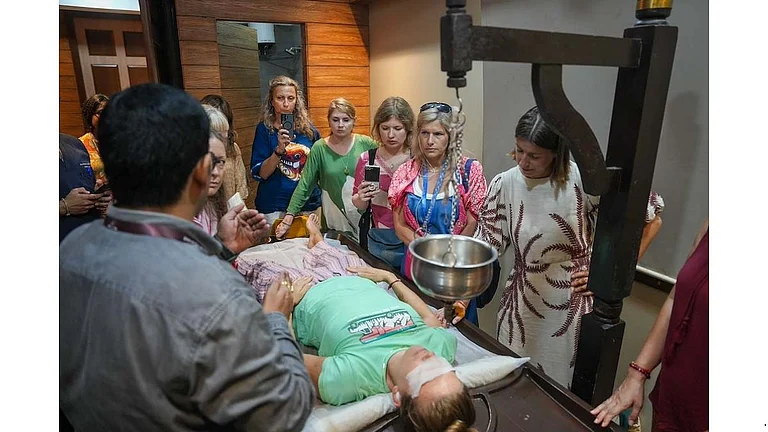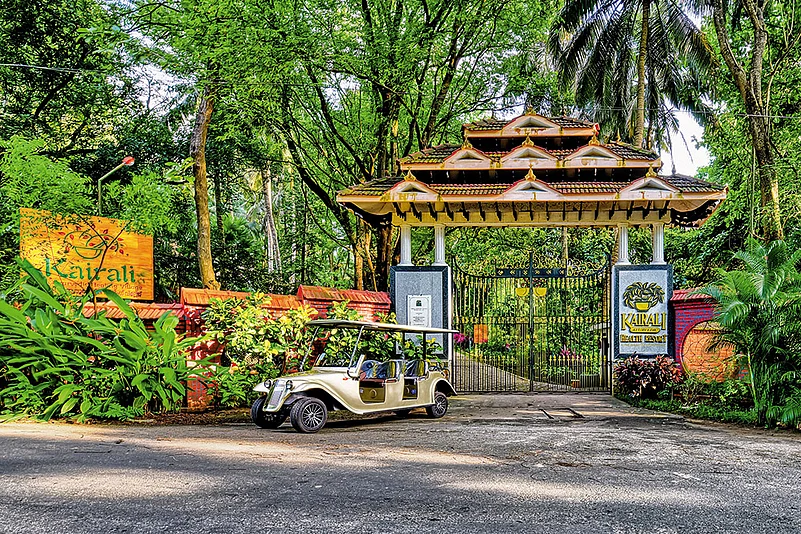
The first thing visitors notice at Kairali Ayurvedic Healing Village in Palakkad is silence. Birdsong replaces the hum of traffic. Guests surrender their phones almost instinctively, settling into a routine dictated by herbal meals, yoga sessions and therapies that can last three weeks or more.
In the late 1990s, when Kairali opened its healing village, it wasn't a hospital or a resort. The phrase wellness tourism was yet to go mainstream and medical tourism itself was still a growing idea.
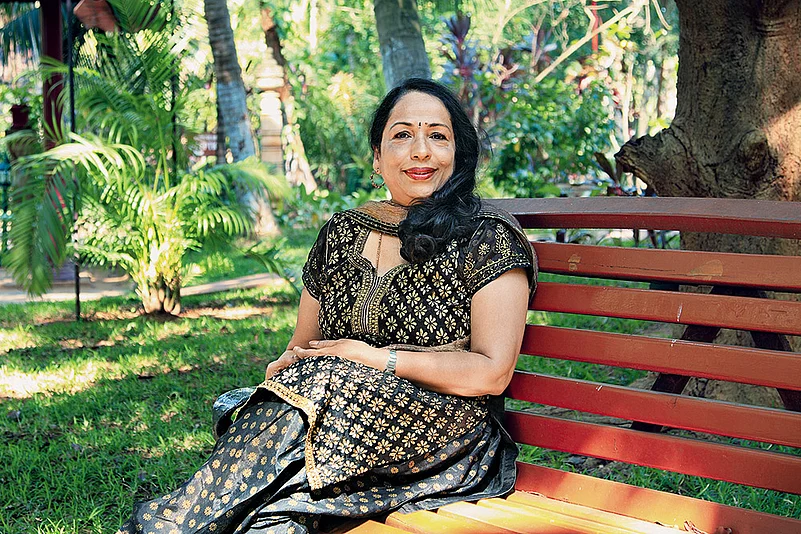
“We were actually building a category which did not exist at all,” recalls Gita Ramesh, co-founder of Kairali Ayurvedic Group.

1 September 2026
Get the latest issue of Outlook Business

“We didn't want a hospital format. We wanted a place where the environment itself makes you feel happy,” she adds.
Today, Ayurveda has become one of Kerala's biggest exports. But nearly three decades ago, convincing people to travel thousands of kilometres to spend several days following a physician-prescribed regimen of therapies, diet and meditation was a challenge. Yet, creating new categories has become something of a family tradition for Kairali.
In the beginning, Kairali's relationship with Ayurveda was far removed from commerce. It began with a sense of duty.
Now, its network has expanded to 24 treatment centres across India and nine overseas spa franchises, and it has set its sight on logging ₹150cr in revenues in the next two years.

Healing Before Business
The Kairali story traces its roots to 1908, though not in the way most corporate histories begin. There was no incorporation certificate, no factory and certainly no business plan. Instead, there was knowledge passed from gurus to disciples.
Medicines were prepared painstakingly by hand. Treatment was deeply personalised but difficult to scale. For decades, the practice remained exactly that—a practice.
The first significant transformation came six decades later. In 1968, Gita's father-in-law KSV Vasudevan established Malabar Chemicals, marking the family's transition from individual healers to organised manufacturers of Ayurvedic medicines.
It was a pivotal shift. “He realised that if Ayurveda had to survive, it had to be presented to the world in a more modern form,” says Gita. “The tradition had to be preserved, but the way medicines were delivered had to change.”
Vasudevan first explored Ayurvedic injections, an attempt to combine ancient formulations with modern delivery mechanisms. The experiment was eventually halted after regulatory restrictions, forcing him back to the drawing board.
Ayurvedic medicines in capsule form came next, making treatments significantly easier for patients accustomed to modern pharmaceuticals. Products such as Lipidex, Durance and Duravin emerged under the company's banner alongside liquid formulations for liver ailments, digestive disorders and general wellness. By the late 1980s, the family was confronted with another question: would manufacturing medicines popularise Ayurveda?
KV Ramesh co-founded the modern Kairali Ayurvedic Group in 1989 along with his wife, Gita. Later, their sons, Abhilash and Abishek, joined the family business. While Abhilash heads the resorts and products division, Abishek oversees centre development.
For Gita and KV Ramesh, the answer was obvious. “We realised manufacturing a few products wouldn't be enough. There was so much more to this science,” she says.
The obvious place to expand would have been Kerala, where Ayurveda was woven into everyday life. Instead, they chose Delhi.
Looking back, Gita still calls it her biggest business gamble. “Ayurveda wasn't known much outside Kerala. We didn't know whether this concept would really work.”
North India in the early 1990s had little familiarity with authentic Ayurveda. For many consumers, traditional medicine was a fringe concept. Those who did approach Ayurvedic practitioners often saw it as the last resort. “But when patients experienced relief within those treatment programmes, they began trusting us,” says Gita.
That trust would become Kairali's first and perhaps most powerful marketing strategy. There were no celebrity endorsements or expensive advertising campaigns. It was word of mouth. Patients who found relief became advocates, recommending the centre to family, friends and eventually international visitors. Word spread gradually, then steadily.
In hindsight, the Delhi centre became a blueprint for Kairali. It went on to shape every subsequent expansion. “The biggest lesson was that you have to remain authentic and earn people's trust,” says Gita.
By the time Kairali had established itself in Delhi, Gita and Ramesh had proved one thing to themselves: Ayurveda could travel beyond Kerala.
But this success also exposed the limitations of the model. A day-care centre could treat illnesses, but could not immerse people in Ayurveda.
“After nearly a decade, we realised it was time to take Ayurveda even further,” recalls Gita.
Back to the Roots
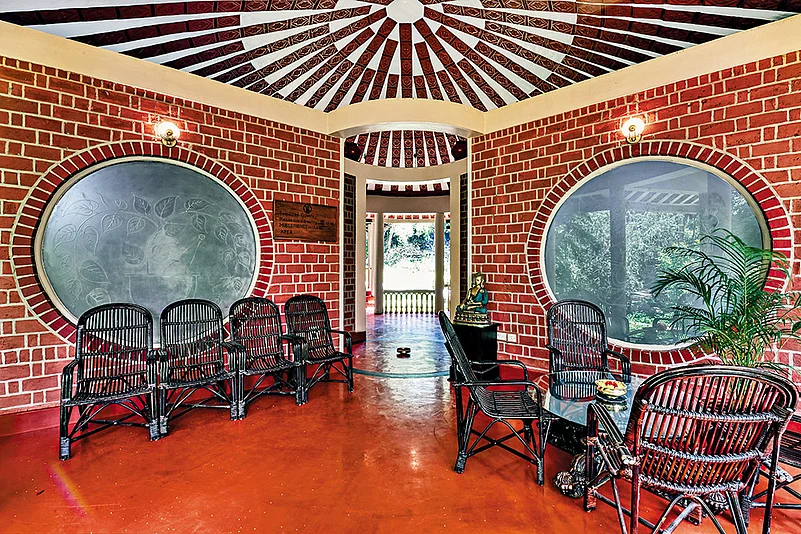
It was time for Kairali to go home. Not to recreate an Ayurvedic hospital, but to build something that didn't fall into any business category. “We wanted to build a place where the environment itself becomes part of the healing process,” adds Gita.
It was an idea borrowed directly from Ayurveda's oldest principles.
Unlike modern medicine, Ayurveda has always treated health as an outcome of harmony rather than the absence of disease. Food, sleep, emotions, surroundings, climate and daily routines are viewed as interconnected. Healing required an environment that encouraged balance.
Kairali is now exploring new international markets, including Europe, New Zealand and West Asia
That philosophy became the blueprint for Kairali Ayurvedic Healing Village in Palakkad, Kerala.
Gita's son and Kairali Ayurvedic Group's executive director Abhilash KR believes the timing was decades ahead of the market. “It was a completely new category. As first movers, we had to teach everyone what it was and why it was different,” he says.
Another challenge was convincing people to visit the Palakkad centre.
For most family businesses, growth presents a familiar dilemma. The systems that make a company scalable often threaten the very qualities that made it successful in the first place.
Ayurveda is, by design, intensely personalised. Two patients with the same condition may receive entirely different treatments. The challenge, therefore, was not simply how to grow. It was how to replicate trust.
That has shaped every major decision taken over the past three decades, says Abhilash KR. “We could have taken shortcuts, using cheaper raw materials or compromising on treatments. But we've been here for over 100 years and we want to be here for another hundred.”
The Next-Gen Choice
Gradually, Kairali has evolved into a group operating across health care, hospitality, manufacturing, education and consumer products.
Today, it has two manufacturing plants in Kerala and Tamil Nadu, and produces more than 400 Ayurvedic medicines and herbal cosmetic products. It is also expanding its consumer products business with plans to grow revenues from approximately ₹20cr now to ₹50cr in near term, while targeting ₹150cr in consolidated revenue through organic growth.
The scale itself demanded organisational change. “When we started, we never consciously thought we were building an institution,” says Gita.
One important factor that made the transition easier was her children deciding to join the business. “That is when we started creating different verticals—manufacturing separately, training separately—and the younger generation began adding newer systems and innovations,” says Gita.
Kairali's evolution is less a deliberate reinvention and more as a natural organisational necessity, observes Abhilash. “Once we reached a certain scale, we were no longer just a family business. Every vertical needed its own leadership.”
Conventional narratives around family businesses tend to portray the next generation as reluctant heirs. For Abhilash “it was never a dilemma. We had multiple verticals. I could choose the area where I wanted to contribute.”
Kairali's fourth generation is no longer simply preserving the legacy, it is reinterpreting it.
Kairali is embracing digital systems, expanding internationally, strengthening manufacturing capabilities and building a wider consumer products business while preserving Ayurveda.
That balance is visible in the company's books. Kairali remains debt-free and plans to expand to 1,000 distributors and is exploring new global markets like Europe, New Zealand and West Asia.