
Thirteen years ago, Rahul Verma was trading currencies and bonds out of financial hotspots across the globe. Today, he is more likely to be found discussing the fat content of buffalo milk with a farmer in a village on the outskirts of Jaipur. And the pivot to this shift is FruBon, the dairy and ice-cream start-up he built with his father and brother.
‟We wanted to have a second innings in dairy,” Rahul says, describing the year 2015, when the idea for FruBon was born. Back in 2004 the family had launched Dev Milk Foods, a company that transported milk.
‟I felt there was a huge opportunity to build a consumer brand for dairy products rooted in quality, transparency and long-term relationships,” says DD Verma, a dairy technologist trained at the National Dairy Research Institute in Karnal and Rahul’s father. That small-town India deserves what big-city consumers get.

1 September 2026
Get the latest issue of Outlook Business

Milky Way
Rahul, an alum of IIT Bombay and IIM Ahmedabad, who had spent a decade as a banker with HSBC, Lehman Brothers and Nomura, had moved back to India in December 2013. His brother Rohit, also an electrical engineer, had already quit his job at Tata Consultancy Services and was back in Jaipur.
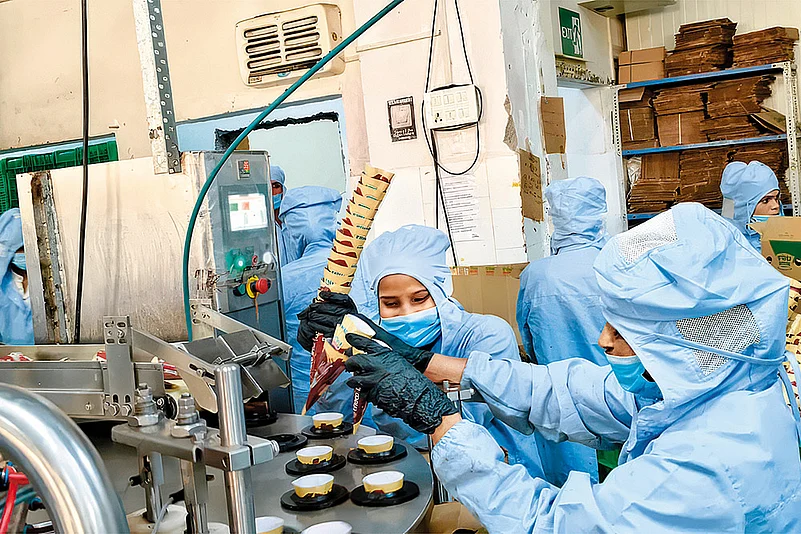
In 2015, the family bought a parcel of land at Mahindra World City, on the outskirts of Jaipur to build FruBon’s manufacturing plant. Commercial production began in April 2017.
The path to success was littered with bumps. Issues cropped up in myriad ways: in a cold room at two in the morning, in a delivery van driving too fast through the summer heat, in the half hour of lost refrigeration that ruined a batch of ice cream before a single consumer had tasted it...
FruBon's share of the organised ice-cream trade has grown from 2-3% during Covid to close to 14% last year
‟It is the most sensitive category with respect to the cold chain. It is not like bhujia or biscuits,” Rahul says. Every batch of paneer, curd or kulfi that leaves the plant travels through a chain of refrigerated vehicles, warehouses and dark stores before it reaches a customer, and a single lapse along that chain can undo months of trust-building with a new brand.
Rohit, who has spent much of the past decade building that chain, put it in starker terms. ‟Cold chain is critical at every step...Our end-to-end control of the supply chain including procurement and manufacturing ensures a much tighter control over quality,” he says.
FruBon draws roughly 90,000 litres of milk a day from 55 collection centres around towns such as Reengus, Sikar, Dudu, Shahpura and Niwai, sourced through 300-plus village-level centres linked to some 9,000 farmer families. Rahul is quick to point out that the relationship with these families goes beyond a milk cheque.
Verma senior had moved payments entirely online years earlier, ending a culture of cash transactions; FruBon has continued with that practice, paying every rupee digitally and, crucially, on time, even through Covid-19. In return, farmers buy cattle feed and household ghee from the company. FruBon's field teams, some of whom have worked in the same villages for years, run vaccination camps, women's financial-literacy sessions and empowerment workshops. ‟It is not just a transactional relationship,” Rahul says. It is, in his telling, a slow accumulation of goodwill that lets a nine-year-old company scale up.
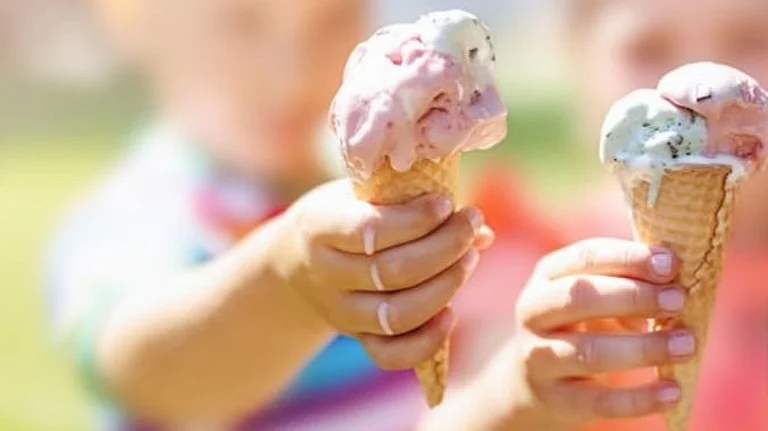
The fruits of that labour shows up on supermarket shelves in flavours most large dairy brands wouldn't bother stocking outside a metro parlour: rose-gulkand, paan, kesar-kulfi, litchi faluda and chilli guava sold in 300ml tubs priced between ₹100 and ₹150.
FruBon has also carved out categories few organised players have touched, such as butter made using the traditional bilona-churning method, and makkhan mishri, an offering usually sold outside Krishna temples.
Milk Van Rolls On
FruBon's share of the organised ice-cream trade has grown from roughly 2–3% during the pandemic to close to 14% last year, with a target of 20% this year. On quick-commerce platforms, its dairy revenue has climbed from about ₹1cr a month in April 2024 to more than ₹5cr now, while ice-cream sales on the same platforms have gone from ₹50 lakh to ₹3.5cr a month in a single year. The company closed the last financial year with revenue of just over ₹200cr and is targeting ₹300cr this year.
None of it has been cheap. FruBon ran on promoter capital and a small angel round until 2022, when industrialist Narotam Sekhsaria's family office led its first institutional round of roughly ₹17-18cr. In January 2024 venture-capital firm Fireside Ventures stepped in, taking total external funding past ₹100cr.
What convinced Fireside that FruBon wasn't just another regional dairy business was that the dairy company tested every batch of raw milk across 36 parameters, well beyond what Food Safety and Standards Authority of India requires.
‟In a category where most players consider compliance a ceiling, FruBon treated it as a floor,” says Adarsh Menon, partner, Fireside Ventures.
The dairy and ice-cream company is now raising another ₹75–100cr, to be invested in a new plant with a starting capacity of 3 lakh litres a day, retail infrastructure such as deep freezers and ice-cream carts, and, for the first time, on brand building.
What FruBon is trying to become is the brand that proves quality and aspiration don't have to be privileges of the metro. In Indian dairy, it has been remarkably hard. That's exactly why it's worth doing.