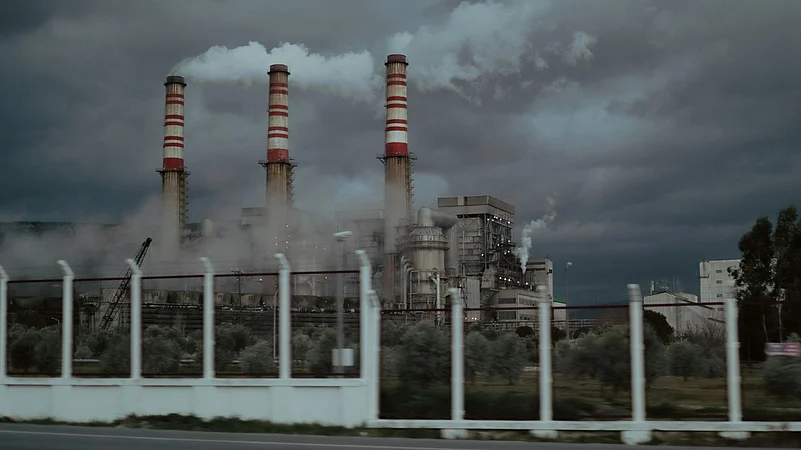

India will not add coal plants after 2035, says power ministry.
Grid challenges and renewable integration delay decisions on future coal capacity.
IEA report highlights storage, upgrades needed to reliably absorb clean energy.
India is not planning to build more new coal power plants after 2035, a top power ministry official told Reuters on December 7.
"India wants to secure its energy requirements," Pankaj Agarwal, secretary at the power ministry told Reuters on the sidelines of a power ministry event. "As on 2035, we want to have a coal capacity of 307 gigawatts."

1 September 2026
Get the latest issue of Outlook Business

India this year proposed increasing its coal power capacity by 46% from the current 210 GW while doubling its non-fossil fuel capacity of 500 GW by 2030. Agarwal said the coal power plans are in line with the country's energy requirements.
Presently, India is facing grid challenges due to the integration of surplus clean energy into the grid and has curbed power output for most months this year.
As reported by Reuters, the country may take a call on adding more coal capacity after taking three years to understand how power demand is growing and the speed of integration of clean energy into the grid.
India should also evaluate grid challenges and the cost of storing excess clean energy in batteries and sending it to the grid before taking decisions on adding more coal capacity beyond 2035, he said.
In seven of the eleven months this year, India's coal-fired generation—which normally makes up around 75% of the country's electricity output—has decreased annually for the first time since 2020 as temperate weather decreased the need for cooling.
Advertisement
However, in order to handle an anticipated spike in evening demand, a number of Indian utilities are entering into long-term agreements with coal-fired power plants.

Global Renewable-Integration Risks
According to the International Energy Agency (IEA) report titled ‘Integrating Solar and Wind: Global experience and emerging challenges’ published in September 2024, while solar and wind capacity doubled their share of global electricity generation from 2018 and their share of electricity generation almost doubled, their reliability is not automatic as variable renewable energy (VRE) adds supply variability.
The IEA report further warned that without adequate integration measures – such as grid upgrades, storage, demand-response and better dispatch flexibility—the global power sector could jeopardise up to 15% of solar and wind energy generation globally by 2030.
Advertisement
This shows that increasing clean energy capacity is insufficient for nations like India. To reliably absorb intermittent renewables, the power system needs smart upgrades like storage, a more robust grid infrastructure, and flexible conventional backup. This helps prevent over-reliance on coal or shortages of electricity.