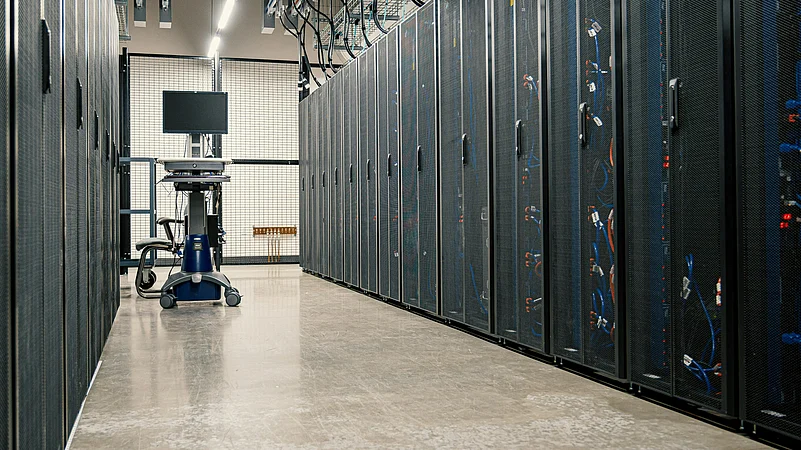


India holds structural edge in APAC data centre race.
Capacity may expand from 1.5 GW to 10 GW.
AI-driven demand to sharply raise electricity consumption levels.
India’s electricity transition at the subnational level is now marked by wider, albeit uneven, progress across states, according to the findings of a new joint report by the Institute for Energy Economics and Financial Analysis (IEEFA) and Ember.
The third edition of IEEFA and Ember’s Indian States’ Electricity Transition (SET) report, based on a three-dimensional framework, indicated that while some states are continuing to advance steadily in the fiscal year (FY) 2025, others have built momentum and a strong foundation for rapid progress. The uneven progress is owing to differences in resources, development priorities and institutional capacities.

3 February 2026
Get the latest issue of Outlook Business

“All the 21 states assessed have advanced on multiple fronts, even as the pace and areas of focus vary,” says Vibhuti Garg, Director – South Asia, IEEFA and a co-author of the report.

“Such divergence is inevitable at the sub-national level given the structural and historical factors, including differences in resource endowment, development legacies, states’ fiscal and economic conditions, rural-urban composition, and institutional capacity within the power sector. Going forward, understanding these state-level differences and gaps in progress is essential for designing targeted policies and interventions,” she added.
Co-author Ruchita Shah, Energy Analyst, Ember, said, “India’s electricity transition is maturing into a multi-speed transition, where instead of a single leader across all areas, we are witnessing new leaders in specific areas. This requires a more targeted approach to policies and interventions to ensure the momentum is evenly spread.”

Strong Performance Despite Recalibration
Despite a change in methodology for SET 2026, including a recalibrated mode of measurement for the capacity addition parameter and the inclusion of hydro capacity, Karnataka remained a top performer in the decarbonisation dimension of the report. Himachal Pradesh and Kerala, too, did well in this dimension that tracks states’ progress in expanding renewable electricity and decoupling economic growth from emissions.
Tamil Nadu, Maharashtra, and Rajasthan improved their performance in this dimension owing to their energy efficiency interventions, reflected in their State Energy Efficiency Index (SEEI) 2024 scores. The readiness and performance of the power ecosystem dimension, which assesses the distributed solar adoption, power supply reliability, and DISCOM performance of the states, incorporated stakeholder feedback to strengthen the assessment parameters. These changes better align the dimension with the current realities.
Even after incorporating the changes to the parameters, Delhi and Haryana continued to perform strongly. Robust distributed solar adoption in these states, alongside reliable power supply and relatively sound DISCOM performance supported their performance. Chhattisgarh and Bihar, too, stood out in this dimension due to improvements in their DISCOM performance since the SET 2024 analysis. In FY2025, Chhattisgarh recorded a negligible power supply shortage of 0.07%, while Bihar recorded the highest percentage of progress in smart meter deployment (78% of its sanctioned meters) under the Revamped Distribution Sector Scheme (RDSS) as of March 2025. Assam, too, emerged as a notable performer, completing installation of 46% of its sanctioned smart meters under RDSS.

National Energy Targets Aligned
India has committed to achieving 500 GW of non-fossil capacity by 2030 and meeting 50% of its electricity requirements from renewables, according to the Ministry of Power.
The ministry stated that India has already added a record power generation capacity of 52,537 megawatts (52.5 GW) from all energy sources in the first 10 months of the 2025-26 financial year, pushing the total installed capacity to 520.6 GW as of January 2026.
"This marks the highest ever capacity addition in a single year, surpassing the previous record of 34,054 MW achieved during FY 2024–25," the ministry stated in its press release.