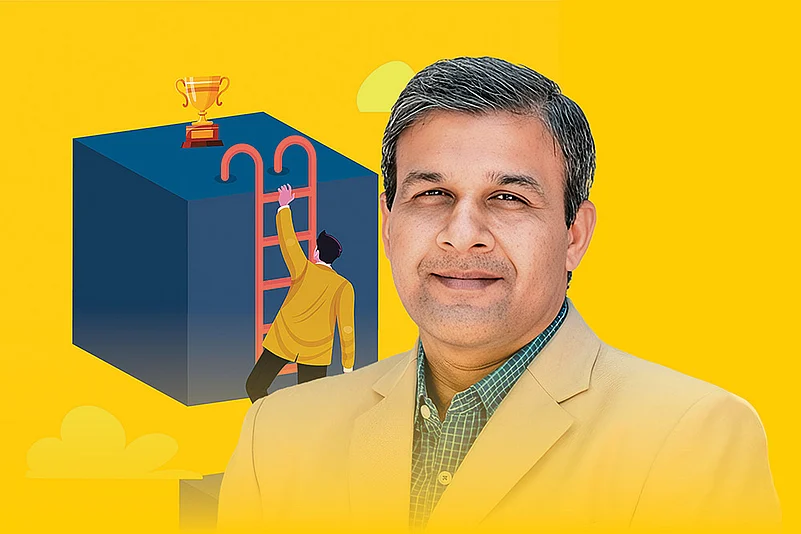

Every big brand started small. Tech giants Amazon and Apple started from garages. Their founders began with an idea that they believed in and went on to create some of the world’s most-valued companies.
Scaling up is, however, not an easy feat. Having a world-class product may not be enough. Based on a sample of 3,164 companies with Series A funding, it was found that companies have a greater than 80% chance of failure even when they have a successful product. Interestingly, investors attribute that 65% failures in their portfolios happen due to people and organisational issues.
Based on my interactions with founders who are trying to scale their organisations, I have observed five common aspects that hinder or facilitate smooth transitions from a founder-driven organisation to an organisation that is run by a CEO and executives.
1 September 2026
Get the latest issue of Outlook Business

Founder’s Mindset Shift
Given that a start-up is a founder’s baby, it is often times difficult for the leader to understand that they need to shift away from the control-oriented mindset to a strategy-oriented mindset. I often summarise this challenge as the question: are you 'working in the business' or 'working on the business'?
‘Working in the business’ means that the founder is totally engrossed with the day-to-day operations and hardly has any time to think of what steps need to be taken on a strategic level to scale the business. This is where the problem happens and research shows that 78% of start-ups fail to see their products to full scale.
The job of the founder is to be able to spot talent and give them charge of the day-to-day operations
The job of the founder is to be able to spot talent and give them charge of the day-to-day operations. According to a survey of about 600 family-owned businesses, 86% of respondents at top-performing businesses agreed or strongly agreed that their company attracts the best talent. More than 90% agreed or strongly agreed that their company successfully identifies, trains and develops their best talent.
Data also shows that businesses take time to build a pool of professional executives. It is only by the third generation that businesses learn to appreciate the value that professional talent can bring. It is important for the founder to shed this mindset of doubt and focus on building a pool of talent that can help them put their organisation on a high-growth trajectory.
In my current consulting assignment with a start-up, I am helping the young founder understand that his role is to find the best-fit talent for his organisation and delegate operational details to the person who can perhaps handle it much better.
Structure That Can Scale
Another crucial element for founders to understand that as their company scales, it is important for them to understand that a well-defined organisational design is a must.
A structure must clearly specify roles, specialisations (work-wise or product-wise) as well as ways in which coordination and communication will happen between different specialisations. Structural choice is about striking a balance between differentiation and integration.
As organisations scale and the operating environments become complex, founders will need to think of specific functions, be it business development or marketing, that may act as eyes and ears for the founder.
A few years ago, I did consulting for a mid-sized business house. I was surprised to see that the founder had never thought of creating a formal organisational chart for the organisation.
Everyone could approach him for even the smallest of issues. The environment had degenerated into politicking and please-the-boss mentality. People were given titles just to make them feel happy. And fancy titles really meant the same work with no real change.
I define a 'TRUST' culture that is made of five elements: transparency, reverse accountability, unity of purpose, psychological safety and talent focus. As organisations transition from a founder-led to a professional CEO-led organisation, it is imperative that the leader spend a good amount of time in establishing these five core aspects.
Promoting Self-Management
Last, the founder should encourage the team to take decisions themselves. In a way, this aspect is called as building the capacity to ‘self-manage’.
It is very likely that even after doing the needful, the organisation degenerates into a place where for every critical decision, executives look up to the founder for a green signal. Such a thing would violate the principle of ‘self-management’.
The founder should perhaps ‘go away’ (figuratively and realistically) for some time and emphasise that the top management team must take the decisions they think is best for their business. The founder can participate in such discussions as an equal and it is possible that the top management team shoots down their idea. And they should be fine with it.
The founder must remember the principle that the ‘highest form of leadership is the act of becoming redundant’. Mistakes will happen on the way. But mistakes should be treated as moments of learning and means to strengthen self-management rather than as evidence that the founder is needed for day-to-day management of the business.
The aspects listed above begin from the founder’s mindset and culminate in creating a self-managed organisation, through the mediating steps of hiring the right talent, establishing structure and building a culture of trust. It is possible to create highly scalable and successful business if the founders begin to realise that their role should be best understood as steward rather than as a controller.
The writer is professor at the Indian Institute of Management Ahmedabad