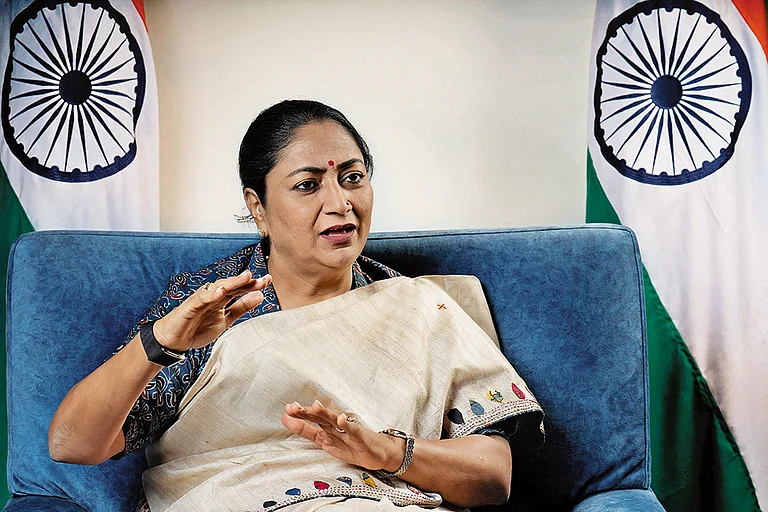
Born and raised in Delhi, Rishabh Goel, chief executive of fintech firm Credgenics, believes the city offers a more start-up-friendly environment, especially for early-stage founders who may not be ready for Bengaluru’s high-decibel setup. “One key difference is mindset. In Bengaluru, start-ups can sometimes feel more ‘fashionable’. There’s a lot of noise,” he says.
It is no wonder then that Delhi is quietly emerging as a major start-up hub, surpassing cities like Bengaluru, Hyderabad and Mumbai. The city is leveraging a combination of favourable policy environment, access to decision-makers, talent availability and market proximity.
And this year, Delhi ranks as the top city for nurturing a robust start-up ecosystem with a score of 96.5, inching ahead of Bengaluru (95), in the Outlook Business Outperformers 2026 rankings.
1 September 2026
Get the latest issue of Outlook Business

Numbers back Delhi’s rise as an important hub for founders. According to the Department for Promotion of Industry and Internal Trade (DPIIT), the number of start-ups in the city rose from 3,293 in 2019 to 15,867 in 2024, a growth of over 381%.
What also works in Delhi’s favour is its historical importance as the epicentre of trade and policy.
Cost and Connectivity
According to data platform Tracxn, Delhi has seen enterprise applications (4,562) and retail (4,510) dominate new company formation, followed by edtech (2,262), media and entertainment (1,811), and health tech (1,701). Fintech (1,573) remains strong, while food and agriculture tech (1,039), and transportation and logistics tech (941) sit mid-tier. Travel and hospitality tech (823), and auto tech (793) see the fewest applications.
Sumit Suneja, co-founder of Rabitat, a direct-to-consumer (D2C) children’s brand, notes that Delhi’s proximity to key states like Rajasthan, Uttar Pradesh and Haryana plays an important role. Seamless access to major satellite cities like Gurgaon, Noida, Greater Noida, Ghaziabad and Faridabad, helps too.
“Delhi is also a stone’s throw from key manufacturing centres. This enables us to maintain efficient manufacturing costs and ensures quick access to raw materials and production partners,” adds Suneja.
Founders also highlight that the city is more affordable, particularly in terms of housing and commute, aided by its vast Metro network. Bengaluru and Mumbai are much heavier on the pocket.
“In Delhi, it’s not impossible to get from point A to B within a predictable timeframe, which is a big relief compared to some other hubs,” says Abhinav Chetan, founder of Digital for Nonprofits (D4NP), an online resource centre.


Academia and Talent
Delhi also boasts of some very premier institutions like Indian Institute of Technology (IIT), All India Institute of Medical Sciences, Jawaharlal Nehru University, Jamia Millia Islamia and the Delhi University. As India pivots towards a more R&D-driven start-up ecosystem, strong academic presence in cities like Delhi is increasingly facilitating innovation-led entrepreneurship.
Founders say Delhi is more affordable, particularly in terms of housing. Bengaluru and Mumbai are costlier
The capital is home to 16 universities, eight deemed universities, six institutions of national importance and over 200 general and professional colleges, creating a dense talent and research base.
Nivedita Shrivastava, chief executive of Thought2Design System, a deep-tech start-up incubated at IIT Delhi, notes that the ecosystem helps spark the idea to launch ventures and provides access to a rich pool of talented individuals.
Delhi hosts the highest number (95) of incubation centres in the country. For Suneja, access to Delhi's high-quality talent pool is critical for a growing D2C brand like Rabitat.
Capital and Customers
According to Tracxn’s Geo Quarterly India Tech Report, Delhi has emerged as the leading start-up hub, accounting for 40% of India’s total start-up funding and surpassing Bengaluru to claim the top spot.
Chetan, who also founded Digicated.ai, an advisory, believes Delhi has the highest density of non-profits and funders. “By funders, I don’t just mean venture capitalists, but also CSR [corporate social responsibility] funds, institutions and trusts,” he says.
Reiterating this view, Suneja says that Delhi allows start-ups to tap into a deep supplier and logistics ecosystem. “This accelerates our go-to-market timelines and enables faster scale,” he adds.
Delhi's pace also adds to its charm. Credgenics’ Goel says the quieter setting allows founders to build and scale at their own pace. “In Delhi, companies have a stronger focus on building sustainable ventures rather than just chasing capital,” he adds.
Though Delhi offers a conducive environment to start-ups, it is not without challenges—air and water quality remain critical concerns. Moreover, as Delhi’s start-up ecosystem is closely intertwined with its satellite cities, sustained growth will require a more unified action.