Summers are brutal across the dust bowls of North India. Rajasthan is no exception with temperatures touching 50°C with gusts of loo lacerating the state. The year 2024 was especially bad (later Met data would show it to be the hottest year ever recorded).
Sitting in his office at AU Small Finance Bank in Jaipur, Ashish Sharma got thinking. How did people survive in this heat without an air conditioner (AC)? Can ordinary people afford one? Will electricity bills burn a hole in the pocket? Why do consumers buy big AC units for small rooms? Is it possible to manufacture ACs with the ‘right’ tonnage at affordable prices?
Sharma turned to his friend Aman Munka. And for obvious reasons.

1 October 2026
Get the latest issue of Outlook Business


Friends Forever
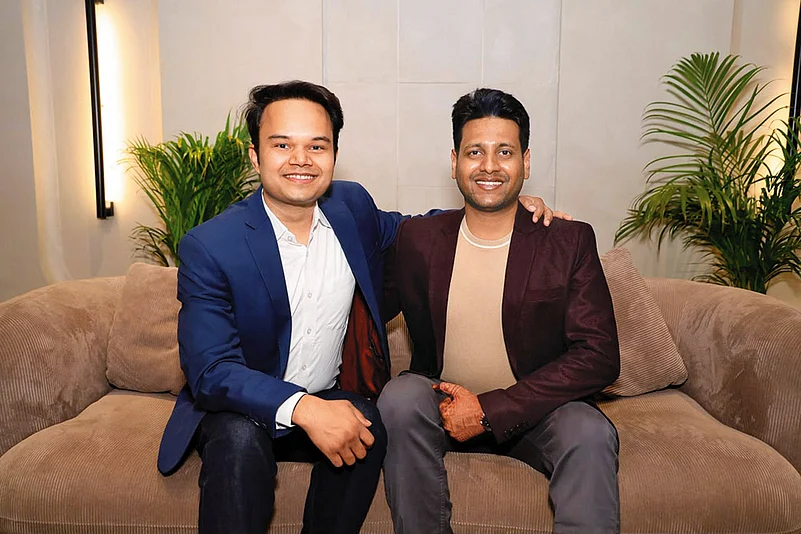
Sharma first met Munka in Kota, both from Jharkhand, both preparing for the Joint Entrance Exams, both carrying a similar socioeconomic background that gave them, as Sharma puts it, a lot of shared values. That shared foundation carried them to IIT Kanpur for their undergraduate engineering degrees, and then, remarkably, to the same employer after graduation: Edelweiss in Mumbai, 2018.
In 2021 Sharma moved to work for AU Small Finance Bank. Munka, meanwhile, joined ShareChat in Bengaluru. The two friends came together to beat the heat in a way. They had to solve three problems.
The first was size. “Most Indian air conditioners sold today are 1.5-tonne units, not because most rooms need that capacity, but because larger units carry higher margins for retailers.
The typical Indian living space, even in newer high-rise constructions in cities like Gurgaon or Hyderabad, rarely exceeds 100–120sq ft per room,” says Sharma.
The second was efficiency. Sharma and Munka wanted to make India's most efficient air conditioner, consuming less than ₹30 a day running for an average six to eight hours daily. According to Sharma, running a 1.5-tonne AC for the same duration costs at least ₹120.
The third was full digitisation. Every aspect of running the AC—electricity consumption, service scheduling, analytics and even safety alerts like gas leak detection—was to be digitised.
The two reached out to their alma mater IIT Kanpur, specifically to the institute's thermal engineering experts and professors, to develop the core technology. The defining problem in the early days, which took the team roughly ten months to work through, was building an AC that could perform reliably in Indian heat and humidity, without becoming prohibitively expensive. Balancing performance against price in cost-sensitive India was the defining problem of those early months.
Helium Air was officially incorporated in July 2025 and the first batch of 0.8-tonne ACs were sold from May 1, 2026. On the way the company raised a $2mn seed round from India Quotient, an early-stage venture-capital fund.
Why Jaipur?
The decision to headquarter Helium in Jaipur, rather than a metro came down to two practical reasons. First, Sharma was already based there. Second, Jaipur's connectivity worked in the company's favour: the Delhi–Mumbai Expressway and Vande Bharat trains put it within easy reach of the Delhi-NCR start-up ecosystem, while still offering a quieter environment to build in.
But the deeper reason ties directly to who Helium is building for. The company's target customer isn't concentrated in India's metros but in cities such as Jaipur, Indore, Bhopal, Patna and Varanasi among others. Staying close to that customer base, rather than chasing the metro-first playbook shaped the headquarters decision as much as logistics did.
“Being headquartered outside a metro hasn't been a talent constraint either,” says Sharma Neither he nor Aman is originally from Jaipur; both are from Jharkhand. He argues that younger professionals today are geography agnostic. Cities like Jaipur, Hyderabad, Indore and Pune are becoming start-up hubs simply because that's where opportunity and talent are now converging.
The defining problem in the early days was building an AC that could perform in Indian heat and humidity
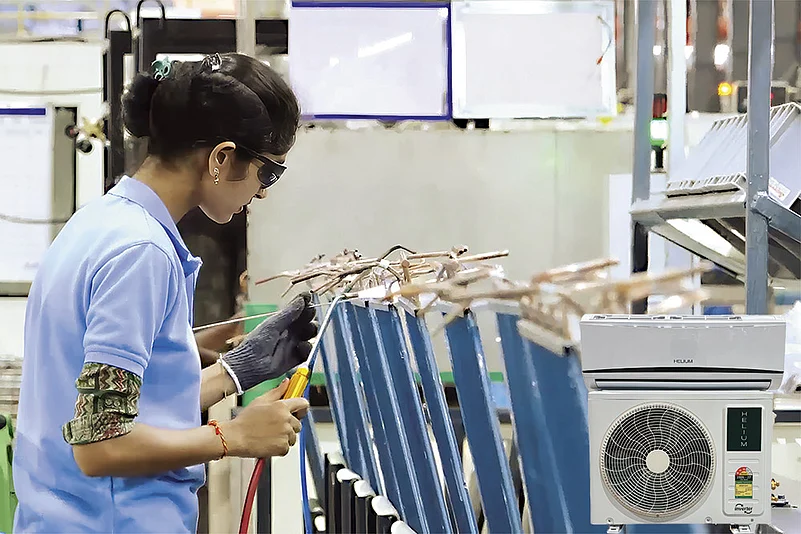
Helium has two manufacturing facilities, one in South India and the other in the north, while Jaipur houses the company’s central functions: marketing, operations and service teams. Warehousing tells its own growth story. The company started with a single warehouse in Jaipur. Customer response arrived faster and stronger than the company's own projections had modelled, and within a short period, Helium had to expand to six warehouses across the country, organised regionally: north near NCR, east near Kolkata, south near Bengaluru and west near Mumbai, among others.
More Than Cooling
The story isn’t over yet. Speed bumps remain. Ongoing global conflicts have disrupted supply chains and raw material costs of copper have risen. These, says Sharma, aren’t unique to Helium but are being felt across the entire air-conditioning industry.
Customer feedback, according to Sharma, has centred on two things in particular: the effectiveness of the cooling itself and a dedicated monsoon mode built to handle the country's humidity swings, alongside the transparency of the app-based controls that let customers see exactly what their unit is doing at any given moment.
The mission, he says, is broader than simply selling air conditioners. The goal is to make every Indian household air-conditioned, so that children have a more productive environment for studying and families have a comfortable indoor space to return to after work. Comfort, according to Sharma, directly impacts productivity and quality of life; it is not a luxury reserved for those who can afford premium cooling.