


Sreekuttan LS returned to India in 2023 after completing his tenure at a quantum-computing start-up in Canada. The following year, he co-founded Bloq, a quantum-software start-up. Soon, with his vision and prototype intact, he was ready for his first investor meeting.
He explained to the investor how his start-up was developing quantum technology capable of solving problems beyond the reach of classical computing. He highlighted his innovation’s market potential.
The investor replied after a long pause. “What you are building is interesting, but this is not something that will generate returns anytime soon. Come back after three or four years when the technology is more mature,” Sreekuttan was told.

1 October 2026
Get the latest issue of Outlook Business

He was dejected, not knowing that a lot is going to change in a couple of years.
In April this year, his phone rang. Sreekuttan’s friend called to inform him that the Department of Science and Technology (DST) had invited proposals from quantum start-ups for funding under the National Quantum Mission (NQM). It was the same initiative announced by Finance Minister Nirmala Sitharaman during her Budget speech in 2020 amid the pandemic.
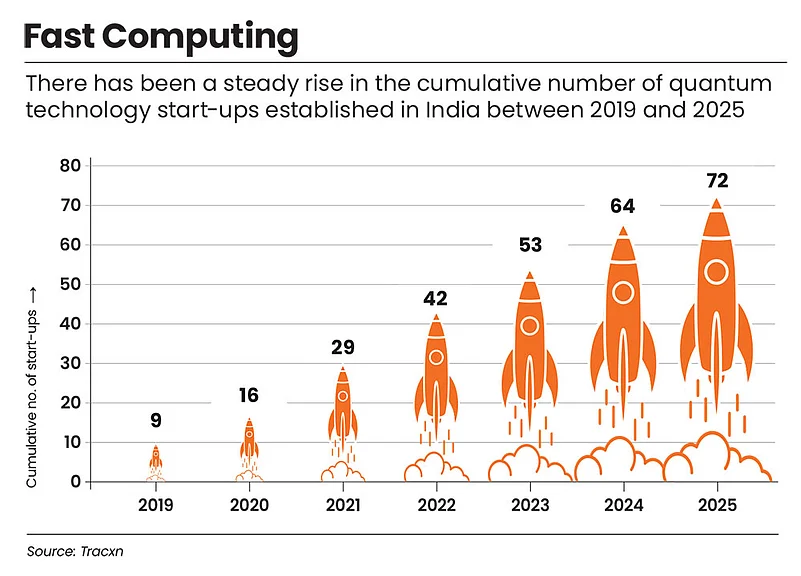
It wasn’t long before Sreekuttan submitted his application. While he is yet to receive a response, the application itself is changing how investors perceive his start-up. Finally, he felt that the long-gestation nature of quantum technology was being acknowledged. The same venture capitalists (VCs) who once questioned the commercial viability and timing of his product were now showing interest.
Sharing a similar journey, quantum start-up Sense XT Innovations’ co-founder Manas Thakur recalls that the idea for his venture took shape in 2023. Thakur and other co-founders—Najes Riaz and Sourav Sarkar—were confident about the technology, but not about funding. Coming from middle-class backgrounds, accessing early-stage capital was particularly difficult for the team.
“As researchers, we realised that scientific innovation alone is not enough. To scale the technology and make it accessible, we had to think like entrepreneurs,” says Thakur.
They applied for multiple grants, but no luck. One of the biggest hurdles was establishing credibility, say Sense XT founders.
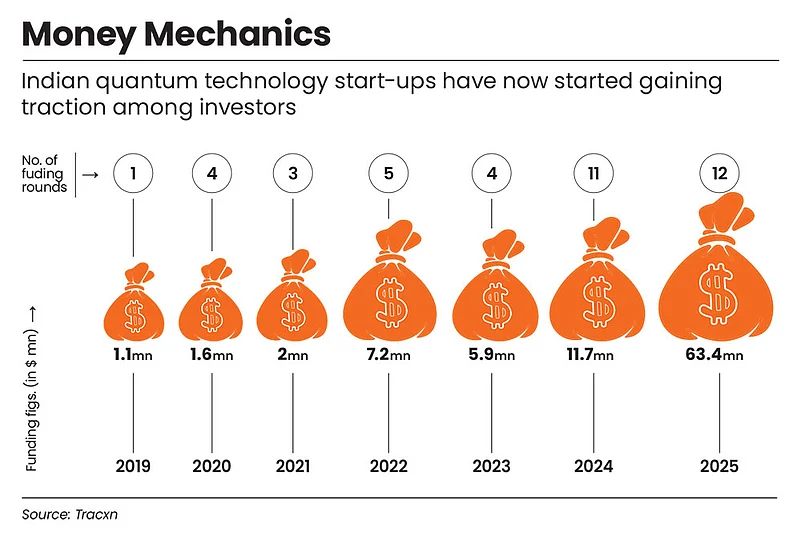
Then came NQM. Initially, they were uncertain whether they would even qualify. But when Thakur’s start-up was eventually picked up, recognition was the biggest gain for him. “Before NQM, there was very little validation. Investors found it difficult to understand both the technology and its commercial potential,” says Thakur. NQM provided both credibility and much-needed institutional support. “Several investors have started reaching out to us,” he adds.
However, private money is still largely missing from this space. For now, the onus is on NQM and similar initiatives to place these start-ups on the private money map. But is state-backed funding enough?

Global Race
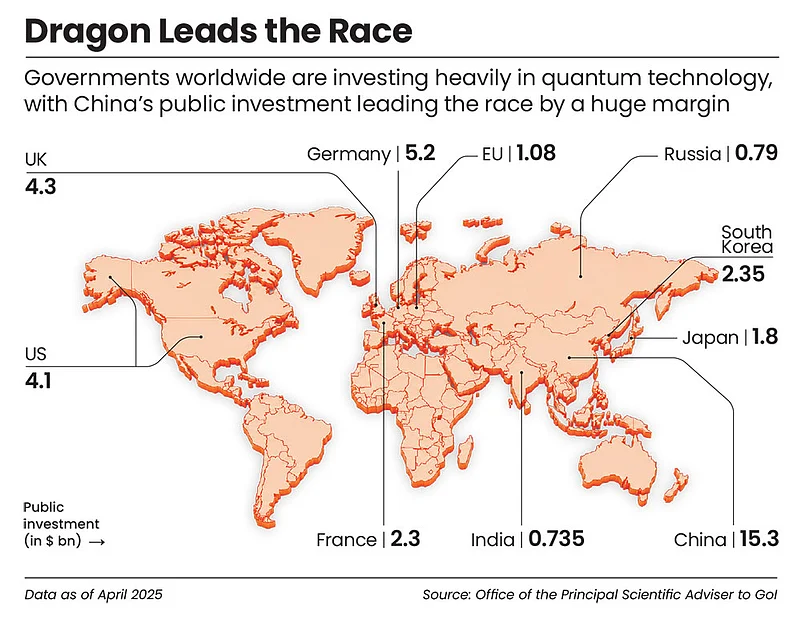
While in 2019, ₹8,000cr was allocated to NQM, it was cut to just over ₹6,000cr (around $735mn) during its launch in April 2023. This was India’s first major commitment towards building a quantum-technology ecosystem.
Still, funding under NQM is modest when compared to billions of dollars being spent by China and the US, who already have a solid headstart in the quantum space.
China launched the world’s first quantum-communication satellite, Micius, in 2016, positioning it at the forefront of quantum-communication research. The US passed the National Quantum Initiative Act in 2018 with $1.2bn in funding to coordinate quantum research and development (R&D) efforts across government agencies, universities and private industries.
But why such heavy bets?
Anil Prabhakar, a professor at the Centre for Quantum Information, Communication and Computing at Indian Institute of Technology Madras (IIT-M), explains it through an analogy. “Classical computing is like trying to build a faster car, but no matter how advanced the car becomes, it will never allow you to fly. To fly, you need an an airplane. Quantum represents that fundamentally different way of thinking about computation,” he says.
Experts and academicians believe quantum may significantly impact several areas of societal importance, including cryptography, logistics and climate science.
Quantum computers have the potential to solve certain highly complex problems at speeds that are currently impossible with classical systems.
The strategic and national-security implications also play a big role. Experts believe that sufficiently advanced quantum computers could eventually break existing encryption systems that protect banking networks, military communications and digital infrastructure worldwide. No wonder, there is a race now to take the lead in quantum technology.
According to government data, China leads global public investment in quantum by a huge margin, with $15.3bn. Germany follows with $5.2bn, while the UK and the US have invested $4.3bn and $4.1bn, respectively. India ranks 12th here.
Gains and Challenges
Nevertheless, India has joined this race. Now, a lot depends on how this initiative is structured to continue the momentum. Quantum technology is still a very resource-intensive field, which makes controlling and commercialising it extremely difficult.
Sense XT’s Riaz points out that this technology requires sophisticated cooling systems, advanced infrastructure and significant capital investment, making the sector difficult for smaller private investors to back.
So, he credits NQM for helping early-stage founders like his team, largely composed of PhD scholars, in bridging the gap between research and business. “It helped us learn how to explain complex technology in simpler terms and communicate its commercial value to investors,” he says.
But what separates NQM from conventional public-funding schemes for deep-tech start-ups?
Many founders say they remain uncertain about market demand and are often unsure if they will find buyers
“Quantum requires extensive research. We realised that traditional start-up funding models where companies receive ₹20 lakh, ₹1cr or ₹2cr would not work here,” says Ajai Chowdhary, chairman of the Mission Governing Board of India’s NQM.
He explains that the quantum space demands significantly higher capital investment. So, the mission adopted a different funding approach. “We decided that each start-up could receive anywhere between ₹2cr and ₹30cr. This gives them the ability to conduct research, build products and eventually take them to the market,” adds Chowdhary.
However, there are still significant gaps in NQM. Since its launch, only 17 start-ups have been selected, a reflection of the limited depth of foundational research and early-stage quantum innovation.
Some founders also argue that the current funding support under NQM cannot meet the long-term needs. It is only a modest starting point for quantum technology.
NQM is still evolving though. It has provided a starting point for investors by validating quantum technology as worthy of long-term capital attention.
The Ground Truth
Much of the VC hesitation stems from the belief that it’s still too early to place a bet on quantum as it’s far from large-scale commercialisation and may not generate immediate returns. This also highlights a deeper gap between foundational research, industry readiness and entrepre-neurship in India’s quantum space.
India’s investment in R&D remains relatively low. According to government data, India spends only around 0.6–0.7% of its GDP on R&D.
In comparison, China spends around 2.4%, the US about 3.5% and Israel nearly 5.4%.
As for foundational research, IIT-M’s Prabhakar explains that Indian academic institutions are typically able to develop technologies only up to proof-of-concept demonstrations within laboratories. “But beyond that stage, industry participation becomes essential to take the technology from proof-of-concept to what we call a minimum viable product,” he says.
In the broader ecosystem, private investment will play a critical role. Experts warn that continued hesitation from VCs could hurt India in the long term. Chowdhary says the biggest challenge is limited awareness about quantum among investors.
“Quantum today is where AI [artificial intelligence] was five years ago. This is the time to invest. If someone had invested in OpenAI ten years ago, the returns would have been enormous today. Timing matters,” he adds.
Lack of government procurement, too, is a sore point. Founders are often unsure whether they will find buyers.
In countries like China and the US, start-ups working in strategic technologies are backed via procurement programmes. Prabhakar says India must adopt this model to gain an edge.
Chowdhary agrees. “If a start-up develops a product that is strategically important, the government should support it through procurement.”
Quantum is also an opportunity for India to reverse the brain drain it witnessed during the 1990s. Nagendra Nagaraja, founder of deep-tech start-up QpiAI, says most of his team is made of people who have returned to India to work in the quantum space.
Though this signals the long-term potential, the quantum technology space needs more than policy intent.
Sustained and large private capital in R&D, stronger industry participation and commercially viable products will ultimately determine if India can translate its early bet into global leadership in the quantum era.



