
India’s freedom struggle would not have been possible without the financial backing of the industrialists of the time. From the Civil Disobedience Movement to Quit India, whenever Mahatma Gandhi and his fellow freedom fighters stood up to colonial policies that reduced Indians to second-class citizens in their own land, money flowed in from the country’s wealthy families. They funded newspapers, relief efforts, legal battles and mass mobilisation. India had a common enemy then, and the desire to see the motherland free united people across class and ideology. It was a moment to reclaim dignity for an ancient civilisation and to secure its long-awaited tryst with destiny.
Gandhi never viewed wealth as morally neutral. His ethical test for the country’s elites, to recall “the face of the weakest and the poorest man you have seen” before taking any decision, was a call for responsibility beyond the freedom struggle. A struggle not merely against British rule, but also a fight against exploitation and the concentration of power. Bhagat Singh also warned that political revolution could not mean “the transfer of power from the British to Indian” hands alone.
On their different paths, Gandhi and Singh were arguing for the same thing: a freedom that secured dignity not just once, but for all time.

1 September 2026
Get the latest issue of Outlook Business

Eight decades after independence, we are no longer the world's poorest, but the fifth-largest economy, as per IMF’s October 2025 World Economic Outlook. We shifted from a socialist framework to a market-oriented system where industrialists are seen as central to growth and job creation. This helped bolster India’s standing at the global high table.
Yet, despite this economic rise, many of India’s social indicators remain uncomfortably weak. In the Global Hunger Index, India ranks 102 among 123 countries surveyed and placed in the “serious” hunger category. On the Human Development Index, India lags well below its economic rivals like South Africa and Brazil, with the rank of 130 among 193 countries surveyed. Indicators related to child nutrition, learning outcomes and public health reveal a persistent gap between economic ambition and social reality.
The deeper problem is that India never had the financial capacity to invest sufficiently in human capital. From Jawaharlal Nehru onwards, every prime minister has had to balance the demands of a vast present against the needs of a fragile future. Economic growth after liberalisation has eased some pressures, but it has not helped with the arithmetic of public finances. In fact, it has produced a society far removed from what Gandhi and Singh had imagined, one in which wealth is increasingly displayed and competed over, rather than directed towards solutions.
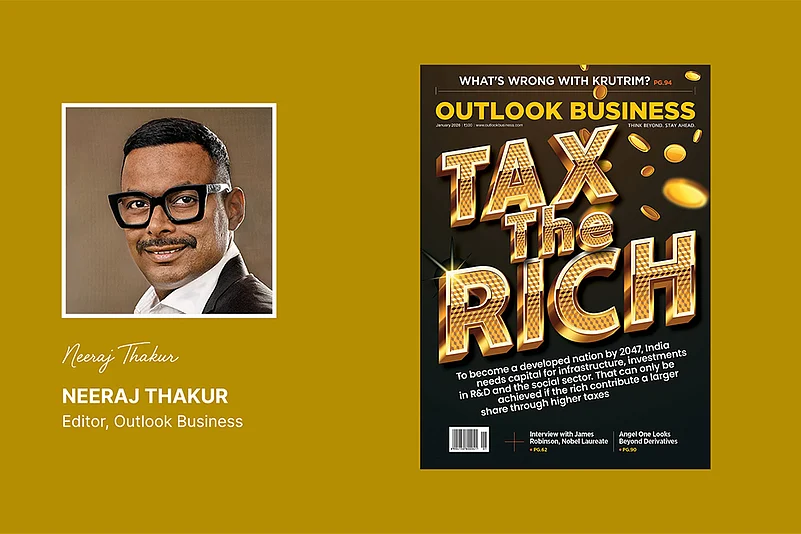
Our January cover examines the weight of a dream left unfulfilled and the paths we can no longer avoid. If India is to lift millions out of indignity and allow its people to stand shoulder to shoulder with the world in productivity and prosperity, those with the greatest capacity must carry a larger share of the burden. This is not an argument against wealth creation, but for accepting taxation as a civic responsibility.
Without sustained investment in human capital, India cannot hope to become a developed nation by the time it marks a century of independence. Gandhi’s moral yardstick—the condition of the last person in the queue—remains relevant and will ever be. If that test continues to fail, the dream of the freedom fighters, and of the industrialists who once funded the cause of national dignity, will remain unfulfilled.
Note: By the time this went to press, the government in a press release on December 29 said India has overtaken Japan to become the fourth-largest economy with a size of $4.18trn.